
Aiming to steer young people away from deeper involvement in the criminal justice system, a law enacted in California last year limited juvenile probation to 12 months for most youth, and ensured individually tailored service plans.
But after judges and law enforcement officials argued that 12 months on probation is not enough time for young people in out-of-home placements, a last-minute compromise excluded foster youth and those leaving juvenile detention centers.
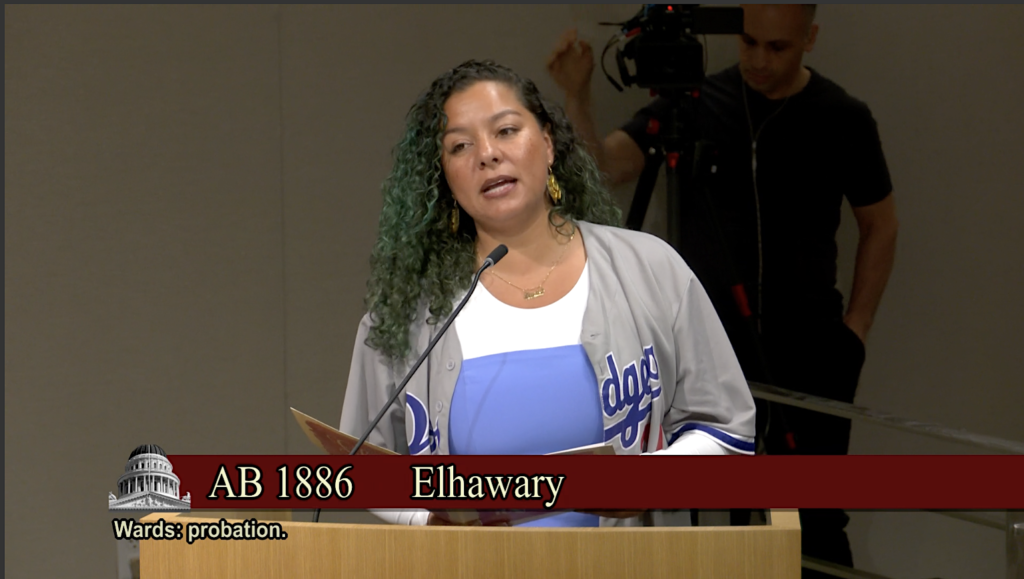
A bill now moving through the Legislature attempts to correct that inequity. Assembly Bill 1886 would extend the probation reform to all young people, except for those who’ve committed the most serious and violent offenses.
Dozens of youth justice organizations, public interest law firms and foster youth advocates support AB 1886, introduced by Los Angeles Assemblymember Sade Elhawary. At a Senate Public Safety Committee hearing last week, two foster youth testified in favor of the bill.
Karina Zavala, an 18-year-old from San Diego, said she was arrested three years ago, and the numerous conditions of her probation made her teenage years more difficult. Once on probation, there were no foster homes available, and she had little stability.
“Instead of moving forward, I became stuck in a cycle of being placed in institutions and going in and out of custody,” Zavala told lawmakers. “There are so many ways to get in trouble, but not enough support to help me succeed.”
Josiah Ben-Oni, a 24-year-old from Antioch, told lawmakers that excluding foster youth from probation reforms is an example of how young people in out-of-home placements are treated unfairly.
Open-ended probation is not rehabilitative, and pulls them deeper into the justice system, he told lawmakers.
Ben-Oni recounted the story of his mother, a former foster youth who was unable to complete her probation as a teenager. He said his mother didn’t receive the therapeutic or substance abuse services she needed as a young person, and ended up in an adult prison.
“We just want equal treatment under the law,” Ben-Oni said in an interview with The Imprint. “Surveillance is not the support that foster youth need.”
The new legislation is opposed by the Chief Probation Officers of California and the California District Attorneys Association.
At last week’s hearing, Cliff Costa, a representative of the Juvenile Court Judges of California, said his group was committed to working on the bill’s “foster care youth issue.” However, he opposed including youth leaving county-run juvenile halls, camps and ranches.
Chief Probation Officers of California Legislative Director Danielle Sanchez expressed concern about extending the probation limits to more serious offenders. And foster youth, she argued, already have review hearings, coordinated services and other support through the dependency courts that address their “specific and complex needs.”
To assuage critics, in June, Elhawary removed language in the bill that would have included minors leaving the state’s most secure detention facilities.
“We just want equal treatment under the law. Surveillance is not the support that foster youth need.”
—Josiah Ben-Oni, speaking in support of ab 1886
Elhawary, a foster parent, argues that juvenile court judges retain their authority to extend probation in any case when they deem necessary. She insists California must end its “two-tiered” probation system that fails to serve youthful offenders who don’t live at home with parents.
“It undermines the goal of rehabilitation and creates inequities in how youth are treated,” Elhawary said at the Sacramento hearing on June 30.
More than 11,000 youth were placed on probation in California in 2024, according to the most recent state Department of Justice data available.
Youth justice advocates, legal experts and even some probation leaders have argued that the system’s reliance on surveillance, fees and the threat of incarceration causes more harm than good. Young people are locked up even when they haven’t committed new crimes, simply for violating probation terms such as missing school or drinking alcohol.
A report released in April quoted young people who said time on probation harmed their mental health and impeded their development.
There are other harms as well. Black youth served longer sentences and were far more likely to end up on probation in California than white youth, according to a 2021 report by the W. Hayward Burns Institute and the National Center for Youth Law.
The report said excessive and arbitrary probation conditions clash with healthy adolescent brain development.
In an opinion piece published by The Imprint last year, youth justice experts Eduardo Mundo and David Muhammad — two former California probation officers — argued that lengthier probation terms do not necessarily improve public safety.
“Most youth don’t need years of probation,” they wrote. “They need clear structure with appropriate interventions, consistent expectations, and opportunities to demonstrate growth.”
California does not collect data on foster youth who are also on probation, but it’s well-known that foster youth are far more likely than their peers to become involved with the justice system as minors.
A landmark longitudinal study produced by the University Chicago’s Chapin Hall included interviews with more than 700 California foster youth at age 17. In 2020, researchers reported that roughly 40% had been arrested.
Similarly, a 2021 study by researchers at universities in California and North Carolina found that 64% of youth in Los Angeles County’s juvenile justice system had previously had contact with the child welfare system.
When foster youth are placed on probation, there are unique complications, such as fewer foster families willing to accept them.
“I felt like I was being sent back to the starting line over and over again,” Zavala said of her time on probation. “We need stability, support and people who believe in us.”