
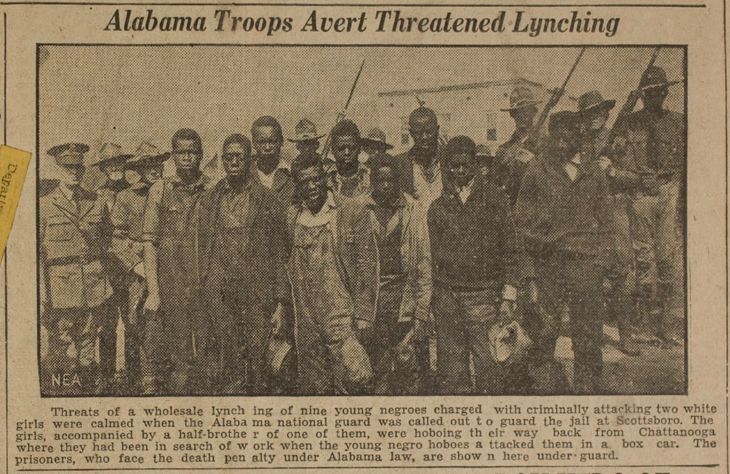
In 1931, two years into the Great Depression, nine Black teenage boys between the ages of 13 and 19 boarded the same train going westward through Alabama in search of work. That train ride for Olen Montgomery, Clarence Norris, Jr., Haywood Patterson, Ozie Powell, Willie Roberson, Eugene Williams, Charlie Weems, Andrew Wright and Leroy Wright significantly changed the course of their lives.
During a train stop in Paint Rock, Alabama, sheriff’s deputies removed the teens from the train and then arrested and detained them in the town’s adult jail. Several days later, a Jackson County grand jury indicted the youth for the alleged rape of two white women on the train.
Over the course of the subsequent decades, the “Scottsboro Boys” endured multiple courtroom trials, convictions, death sentences, retrials and incarceration, collectively spending over 100 years in Alabama’s adult jails and prisons for a crime they did not commit. For years, they lived on Alabama’s death row. In the end, they were spared the electric chair, and throughout this experience all nine maintained that they did not commit the crimes.
By 1950, when the nine young men were all finally free, they faced a harsh and uncertain future. Some were locked up again, and others suffered from ill health and violence. Several experienced early deaths.
The plight of the teens in the Scottsboro Boys case began nearly a century ago, but it still reverberates today. The Scottsboro case illustrates the serious consequences for youth of a conviction in adult criminal court. Even though Alabama, like most other states in 1931, had a juvenile court, the judge chose to charge all nine teens in adult criminal court.
Today, every state has a juvenile court that was established 100 or more years ago. However, most states still allow youth to be prosecuted in adult criminal court at specific ages when charged with certain offenses.
Prosecuting youth in adult criminal court means that young people face the same punishments as adults. They can be placed in adult jails before and after trial, sentenced to serve time in adult prisons, or be placed on adult probation with few to no rehabilitative services. Youth also are subject to the same sentencing guidelines as adults and may receive mandatory minimum sentences or life without parole in non-homicide cases.
When young people leave jail or prison, are on probation, or have completed their adult sentences, they carry the identical stigma as adults of an adult criminal conviction. In the Scottsboro case, the nine young men felt these impacts for the rest of their lives.
States continue to maintain these policies, even though an overwhelming body of research unequivocally shows that trying and sentencing children in adult criminal court does not reduce crime; in fact, it does just the opposite. Prosecuting youth as adults has both a detrimental impact on the young people as well as decreasing public safety.
The Scottsboro Boys spent decades behind bars, first in adult jails and then in adult prisons.
In the U.S. today on any given day, there are 2,000 youth in adult jails and 500 youth in adult prisons, along with 29,300 in a detention or correctional facility or other out-of-home confinement in the juvenile justice system.
The research shows that young people are especially at risk of abuse in adult jails and prisons. The National Prison Rape Elimination Commission reports that “more than any other group of incarcerated persons, youth incarcerated with adults are probably at the highest risk for sexual abuse.”
The abuse of incarcerated teens in the justice system is well documented in news reports, lawsuits, studies and incarcerated youth themselves. Not a week goes by without a headline citing abuse of an incarcerated youth, including deaths of children in custody, reports of abuses of incarcerated teens by staff, and litigation over abusive treatment of youth in numerous states.
The negative effects of juvenile incarceration are not limited to physical safety risks. Youth who are locked up are often placed far from their families, and those families are too often not involved in their treatment plans. But that doesn’t stop many systems from charging those families for a share of the cost of incarceration, even though research shows most young people who are detained or incarcerated do not pose a serious threat to public safety.
Incarceration also puts youth further behind in school. Education for teens in correctional facilities is often not aligned with state curricula or quality standards, and most young people do not return to school after release from secure custody.
The Scottsboro Boys case underscores the pervasive unfairness and inequity in the justice system. After their conviction, during a subsequent retrial one of the two women recanted her testimony, stating that she and the other woman made up the false accusations. The jury overlooked this new evidence and still voted to convict the teens.
Today youth of color continue to be disproportionately represented in the justice system. According to the latest data from the U.S. Department of Justice, African-American youth are 5.6 times more likely to be incarcerated than white teens. Latino youth are 2.5 times more likely to be incarcerated than white youth and Native American kids are 4 times more likely to be incarcerated.
Youth of color are treated more punitively and harshly than white youth, even when charged with similar offenses, according to research by The Sentencing Project
While the justice system today still has many hallmarks of the justice system in the Scottsboro case 100 years ago, the difference is that there is now an extensive array of research showing what works to help young people grow and thrive. In light of the new research, over the last two decades a number of states have enacted policy changes to decrease the prosecution of juveniles in adult criminal courts and the incarceration of youth, as well as to reduce the disparate treatment of youth of color in the justice system.
The only way to truly alter our future is to learn from our past. We must admit and face the wrongdoings that were committed, and we must commit to never repeating these mistakes. Our work will not be complete until every young person receives equitable treatment in every phase of the justice system. We cannot rest until the color of a young person’s skin no longer colors the outcome of their case.