
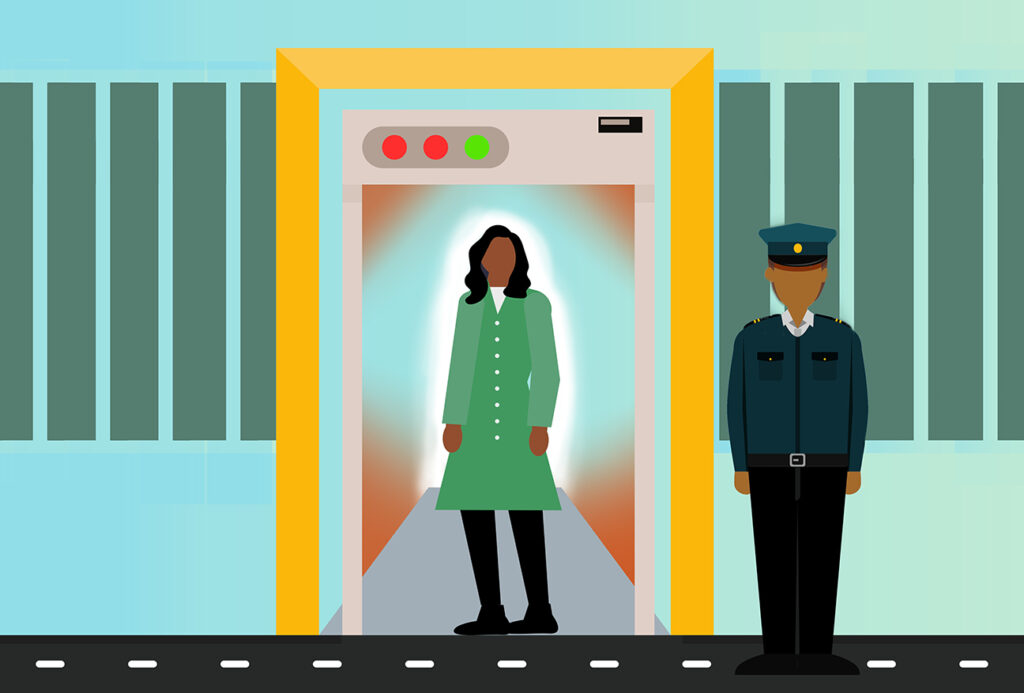
State lawmakers voted Tuesday to place full-body scanners in New York’s state-operated juvenile detention facilities — a move proponents say is needed to better screen residents and staff for contraband, including weapons and drugs.
Similar to scanners used during security screenings at airports, the devices under consideration use ionizing radiation to help detect concealed items. Under current New York law, the machines are only allowed in adult correctional facilities.
Supporters of the legislation say body scanners are the best way to address safety issues that have been tied to understaffing problems in the state’s nine juvenile residential centers. Run by New York state’s Office of Children and Families (OCFS), the low- and high-security facilities have lost roughly 38% of their staff over the past five years.
That shortfall has collided with an increase in the population of detained youth in these facilities following passage of the 2017 Raise the Age law. The reform lifted the age of criminal responsibility to 18, moving most 16 and 17-year-olds out of the adult justice system and into juvenile lockups.
An uptick in incidents of employees arrested for smuggling contraband has added pressure on these state facilities, the bill’s sponsors said.
“With uneven staff-to-youth ratios as well as increasing reports of violence and contraband, installation of body scanners will keep both staff and youth at these facilities safer,” bill co-sponsor Sen. James Skoufis said in an emailed statement to The Imprint.
The Legislature has until the end of the year to deliver the bill to Gov. Kathy Hochul.
“When you have enough staff, you can monitor people. You can get to know the youth better so you recognize early warning signs. When you don’t have adequate staff, you have to rely on all these other tools. The body scanners address the problem before it becomes a problem by being preventative.”
— Randi DiAntonio, New York State Public Employees Federation vice president
The proposal comes more than three years after the overdose death of Caprist McBrown, an incarcerated New York teenager. In 2022, McBrown died inside a secure detention facility near Albany after ingesting fentanyl that was allegedly given to him by an employee who had smuggled drugs into work. A civil lawsuit brought by the teen’s parents was settled in 2024, and a former employee at the facility was charged with criminally negligent homicide in connection to McBrown’s death.
The body scanner bill is supported by the union representing prison staff. Randi DiAntonio, union vice president, said radiological body scanners are particularly helpful for detecting illicit drugs and other contraband that cannot be picked up by metal detectors. They can also help identify hidden “homemade weapons” which often go undetected until someone gets injured, DiAntonio said.
“When you have enough staff, you can monitor people. You can get to know the youth better so you recognize early warning signs,” she said. “When you don’t have adequate staff, you have to rely on all these other tools. The body scanners address the problem before it becomes a problem by being preventative.”
Another plus, the bill’s sponsors said: The imaging technology would reduce the need for “invasive physical searches” of youth.
But some advocacy groups argue that body scanners frequently produce false positives.
During legislative testimony last February, the New York affiliate of the American Civil Liberties Union, NYCLU, urged caution regarding the scanners and asked legislators to “adopt meaningful guardrails’’ that ensure proper training for guards. The organization has alleged instances of sex discrimination involving women who sometimes traveled hours to visit loved ones in adult prisons and were turned away, or banned from reentry after being flagged for contraband later suspected to have been menstrual products.
The Legal Aid Society’s Juvenile Rights Practice also submitted testimony opposing the expansion of scanners to juvenile facilities. Advocates argued that the technology creates a “carceral” environment that would undermine the rehabilitative goals of the youth justice system and deter visitors of incarcerated youth.
“The maintenance and strengthening of family and community ties is particularly critical to youth rehabilitation,” attorney-in-charge of the Juvenile Rights Practice, Dawne Mitchell, testified.
But the agency that oversees — and has struggled to staff — the state’s juvenile facilities has given the proposal its full support. Commissioner DaMia Harris-Madden told legislators earlier this year that she believed the extra safety measure would encourage staff to remain in their jobs longer.
Assemblymember Andrew Hevesi, who co-sponsored the bill, said body scanners will be useful, but added that they should not be considered the main solution to the understaffing crisis.
“The safety of young people in OCFS facilities, and those who look after them, is our primary concern,” Hevesi said in an emailed statement to The Imprint. “We owe our current frontline workers the ability to do their jobs as safely and effectively as possible.”
“This measure does not, however, address the significant staffing shortages that our facilities are currently facing, which must also be addressed through conversations about compensation and incentives for this workforce,” he continued.
Other states are taking similar steps in youth detention facilities. Last year, county leaders in Los Angeles voted to install “airport-style” full-body scanners in juvenile halls. The move followed several incidents of drug overdoses and suspected drug trafficking allegedly carried out by staff, including a probation officer and a tutor.
And a Connecticut pilot program approved last year called for body scanners at two state-run prisons including a juvenile detention facility. The scanners were proposed in response to complaints about strip searches, which some detainees likened to sexual assault, but the program encountered implementation hurdles late last year.
Do you have any tips or experience you’d like to share about working at juvenile detention facilities? Email ssarkar@imprintnews.org