
New York Gov. Kathy Hochul continues to back landmark legislation aimed at keeping most 16- and 17-year-olds accused of crimes out of the adult justice system, despite growing pressure on state lawmakers to roll back the 2017 reform.
The state’s Raise the Age law has been criticized in recent years by Republican legislators and law enforcement including New York City Police Commissioner Jessica Tisch. Critics say its provisions are too lenient and lead to increased crime rates.
But in Hochul’s 2026-27 executive budget proposal released Tuesday, the governor rejects those claims. Her team lauded the “ambitious investments” made during her tenure to keep kids out of adult jails.
“To prevent youth from interacting with the justice system, under Governor Hochul’s leadership, the State has made significant increases in programs that support at-risk youth,” her budget proposal states. It notes that since taking office, funding for such programs such as after-school sports and job initiatives has increased by 70%, to more than $400 million.
Fearful of backward momentum on a landmark reform, youth justice advocates lauded the governor’s stance.
Patrick Edge, a 27-year-old youth mentor rallied in support of youth justice reforms last week in New York City. In an interview, Edge — who was incarcerated at Rikers Island at age 17 — praised Hochul for her current budget plan to continue backing Raise the Age.
“I feel great about it,” Edge said in an interview Tuesday. “The decision ensures that this is about public safety and giving youth a second chance and the resources that they need. It’s about investing in the youth and also understanding that we’re being heard.”
The Coalition to Protect Raise the Age issued similar support.
“New Yorkers do not want rollbacks that criminalize more children or drag our state backwards,” the group said in a statement. “We welcome this announcement from Governor Hochul, and we urge the Administration and the Legislature to leave Raise the Age untouched throughout this session.”
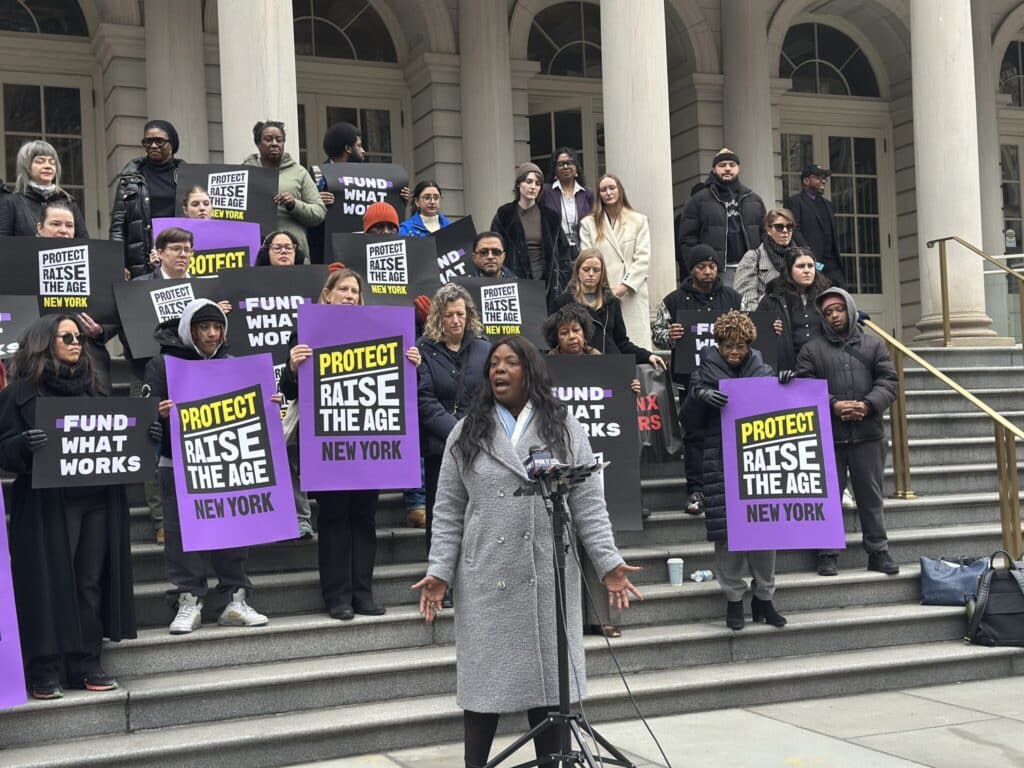
At last Tuesday’s rally in front of New York City Hall, dozens of advocates, lawmakers and young people like Edge who have been incarcerated or arrested gathered to protest against changing the law and to call for more direct investments in healthier futures for young people.
Edge spoke about how advocates and nonprofits helped support him after he returned home from jail during the pandemic.
“Today looks very different. It doesn’t look like a courtroom where I had my hands behind my back. It doesn’t look like a jail cell where I was wearing an orange jumpsuit, calling loved ones from Rikers Island,” Edge told those assembled.
“I FEEL GREAT ABOUT IT. THE DECISION ENSURES THAT THIS IS ABOUT PUBLIC SAFETY AND GIVING YOUTH A SECOND CHANCE AND THE RESOURCES THAT THEY NEED. IT’S ABOUT INVESTING IN THE YOUTH AND ALSO UNDERSTANDING THAT WE’RE BEING HEARD.”
— PATRICK EDGE, YOUTH MENTOR AND ADVOCATE
The 2017 Raise the Age Law included $250 million a year to fund improvements to youth detention centers, crime prevention programs and alternatives to incarceration, although city and state legislators have complained of the funding not being adequately disbursed.
In a statement sent to The Imprint, New York City Council Member Nantasha Williams criticized the governor for failing to propose a solution in this budget cycle.
“I’m disappointed by the Governor’s decision to leave Raise the Age in place without taking action to fix what is clearly not working,” Williams said. “Keeping the law on the books without fully financing it leaves young people, families, and communities carrying the cost.”
Lawmakers at Tuesday’s rally dismissed concerns that Raise the Age had impacted public safety. New York City Council Member Althea Stevens pointed to data that showed juvenile arrests had decreased by 70% in the city since the law was implemented.
“WHEN YOU CRIMINALIZE YOUNG PEOPLE INSTEAD OF INVESTING IN THEM, WE ROB THEM OF THAT CHANCE, AND WE DON’T ACCEPT THE FACT THAT WE FAILED THEM, BECAUSE ANY CHILD THAT IS BEING CRIMINALIZED IS A FAILURE ON OUR PART.”
— NEW YORK CITY COUNCILMEMBER ALTHEA STEVENS
“When you criminalize young people instead of investing in them, we rob them of that chance, and we don’t accept the fact that we failed them, because any child that is being criminalized is a failure on our part,” said Stevens, who chairs the Committee on Children and Youth. “When we deny a space for true reform, we create harm that follows them for life.”
Edge and others also called for more funding for the programs that helped him — specifically through the $50 million Youth Justice Innovation fund now before the Legislature. If passed, this funding would be peeled off from the annual $250 million and go directly to community-based organizations that provide services like behavioral health therapy, life-skills and job training to older teens accused of crimes.
“Leadership looks like when you put young people at the table,” Edge said, “when they’re not looked at as monsters or criminals or being bad for the mistakes that they made.”