Weeks after New York City advocates for homeless LGBTQ+ youth released a white paper detailing discrimination in the foster care system, its members are now hailing renewed commitment by city leaders to provide more welcoming homes and an end to hostile treatment.
Upcoming reforms they say they’ve secured include updates to the Administration for Children’s Services’ 12-year-old policy on youth of all genders and sexualities; better enforcement of existing policies requiring city workers to use preferred pronouns; tailored mental health services; and updated training for caregivers and staff. Caseworkers also must prioritize placements in homes “that not only affirm but celebrate” the identities of LGBTQ+ foster youth.
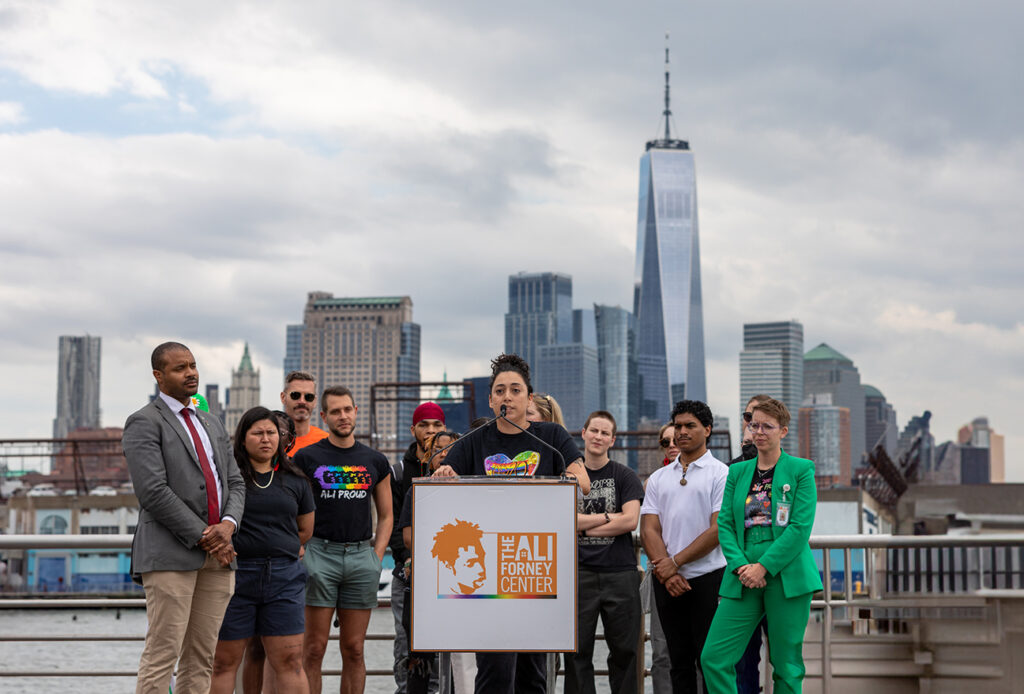
Earlier this month — amid chants of “love and care, it’s only fair!” — the nonprofit Ali Forney Center gathered its supporters along the Hudson River. At the gathering, state legislators, current and former foster youth and LGBTQ+ activists underscored the urgency of the reforms.
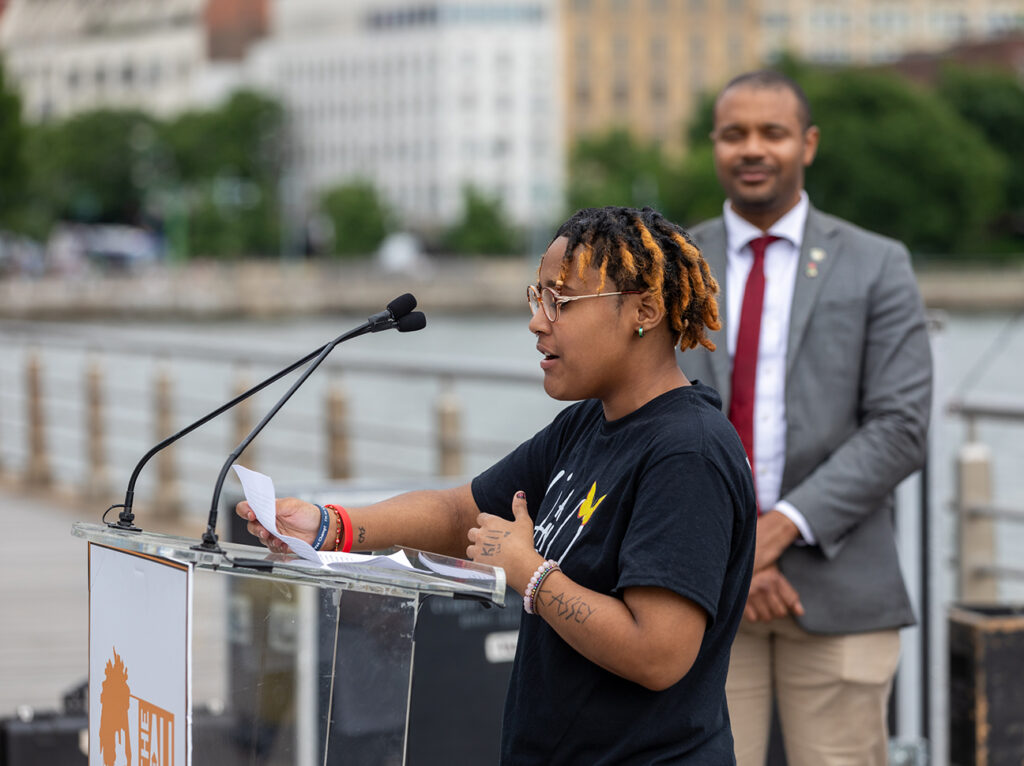
“If a child is telling you they are more comfortable with their biological family, listen to them,” Wynesia, a former foster youth who is transgender, said in a statement read to the crowd. “If they are saying they don’t feel safe with their foster or adoptive parents, don’t make them stay there.”
The Ali Forney Center, which provides direct support and housing to homeless LBTQ+ youth, is also urging passage of a city council bill that would require annual reports on the number of queer foster youth and where they are placed. To date, that information, vital to providing targeted services, has only been released through point-in-time surveys.
Wynesia, who was identified by first name only, articulated the desperate need to better serve these youth. They described painful treatment at a foster-turned-adoptive home that was “filled with abuse, homophobia, racism and transphobia.” Religious caregivers used homophobic slurs and became suspicious when they got hugs from certain friends.
“They saw me as perverted because of my identity, and would police my relationships with friends,” Wynesia stated.
Although concerns remain, compared with other child welfare agencies nationwide, New York City is known for its pioneering work to improve visibility and treatment of LGBTQ+ foster youth. It devised guiding policies in 2012, commissioned a survey of its population in 2019, and in 2021 followed up with a broad “action plan” to improve current practice.
The Administration for Children’s Services (ACS) also commissioned the Ali Forney Center’s review, resulting in the white paper released in April. That report detailed numerous examples of misconduct by city staff and providers who care for foster children, as well as by workers at the state’s child maltreatment hotline who receive reports of abuse and neglect and determine whether allegations warrant an in-person investigation.
The white paper described “an increase in blatant homophobic and transphobic remarks and treatment” among these professionals, and pointed to repeated examples of staff failing to use preferred pronouns, or dismissing complaints of discriminatory treatment.
In one example detailed in the nonprofit’s report, a caseworker making a routine visit refused to use a foster youth’s chosen name and said it wasn’t allowed. The same young person reported they were told by a service provider that their trans identity was a “symptom of psychosis.”
“they might not see that forcing a child to dress in accordance to a gender that they don’t identify with is abuse.”
— Nadia Swanson, ALI FORNEY CENTER CONSULTANT AND REPORT AUTHOR
In an email, Marisa Kaufman, a spokesperson for the Administration for Children’s Services, praised the advocacy group for the information it has provided and for its assistance in improving city policy.
“It is of the utmost importance that all of the youth and families we serve are treated and cared for in an affirming manner,” Kaufman said. “We look forward to working in partnership with the Ali Forney Center and benefitting from their expertise so that every young person and family in contact with ACS feels affirmed and supported.”
Although a new written agreement or policy is yet to come out, Kaufman stated that city staff are required to use proper pronouns, and confirmed that gender-related abuse allegations are investigated as forms of child abuse. In its white paper, the Ali Forney Center recommends updating the code of conduct for city workers to ensure such investigations.
New York City established the Office of LGBTQ Policy and Practice in 2012, the same year its governing policy took effect. It requires that foster youth have access to gender-appropriate bedrooms and bathrooms, as well as necessary grooming and hygiene products. Under the policy, city contractors must “recruit and support foster homes that are LGBTQAI+ affirming.”
In its subsequent 2021 Action Plan, the city took further steps to diminish gaps in support, strengthen staff training, implement more gender-affirming policies, and create a dedicated LGBTQ+ committee under its Youth Leadership Council. That group informs city leaders, helps develop learning materials and plans youth pride events. In addition, an LGBTQIA+ refresher and training course includes mandated training sessions for thousands of caregivers, foster parents and juvenile justice professionals about sexual orientation and gender identity issues. The agency plans to roll out further updated versions of the training in the fall. It has also created a Sexual and Reproductive Health Policy for Youth in Foster Care, which aims to improve access to sexual and reproductive health services, including HIV testing and preventive medication — without requiring the consent of guardians.
Nonetheless, the needs of the population remain significant. The city’s 2019 survey showed that LGBTQ+ foster youth comprised more than one in three young people in the system between ages 13 and 20. One-third of those surveyed identified as Latino and three-quarters as Black.
New York City’s LGBTQ+ foster youth are more likely to end up in group settings rather than family-based care, often compounding early childhood trauma and leading to its own set of physical and mental health challenges.
They are also more likely to run away or become homeless, noted Nadia Swanson, a center director and author of the Ali Forney Center white paper. To counter that loneliness and vulnerability, Swanson emphasized the need to “support families in understanding the severity of what homophobia and transphobia does,” as well as the long-term effects on young people’s mental and physical health.
Those impacts may not be clearly understood by adults who have grown up with biased views.
“We have to keep on raising awareness, as this white paper does, to the fact that being a trans youth of color in New York City is currently dangerous.”
— JCCA EXECUTIVE DIRECTOR Ron Richter
“A lot of times, they might not see that forcing a child to dress in accordance to a gender that they don’t identify with is abuse,” they said. Swanson and their colleagues want the city to recruit sensitive caregivers and “to make sure that we’re holding foster parents accountable and not letting them become foster parents if they’re homophobic or transphobic.”
Former Administration for Children’s Services Commissioner Ron Richter, who now heads the nonprofit foster care agency JCCA, pointed to a common gap between policy and practice.
“While ACS and provider agencies have taken these issues very seriously and provided required training, in our society there are people who are especially transphobic,” Richter said. “And whether they are trained or not, they sometimes — unbeknownst to their supervisor and to their organization — act in ways that are not unlike people in society.”
Richter said as a result, “We have to keep on raising awareness, as this white paper does, to the fact that being a trans youth of color in New York City is currently dangerous.” He called the pending policy update an “important step” for both the city agency and its contractors.
Jonathan DeJesus, an immigrant from Ecuador, spent roughly nine years in and out of foster care, beginning at age 12. He stressed the difficulty trying to figure out his identity as a trans man in residential treatment centers and foster homes. Without any guidance from supportive adults, it was a confusing and lonely process.
“That was most of the years in the system, wandering, exploring my sexuality and not receiving support, which was a big problem,” he said. “And that kind of led me into a longer road of figuring out who I was.”
When he finally did come out, no one took him seriously or asked what he needed, DeJesus added. So he just “went back into a shell” and pretended it never happened.
That’s until he was placed with SCO Family of Services, which has the only residential program in New York City for youth in foster care who identify as LGBTQ+. Placed with other children he could identify with, and working with staff members who were also part of the queer community, he finally received more acceptance and guidance with things like medical appointments.
It wasn’t perfect. DeJesus said he wishes there was more support with sex education, more access to therapy, and most of all, a better level of emotional understanding from caregivers that does not conflate the enormous impact that transitioning can have on a child’s body and mental health with a “behavioral problem.”
As a foster youth advocate, DeJesus said he’s now witnessing some positive changes — more training for staff and a change in attitudes — and is feeling more secure and hopeful for the future.
“Trans youth especially are going through all of these changes: physically, emotionally,” he said. “So if a person can be more aware of that and can understand that, you’ll be able to be there for them more as well, and lessen the judgment towards them.”
State Sens. Jabari Brisport and Brad Hoylman-Sigal joined the rally earlier this month to encourage efforts toward greater support for foster youth in New York City. City Councilmember Althea Stevens, who chairs the committee overseeing the city agency, also weighed into the push for urgency.
Brisport spoke from experience as a queer youth of color, and described seeing students struggle with their identities during his tenure as a public school teacher. He called on the state and city agencies to “step up” to the goal of creating safe and affirming homes for LGBTQ+ foster youth.
“It’s a very sensitive time, and it’s a very delicate time, and it’s definitely a time of your life where you need the most love and the most resources and the most support,” he said, amid cheers from the crowd. “It’s important that the voices of our queer youth are centered, that they are recognized and that they have the resources they need to thrive.”