See how each state child welfare agency monitors use of these medications for its children and youth in government custody.

The Imprint’s recent five-part series, Medicated in Foster Care: Who’s Looking Out? revealed that states across the country have failed to properly monitor and curtail the heavy, haphazard reliance on psychiatric medication prescribed to foster youth.
Dozens of young people with histories of trauma described “pain and anguish muffled, not healed,” by these quick-fix drugs. In court testimony and interviews, they said they felt pressured to take sedating psychotropic meds, including powerful antipsychotics that left them lethargic, dizzy or destabilized. In some cases, side effects led to massive weight gain and uncontrollable body tremors.
By law, local governments must better protect them. A 2011 federal law requires that states develop “protocols for the appropriate use and monitoring of psychotropic medications.”
Congress authored this provision of the Child and Family Services Improvement and Innovation Act in response to years of public testimony, federal audits and scientific studies raising the alarm. Prescribing to foster youth nationwide often exceeded FDA guidelines and fell into clear patterns: “too much, too many, too young,” as the legal advocacy nonprofit Children’s Rights has put it. The protocols were meant to improve accountability and transparency for states’ practices.
Yet our investigation revealed four ongoing class-action lawsuits and related settlements involving more than 18,000 young people in government custody who allege that state or federal agencies maintained inadequate medication protocols, or failed to follow them.
To measure compliance with federal requirements, The Imprint collected publicly available documents and queried each child welfare agency for its psychotropic medication oversight policies. The policies we received after months of inquiries and numerous formal public records requests range widely in length and detail, from documents of one page or less in states like Washington and Mississippi, to the 52 pages of policies guiding prescribing in Illinois.
SOURCE DOCUMENTS FOR The Imprint’s state-by-state reporting ARE now publicly available on DocumentCloud. search your state’s name to find its relevant policies.
Thirteen state agencies had no policy that they were able to produce. Spokespeople in Pennsylvania and Colorado’s child welfare agencies confirmed they have published guidance, but no requirements that professionals caring for foster youth must follow. Wisconsin’s agency provided regulations that only apply to foster children placed in group facilities.
There are vast differences in the policies that do exist. A foster child in the northern Florida town of Jennings would be prescribed under different rules than another foster child 20 minutes away in Valdosta, Georgia, for example. The child in Jennings — according to Florida state policy — must have their psychotropic medication approved by a parent and a judge, with opportunities for caregivers to object or seek a second opinion.
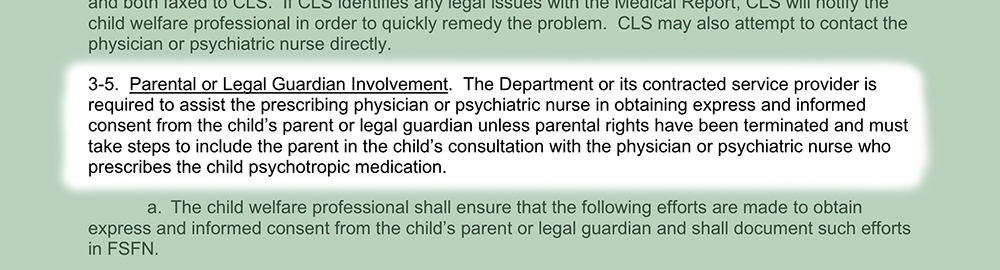
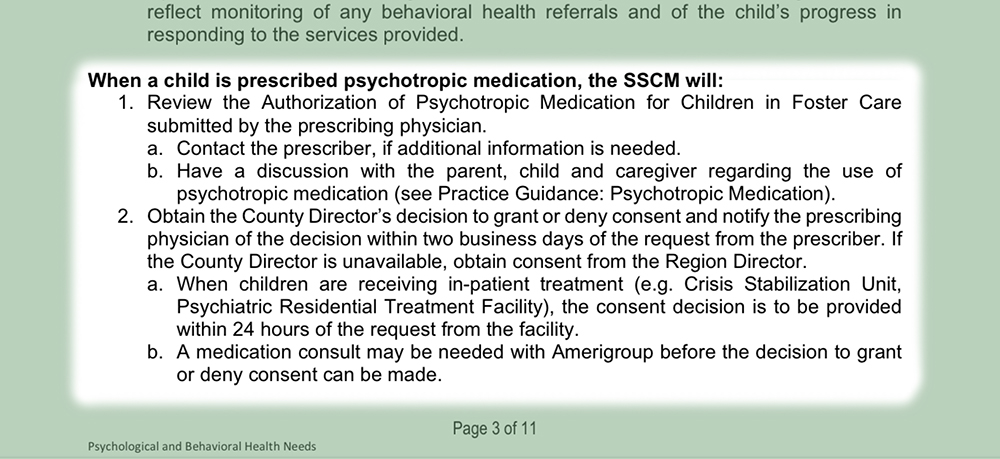
Under Georgia state policy, youth and their parents are allowed to provide feedback on whether they think medications are needed, but the final decision is reserved for directors at county child welfare agencies.
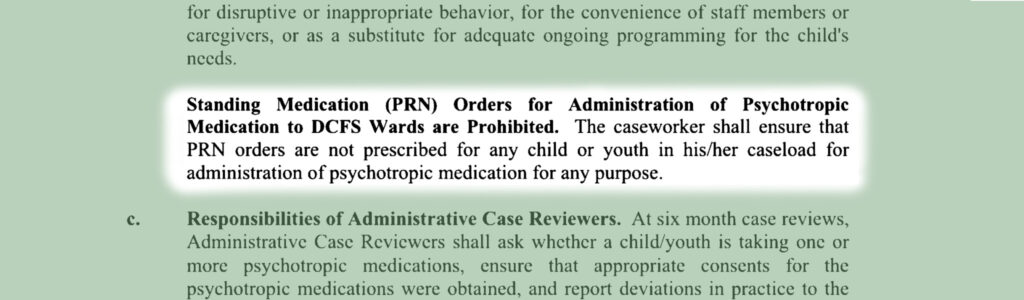
The policy in Illinois specifically prohibits “pro re nata” or “PRN” psychotropic prescribing to foster youth – a term used in medicine to describe drugs taken “as needed” and without a fixed schedule.
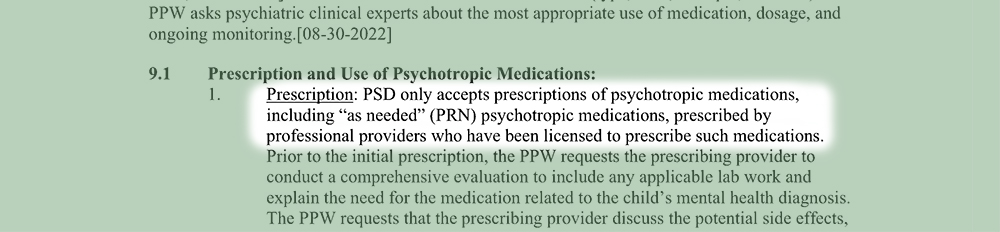
New Mexico’s policy allows such prescriptions from a “professional provider” with a relevant license.
Some states are now updating their policies in response to class-action lawsuits filed by foster youth against the government agencies responsible for their care.
A spokesperson for Maine’s Office of Child and Family Services said its current psychotropics policy “is in the process of being revised to align with current standards of care and the conditions of the court agreement.”
Last month, Maryland’s child welfare agency asked a federal judge to dismiss a similar class-action lawsuit filed on behalf of hundreds of foster youth. The named plaintiffs, represented by three public interest law firms and a corporate firm, argue in part that foster youth are “routinely not given a voice” in their prescriptions, and that the state’s policy fails to adequately address “informed assent” for youth.

“That the policy does not explicitly include language providing youth 16 and younger with a right to assent is of no consequence,” the state’s lawyers responded in its recent court filing.
Nevertheless, this week, an agency spokesperson confirmed to The Imprint that “diligent efforts are underway” to update its 2014 policy.
Do you have tips or feedback on your state’s policies or practices with psychotropic medication? E-mail MFitzgerald@imprintnews.org