


In recent years, a quiet but massive change has taken place in the nation’s largest local child welfare system.
A growing number of calls to the CPS hotline prompt a referral to a food bank or homeless shelter — instead of a social worker investigation. Public hospitals no longer report new moms for using drugs. And parents accused of abuse or neglect receive legal assistance well before their cases land in dependency court.
This is a snapshot of Los Angeles County and its shrinking reliance on foster care, down 46% from just five years ago.
Statewide numbers have fallen almost as dramatically since 2020, dropping 33%, according to state statistics.
Brandon Nichols, director of the county’s Department of Children and Family Services (DCFS), attributes the drop to better social work and “getting to the root” of family dysfunction that causes harm to children.
“My personal north star is if there’s any way for children to be safe with their family, that’s what we need to be striving for,” Nichols said. “The data shows we’re going in the right direction.”
There are now 11,745 young people aged 20 and younger in Los Angeles County custody, compared with 21,637 in 2020 — a decline propelled by an array of new policies and approaches. A variety of forces — a declining number of children born in the county, new state and federal laws, racial justice advocacy and closer connections with community-based service — are among the reasons the number of children and youth in foster care here has reached its lowest figure on record.
In dozens of interviews, CPS officials, attorneys, politicians, parents and advocates theorized on various reasons for the decline, many of which are detailed in this article. They offered no single explanation.
All agreed, however, that to date, Los Angeles County has slashed its reliance on foster care removals, without a sizable uptick in child fatalities or reports of maltreatment after children leave foster care. Child welfare leaders here also agree that the dramatic decline in the foster care population is no temporary trend, and instead reflects deliberate work to help families remain intact.
Leslie Heimov, longtime executive director of the Children’s Law Center of California, said the change is no temporary fluctuation. Her firm now represents roughly 12,000 Los Angeles County foster youth. For the past four years, the closing of dependency cases has outpaced the opening of new cases.
“In Los Angeles, there is no pendulum,” Heimov said.
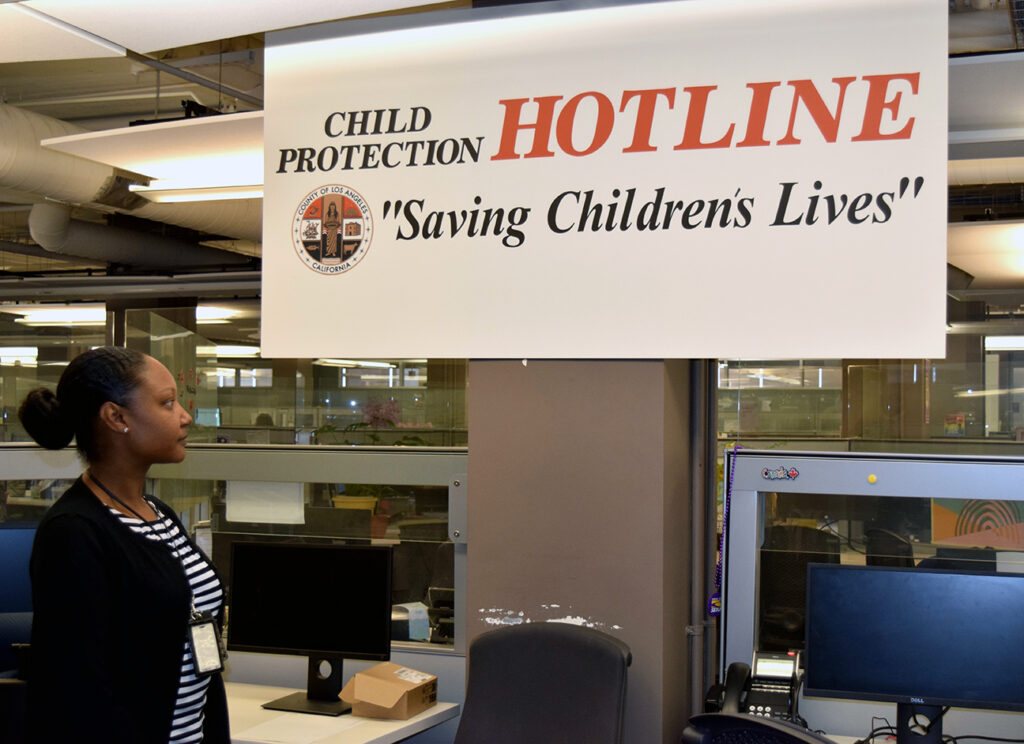
Signs of the decline in foster care numbers can be found on a quiet block south of downtown Los Angeles. On the fifth floor of a nondescript highrise, dozens of hotline operators work 24 hours a day, seven days a week, to sift through reports of child maltreatment. From their cubicles, social workers wearing headsets field calls and review files on towering computer screens. The low thrum of conversations belies momentous decisions that must be made within minutes about whether a Child Protective Services investigator will be dispatched.
The office never closes, but in recent years, the volume of calls has slowed. Allegations of abuse or neglect have dropped by 26% over five years, according to state data.
Child neglect is still the most common reason for a report to the hotline. But unlike a decade ago, the agency has more ways to help families who come to the attention of authorities due to a lack of food or shelter rather than outright physical abuse or extreme levels of parental neglect.
In the past, call screeners had few tools to help. They simply had to decide whether or not to investigate. Now, they can divert those calls to the Hotline to Helpline program, which matches parents with community-based groups that can help with immediate needs — from diaper supplies to food boxes and help paying the rent.
The number of families served by the helpline has soared over the past five years — from 4,000 to more than 7,000.
“It’s no accident that L.A. County numbers are lower, because there’s really been a concerted effort by people harmed by the family policing system in L.A. and across the state, to really push for for radical change.”
— Minouche Kandel, ACLU of Southern California
Los Angeles County supervisors have also played a role in limiting calls to the hotline. In 2023, they launched the Mandated Supporting Initiative, a decision-making tool and website for child-serving professionals such as teachers, therapists and doctors to use before deciding whether a call to the hotline is warranted. When a student continually shows up at school without lunch, for instance — their family would be referred to a food pantry instead of receiving an unannounced visit from CPS.
In an email, Supervisor Lindsey Horvath lauded her county’s “intentional focus on prevention and family wellbeing.”
“We’ve made real progress,” she stated, adding: “but we must stay focused on building a child welfare system that protects, empowers, and uplifts every child and family in Los Angeles County.”
Two state laws first enacted in 2023 have contributed as well, by scaling back the definition of what constitutes a reportable child maltreatment claim. One law narrowed the definition of neglect. Another prohibits social workers from removing children solely due to poverty or homelessness.
L.A. County hotline supervisor Krystal Boulden underscored a common perception among those close to the child welfare system here: The combination of new ways to serve families in need and state laws narrowing what defines a reportable accusation have helped drive down the foster care numbers.
“This really highlights how important it is that we all work together to support these families,” Boulden said.

Former Los Angeles foster youth Shi’Ann Taylor said she wished the current approach had been around when she was growing up. Taylor was 13 when she was removed from her mother’s care. Now 27, she is clearer on the struggles her mother faced back then as a former foster youth herself living with schizophrenia and addiction. Taylor’s mother was also trying to parent five children while recuperating from a series of strokes that left her confined to a wheelchair for a time.
Taylor said her mother was “very mishandled” by the county’s child welfare agency, Taylor said. After her children were removed, her mom took court-ordered classes, but spiraled into drug addiction when she wasn’t able to reunify with her kids. Years later, Taylor has helped her find mental health services and a housing voucher after a period of incarceration.
“I wish our community could have stepped in and just seen her as a woman that was trying her best to raise five kids,” Taylor said, “instead of just seeing her as a problem.”
Social forces fueled reform
A major catalyst for reform of the Los Angeles County child welfare system emerged in 2020, during the months following the murder of George Floyd. Nationally, critics pointed out examples of the system’s cruelty and racism in journalistic coverage and social media posts.
Activist Tina Rios and another mother, Latia Suttle, helped lead the charge in L.A. County. They formed the Reimagine Child Safety Coalition, a group for people with lived experience in the child welfare system, and partnered with the local chapter of Black Lives Matter and other advocacy groups.
The result was a list of 11 demands presented to county supervisors.
The coalition’s stated goal was to “break down the family regulation policies in Los Angeles that target and harm Black and Indigenous families,” the most disproportionately represented demographic groups.
Some members’ demands were met: Local leaders began funding legal representation for parents under investigation for maltreatment — before a dependency court case has been filed. They ended routine drug-testing for pregnant people in hospitals, and expanded court-ordered rehabilitative services for parents.
“It’s no accident that L.A. County numbers are lower, because there’s really been a concerted effort by people harmed by the family policing system in L.A. and across the state, to really push for for radical change,” said Minouche Kandel, senior staff attorney in the Gender, Sexuality, & Reproductive Justice Project at the ACLU of Southern California.
For Rios, 52, her activism was personal. The East L.A. native said her son was removed from her care after her abusive partner made a false report against her. She was soon enmeshed in court proceedings and traumatic investigations.
During dependency court hearings in 2017 and 2018, Rios said a judge warned her not to speak, even as she struggled to dispute allegations against her made by her abuser and her social worker. Meanwhile, she feared for her son’s safety as he was temporarily removed from her custody.

Rios, who is Apache and Navajo, said caseworkers also failed to follow protections for Indigenous families required under the federal Indian Child Welfare Act, actions all too reminiscent of her family’s past. Decades earlier, her great-grandfather fled a New Mexico reservation so that his daughters could escape boarding schools — another form of family separation that the U.S. government historically championed.
After a year, Rios was able to close her case, she said. But she calls that chapter of her life “terrifying.”
“Family separation has been haunting me and my ancestors,” Rios said. “For me, it was a personal act of liberation to dismantle this system just to reach my own family that was separated from me.”
Los Angeles Dependency Lawyers Supervising Attorney Christina Curtis, whose nonprofit firm represents parents like Rios in court hearings, described a stark change from a decade ago. Back then, she carried a caseload of more than 300 parents who had been accused of abuse or neglect, which she said is almost two times the size of what a dependency attorney could ethically carry. As a result, she said, at times she would ask judges for continuances on cases because she was not able to provide effective assistance of counsel due to her high caseload.
But lower caseloads these days have allowed dependency lawyers to provide better case management, and ensure that parents can access the court-ordered services required to reunify with their children, she said. Lawyers — along with peer advocates — can also provide support for parents before a case is filed in court.
Still, Curtis insisted, there are still too many cases being filed against parents, and a disproportionate share of Black families under surveillance and CPS supervision. Black children account for about 8% of all children in Los Angeles County, but represent about 28% of those in foster care, state data shows.
“In 2015 I would have thought that this was a dream come true, and we’re doing amazing,” Curtis said. “Since then, I see that a lot more is yet to be done.”
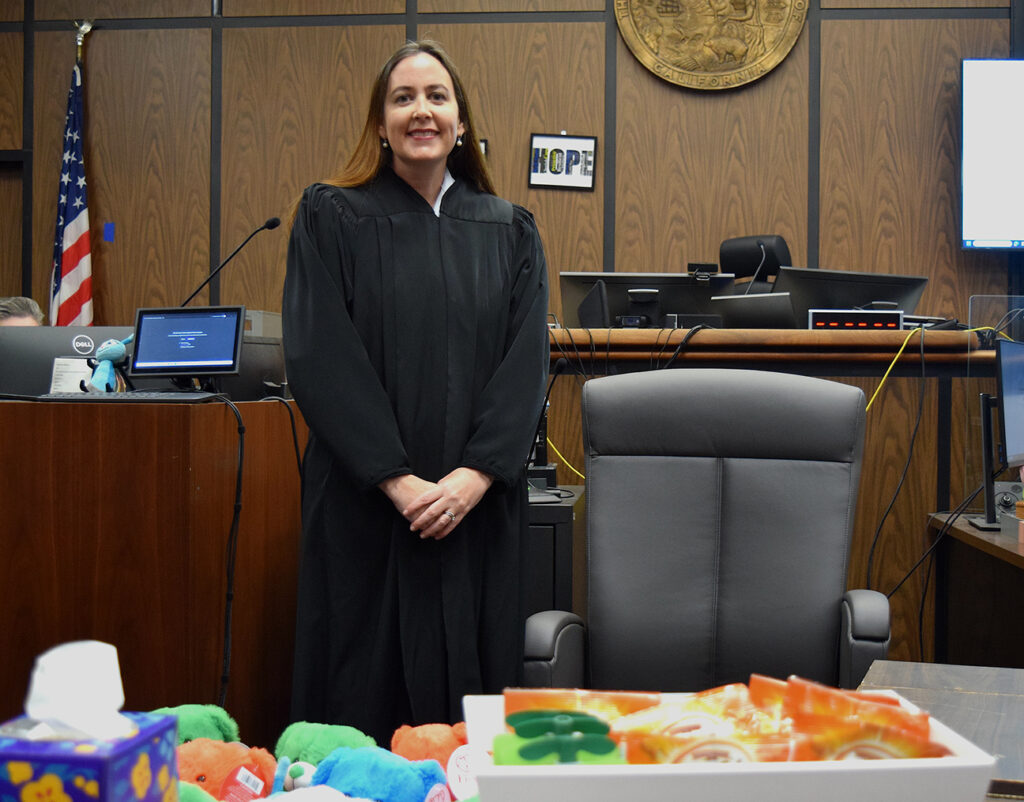
Thousands of children still enter foster care each year in L.A., but they, too, are met with a new perspective from court officials.
A state law enacted in 2024 requires judges to consider the risk of trauma that occurs when separating children and parents in court.
That is a primary concern for Judge Ashley Price, who holds dependency hearings in the Helping Our Parents Excel Children’s Court. Price’s aim is to keep families with children aged 3 and younger intact, preserving parental bonds at a critical developmental time. For families with open dependency cases in the court, the goal is to be free of the child welfare system as quickly as possible by addressing the concerns that brought them to court.
In Price’s Compton courtroom, every physical detail has been thought through: There are no benches on separate sides of the court. Instead, Price and parents accused of maltreatment sit side-by-side in a specially built semi-circular table alongside social workers and attorneys. Children’s drawings and colorful illustrations of local landmarks like the Martin Luther King, Jr. Memorial and the Compton Cowboys line the walls of a nearby waiting room. There are shelves of books and blocks for children to play with while their parents discuss case plans with court staff. Children’s lawyers get to know their toddler clients sitting on the floor of an adjacent interview room, offering up plush toys and meeting them eye to eye.
Transforming the physical layout was the first goal when Judge Price set up her courtroom nearly two years ago. The next was to “immediately take down the temperature” for parents facing the removal of children into foster care.
“We have a philosophy of empathy, and of taking away some of the threatening feeling of having to come to court under such stressful circumstances,” Price said in a recent interview.
Price’s approach relies on court staff being supportive rather than punitive, and close relationships with local service providers. Price and her team regularly drop in on programs like drug treatment centers where parents of young children are required to receive services.
And she has them return to court on a monthly basis, rather than the more standard 180-day timeline. That builds accountability and “capitalizes on the momentum” of parents’ progress, she said.
“We feel like this can have a generational impact,” Price said. “It gives us a chance to stabilize families at the earliest possible stages.”
Steering children away from foster care
In the last three years, L.A. has made another prominent move: Ending the removal of some newborns. Under a 2022 policy change, staff at public clinics and hospitals no longer automatically call CPS after positive drug tests.
Kathryn Icenhower, CEO of Shields for Families, called drug testing a “straight pipeline” into the child welfare system, shattering the delicate bond between mother and infant just hours after birth. But now, the county is working on a different way to respond. A pilot program at five hospitals focuses on keeping babies with their families whenever possible.
Instead of calling CPS, staff at these hospitals call Icenhower’s nonprofit advocacy group. Shields for Families then sends “navigators” to work with new moms, helping them create a “safe plan of care” for their newborns. Options include enrolling in substance abuse programs that allow mothers to live with their infants during treatment.
“Children get to stay home and eat dinner with their families and celebrate holidays and play outside. And they don’t have to feel the pain of family separation because they are able to get support somewhere else in their community.”
— Tina Rios, Reimagine Child Safety Coalition
Of 70 cases in the pilot project between March and August 2025, just nine have ended up under CPS investigation, early data shows.
The positive outcomes fulfill a longtime dream for Icenhower, who started the organization during the crack era to help moms with substance abuse issues keep their families together.
“For years, we’ve been seeing automatic calls to DCFS on moms,” she said. “It’s incredible that we finally have a way to keep families safe without calling DCFS, decades later.”
If you have tips or experiences you want to share about Los Angeles County’s child welfare system, please contact jloud@imprintnews.org.
Another shift in the handling of early-stage cases began in March, when the county began providing low-income parents under CPS investigation in one section of South Los Angeles with access to a free lawyer — before petitions alleging maltreatment are filed against them in dependency court.
The “pre-petition” pilot project provides parents with other types of support as well. During the investigations, attorneys, social workers and peer advocates meet with parents to find a way to close out the case before it gets filed in court. They help file restraining orders against abusive family members, make referrals for mental health care and provide basic necessities like motel vouchers and Food4Less gift cards.
Of 209 “pre-petition legal representation” referrals made between March and August, just nine cases ended with the removal of a child, according to county data.
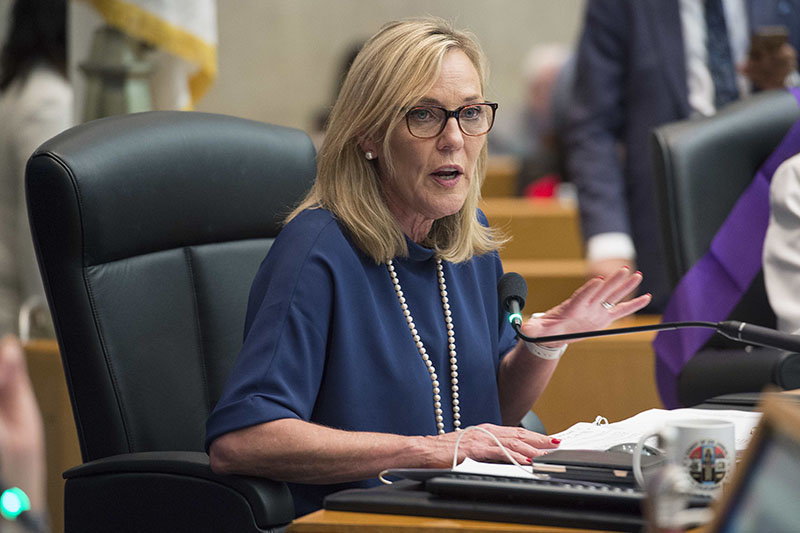
Sharon Ballmer Cartagena, directing attorney of the Child Youth and Family Advocacy Project at Public Counsel, cautions that these results are preliminary, but promising. She hopes they will be replicated when the county expands the effort next year to all of South Los Angeles — an area with a population of approximately 1 million people that is one the biggest feeders into L.A.’s child welfare system.
Amid decrease, cautionary notes
To be sure, county officials say they are carefully monitoring whether the new approaches may be leaving some children in dangerous situations.
Department of Children and Family Services Director Nichols said he can “draw some comfort” from data — even though no one statistic is a perfect predictor.
In 2015, there were 70 fatalities confirmed to be the result of abuse or neglect. In 2020, that number had dropped to 54, according to county statistics. During the first half of this year, nine children under age 18 died due to child maltreatment.
Nichols also pointed to the percentage of children who return to foster care after 12 and 24 months — which has not substantially increased over the past decade — and calls to the hotline that have continued to decline. Other measures also do not show an uptick, such as additional hotline reports after cases are closed.
Yet there are new threats on the horizon.
Fewer kids in foster care means less federal money to cover legal representation for those who can remain through age 21. And under the second Trump administration, massive cuts to the social safety net could threaten the county’s efforts to avoid foster care removals through providing direct assistance to needy families.
Passage of the president’s sweeping tax and spending cut legislation in May green-lit cuts to nutrition benefits, health care, preschool and substance abuse treatment — programs that impoverished families at risk of entering the child welfare system and aging-out foster youth rely on.
“If people can’t put their kid in Head Start or child care, they can’t go to work,” said Heimov. “They will have more stressors. And that’s when the puzzle starts to fall apart.”
“In 2015 I would have thought that this was a dream come true, and we’re doing amazing. Since then, I see that a lot more is yet to be done.”
— Christina Curtis, Los Angeles Dependency Lawyers
County Supervisor Kathryn Barger called the recent drop in foster care numbers “long overdue” and credited the county’s successful efforts to support families before they come to the attention of the child welfare system. But she, too, offered caution. She said particularly close attention must be paid to youth aging out at 21, who face high odds of struggling to survive after foster care. “While the number of cases may have gone down,” Barger said, “the ones that remain in our system are the most complex and serious cases and we need to closely monitor them.”
Free of the system
For her part, Rios now works as a domestic violence counselor. She has launched the Altadena-based nonprofit A Child’s Dream to support families navigating the child welfare system.
Professionally, she is thriving. For the past few years, Rios participated in a state commission tasked with reforming mandated reporting in the state. The woman who was once barred from talking in court now regularly speaks out at county commission meetings, and sometimes talks in person with child welfare director Nichols.
Sometimes, Rios said, she daydreams about what might have happened if, as a younger mom, she had better legal and community support. Now she is building a relationship with her son, but the time she missed still hurts.
What consoles Rios is the realization that during her time advocating for parents and helping drive reform in the county, thousands of families have been able to remain intact.
“That means children get to stay home and eat dinner with their families and celebrate holidays and play outside,” Rios said. “And they don’t have to feel the pain of family separation because they are able to get support somewhere else in their community.”
EVERY DAY, our nonprofit newsroom seeks to inform readers about issues in the child welfare and youth justice systems and to hold the powerful accountable. This work is not possible without the support of community members like you. Donate today!