Former foster youth testified today at the first-ever hearing of the newly created Senate Study Committee on Additional Services and Resources for Transition-Age Youth in Foster Care.
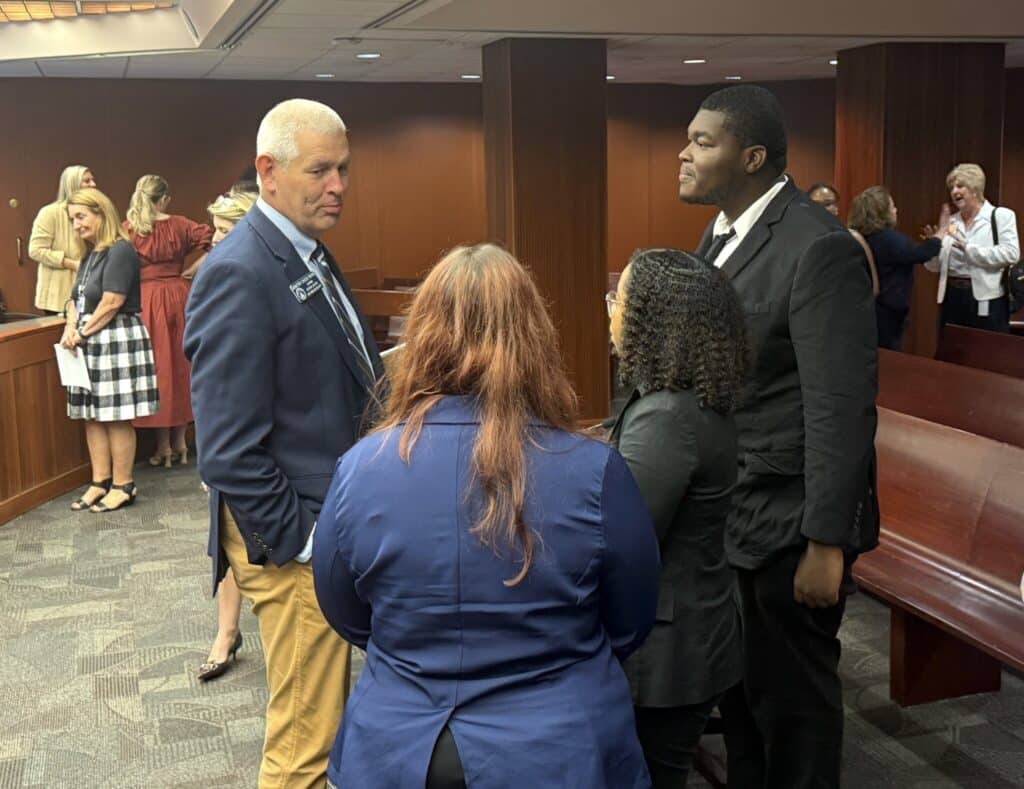
With no family connections after 17 years in foster care, Reginald Holloway enrolled at the University of West Georgia, eyeing an opportunity to build a stable life for himself.
But the challenges didn’t end there.
After being pushed out of student housing, Holloway told state lawmakers in a public hearing today, he had to couch surf with friends to stave off homelessness.
“A few weeks before my 21st birthday, when I aged out of care, I asked about housing resources,” he said. The response he got from child welfare staff in 2019 was nothing more than advice to enter the overloaded public housing system. “I was advised to look for Section 8 housing.”
Holloway shared his struggles during the first hearing held by a new oversight body in the Georgia Legislature: the Senate Study Committee on Additional Services and Resources for Transition-Age Youth in Foster Care.
Chaired by Sen. Kay Kirkpatrick, the bipartisan “aging out committee” will assess what services are currently provided and identify service gaps for foster youth reaching adulthood. A final report with recommendations will be released after the committee finishes its work this December, which could include legislative proposals or new funding allocations.
As of this month, almost 30% of the 11,000 children and young adults in Georgia foster care fall between the ages of 14 and 20, according to state data shared at the meeting. There are more than 650 young adults in extended foster care, a voluntary program for 18- to 21-year-olds.
Testimony from Holloway and fellow former foster youth Kyra Stoute shaped today’s public hearing in the state capitol. Both speakers represented Georgia EmpowerMEnt, a youth-led initiative providing foster youth with a voice in state policy matters.
“We want to dispel the belief that only certain young people have the drive. When, in reality, the majority of young people have the drive. They just don’t have the tools.”
Kyra Stoute, Foster Youth Advocate
It was the first time Stoute, a second-year biology major at Georgia State University, ever testified in front of lawmakers. While a bit nerve-wracking, she said after the hearing, she was “elated” to do so.
“These issues are still very much relevant, even though I exited care about 10 years ago,” Stoute said. “I still feel like there’s a lot of catching up to do as far as improving the outcomes for foster youth.”
Stoute told lawmakers that disrupted education poses one of the greatest challenges, often stemming from obstacles typically caused by circumstances beyond the control of foster youth like herself.
In her case, Stoute recounted being held back a grade in high school because credits from earlier schools hadn’t been properly transferred. That left her feeling too ashamed to socialize with classmates because she didn’t want them to find out her age.
“I was in the 10th grade when I should have been in the 11th,” she said. “Some teachers recognized, ‘Oh yeah, you’re way too smart to be taking a 10th grade course.’”
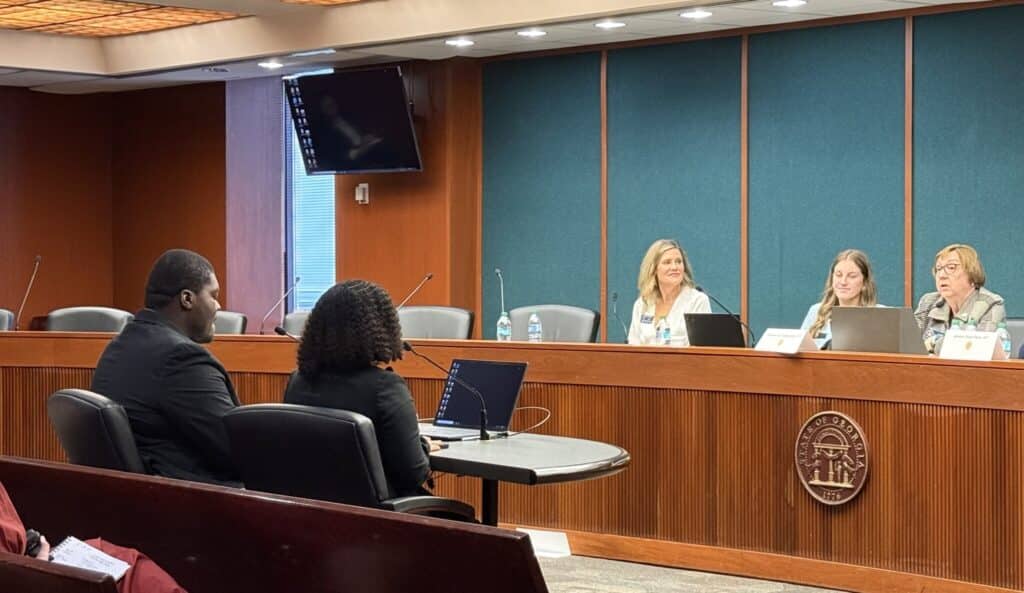
Deven Rudy-Johnson — a youth engagement coordinator at The Multi-Agency Alliance for Children which runs Georgia EmpowerMEnt — told lawmakers about bureaucratic hurdles disrupting children’s education. “At one point, it took me a month and a half to get a young person enrolled in school, transferring from one county to another,” she said. “Imagine missing a month of school and trying to catch up.”
Sen. Bo Hatchett asked how lawmakers could help: “Are there things that we can do, as far as legislation — or is it more education for guidance counselors to give them the tools they need so students don’t slip through the cracks?”
Stoute responded that both approaches may be necessary.
Once they leave high school, foster youth can face even greater challenges. Statewide, seven out of 10 say they want to attend college, but only 6% of those who age out of the system will reach post-secondary education, according to a Georgia State University study.
Stoute testified that when she expressed interest in going to college to her high school staff, she felt minimized. “I didn’t feel like the adults were trying to steer me in that direction,” she said.
Donjai Calhoun, well-being and safety services director for Georgia’s Division of Family and Children Services, outlined existing state programs for young adults leaving the foster care system, including independent living programs and help securing health care, housing and employment after exiting foster care.
This year, 184 Georgia students in foster care graduated high school or earned a GED, Calhoun told lawmakers. Nearly half have plans to attend college or join the armed forces.
Housing vouchers are also available through a federal program known as the Foster Youth to Independence program. But a 2024 ProPublica investigation found that Georgia has failed to tap those resources, receiving only eight vouchers since the federal program launched in 2019. In contrast, Texas, Florida, and Washington have each received more than 400.
It’s the only long-term housing assistance program for former foster youth on the federal level, and Holloway said the state should be “fully utilizing” the vouchers, since young people leaving the system are particularly vulnerable to homelessness.
Sen. Kirkpatrick said the committee is still gathering information on the problem, which is in part due to the “complexity” of the federal application process. “I think DFCS is already working on that, so you’ll hear more about it, I’m sure, in the next couple of meetings,” she added.
Absent enough state support, Stoute and Holloway said many foster youth find themselves relying on community-based organizations. One local nonprofit, Up3 Atlanta, helped Stoute obtain a housing voucher within a month. Some of her peers relying on the Independent Living Program waited up to two years, she said.
She urged lawmakers to prioritize stable housing and access to higher education for foster youth.
“It’s not just about me or Reggie,” she said. “We want to dispel the belief that only certain young people have the drive. When, in reality, the majority of young people have the drive. They just don’t have the tools.”