
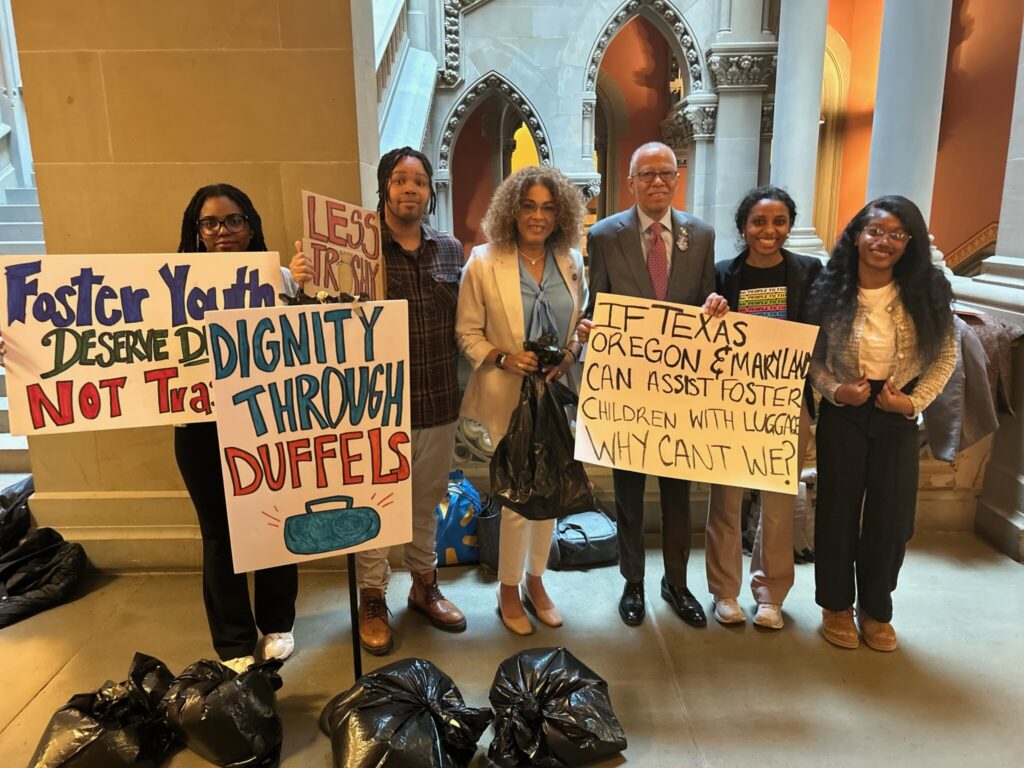
Former foster youth joined lawmakers for a rally on the steps of the state Capitol this week after a New York bill that sought to end the practice of giving foster youth trash bags to transport their belongings failed to make it onto the Legislature’s budget proposals for the coming fiscal year.
Advocates held the rally to demand passage of legislation that calls for providing proper luggage to thousands of foster youth around the state. New York lawmakers carried their own belongings in black garbage bags to call attention to what they called a dehumanizing practice.
“Today in New York, too many of our foster youth are forced to carry their lives in garbage bags as if their memories, their hopes, their belongings were disposable,” Sen. Robert Jackson told about two dozen supporters who assembled at the Capitol. “This is not just unacceptable, it’s immoral. This bill says to every child in care: Your journey matters.”
State Sen. Jabari Brisport and Assemblymember Andrew Hevesi sponsored the bill, which would require New York’s Office of Children and Family Services (OCFS) to distribute luggage through each county’s social service agency and to submit an annual report to the governor to track progress. The legislation calls for $200,000 in annual funding for the effort — less than $15 per bag.
But neither the state Senate nor the Assembly included funding for the bill in their 2025-26 budget proposals presented earlier this month. On Wednesday, supporters urged Gov. Kathy Hochul and members of the Legislature to include the needed funding by the April 1 deadline for final budget negotiations.
“It was common to receive children in the middle of the night with their personal belongings all put in trash bags that were lined up outside. You can imagine all of the young children — their stuffies, their clothes, their memorabilia left behind.”
Assemblymember Phara Souffrant Forrest
Sofie Fashana, who was instrumental in the success of a similar bill in her home state of Oregon, spent months helping draft the legislation along with other former foster youth from New York.
While frustrated that the legislation was overlooked this year, she said she was grateful for the outpouring of support from lawmakers and youth advocates.
“I feel furious,” Fashana said. “I also feel like there’s more reason to fight, and that’s why we’re here. We’re not going to give up.”
About 13,000 children in New York’s foster care system endure roughly 23,000 transitions each year, according to the proposed bill’s language. On average, each child lives in three different placements while under the government’s care.
They are handed plastic bags whenever they move. What’s more, foster youth report they sometimes find that their belongings have been thrown into trash bags and transported to new placements by caseworkers while they were at school.
Dylan Tatum held back tears at Wednesday’s rally as she described being bounced between nine homes after entering foster care at age 13. She was forced to use a trash bag for every move. One of those times, a bag with her belongings went missing.
“I lost everything that I owned in that trash bag — every experience, every memory, was gone in a moment,” Tatum told the crowd. “ New York State has to do better for our young people. These are experiences that stick with them, that teach them that they don’t matter, that what they have is not valuable.”
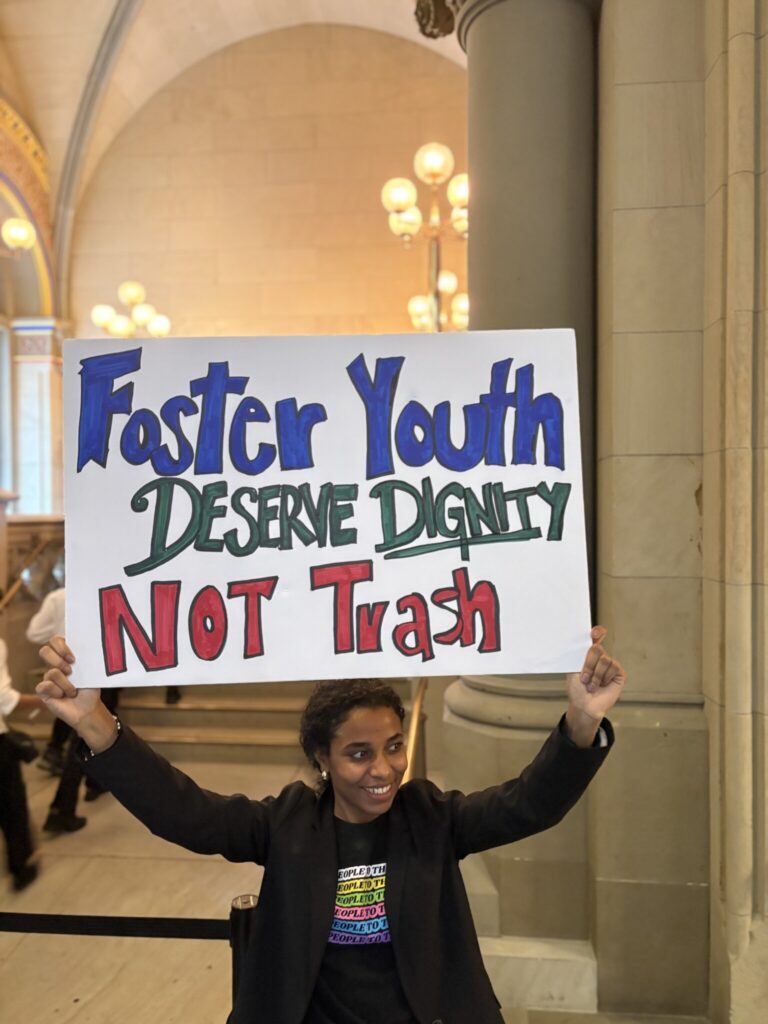
Tatum said she considers the bill’s funding amount a “drop in the bucket.” Others who spoke during the rally urged policymakers to consider how the humiliating practice adds to the trauma foster children already experience through repeated and sudden moves between homes.
Assemblymember Phara Souffrant Forrest, who previously worked as a nurse for New York City’s Administration for Children’s Services, recounted meeting young children who had been “forced out of their homes without really knowing why.’’ They often lost track of belongings during those moves.
“It was common to receive children in the middle of the night with their personal belongings all put in trash bags that were lined up outside,” Forrest said. “You can imagine all of the young children — their stuffies, their clothes, their memorabilia left behind.”
If passed, the state legislation would also cover New York City, where lawmakers are considering a similar bill. In recent years, several other states around the country have banned the distribution of trash bags to foster youth.
Brisport said if funding for the effort doesn’t make it into the governor’s final budget, there is still hope that the Office of Children and Family Services might pick up the cost without the extra help from the state.
But youth advocate Fashana said the agency’s past efforts in this regard have fallen short. In 2021, the state launched the My Bag initiative, but only around 3,500 bags were distributed in 2023, the latest figure available from the Office of Children and Family Services. Even fewer were allocated in 2024 — roughly 2,700 bags, according to state data. The program’s annual cost has ranged from $31,000 to $65,000.
“There’s always competing priorities that we’ve seen OCFS have,” Fashana said. “But we’re saying this is important. This is a priority, period.”