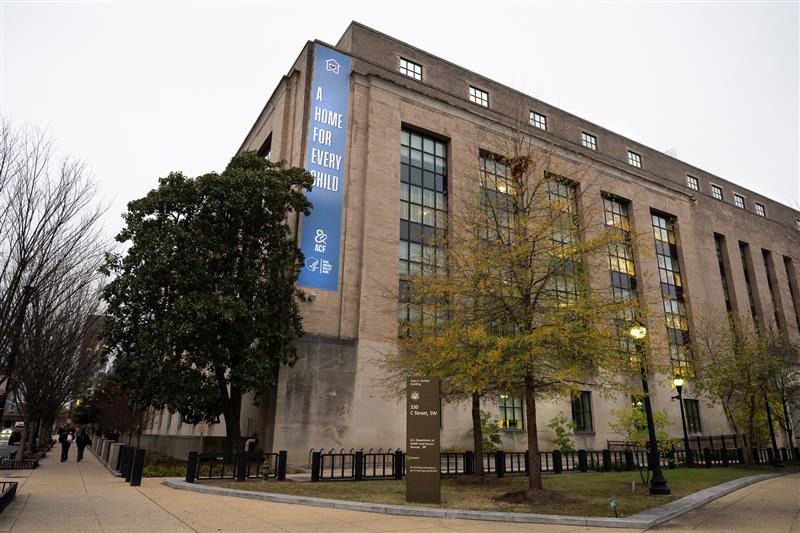
Five states filed suit late Thursday to counter the federal government’s social services funding freeze.

Update, Jan. 10, 2025: The day after this story was published, a federal judge in New York granted five states’ request for an emergency restraining order, temporarily blocking the Trump administration’s freeze on the states’ social services and child care funding. The stay will last 14 days while the trial continues.
The Trump administration is demanding that five Democratic-led states provide the “complete universe” of data on millions of families receiving public benefits by Jan. 20 in order to release $10 billion in frozen funds for child care, cash assistance programs and other social services, according to letters sent to governors and reviewed by The Imprint.
Just before press time Thursday night, the five states targeted — California, Colorado, Illinois, Minnesota and New York — filed a lawsuit in federal court challenging the funding freeze.
The U.S. Department of Health and Human Services announced its intent earlier this week to halt the social services funding for California, Colorado, Illinois, Minnesota and New York due to the federal government’s stated concerns about what it described as widespread fraud. The notices that went to governors in each of the five states followed dozens of criminal prosecutions for public benefits fraud schemes in Minnesota — though no specific evidence of fraud in the other four states has been provided.
The letters signed by Alex Adams, assistant secretary of the Administration for Children and Families, allege “extensive and systemic fraud” in three aid programs for low-income families and the use of public benefits by ineligible immigrants.
“These concerns have been heightened by recent federal prosecutions and additional allegations that substantial portions of federal resources were fraudulently diverted away from the American families they were intended to assist,” Adams wrote in a Jan. 6 letter sent to California Gov. Gavin Newsom about his state’s cash assistance spending.
Democrats and family advocates have called the threatened funding freeze a dangerous, baseless political ploy that will devastate vulnerable families. New York Attorney General Letitia James and California Attorney General Rob Bonta announced the lawsuit from their states, joined by Illinois, Minnesota and Colorado, after close-of-business on the East Coast.
The suit was filed in U.S. District Court in Manhattan against Adams, Health and Human Services Secretary Robert F. Kennedy, Jr., and their respective agencies. It calls the funding freeze “extraordinary and cruel” and accuses the agencies of six counts of statutory and constitutional violations, through a “breathtaking array of unexpected, ambiguous, unreasonable, and coercive obligations.”
New York Gov. Kathy Hochul previewed the suit in an interview with New York’s PIX11 News hours earlier. She also pointed to last year’s pause on funding for food stamps, or the Supplemental Nutrition Assistance Program (SNAP), that millions of Americans rely on.
“Donald Trump is literally declaring war on kids,” she continued. “Wasn’t it just a couple months ago when they stopped feeding our kids by eliminating SNAP during the budget shutdown?”
The letters sent to the targeted states address three programs mostly serving families with little or no income: Temporary Assistance for Needy Families, or TANF, which pays for monthly cash assistance and other services; the Child Care and Development Fund, which subsidizes child care nationwide and Social Services Block Grants, which fund an array of services, including foster care, housing programs and day care.
The Imprint obtained the letters from California, Colorado, Illinois and Minnesota. New York did not provide correspondence it received from the federal government.
The similarly worded directives call on the states to provide detailed citizenship information, as well as other administrative data including the “recipient name, address, Social Security Number, date of birth” for kids and families in TANF and the smaller Social Services Block Grant.
Each state was also asked for information on all “organizations, subcontractors, service providers, local agencies, community groups, and any other entities that received TANF funds.”
All “policies, procedures, system controls, and verification records” that the state uses to “confirm citizenship or qualified alien status” of participants in programs like home heating assistance for low-income people were also requested. Adams wrote that the information is necessary to “assess the extent of any irregularities that may have occurred” in light of the recent fraud cases – a likely reference to the cases in Minnesota.
The Administration for Children and Families leader also stated that his agency “has reason to believe” that each state “is illicitly providing illegal aliens” with “benefits intended for American citizens and lawful permanent residents.”
California has the largest TANF program of all five states targeted. In fiscal year 2024 it provided a monthly TANF cash benefit to more than 362,000 families with little or no income. As of last October, families received an average of nearly $1,000 per month for basic living expenses. The federal government covered nearly half the state’s total TANF spending: $7.1 billion in 2023, almost half of which goes toward cash assistance.
Letters to all of the states concluded with Adams noting that they are now “placed on a temporary restricted drawdown for all TANF funds provided by ACF until further notice,” pending a review of these materials.
Elizabeth Lower-Basch, an expert on public benefits, called the freeze unprecedented and said it was very likely illegal given that federal laws already include oversight penalties for misuse of funds — penalties that are far less severe than this week’s total freeze.
Lower-Basch added that states may only be able to cover the cost of the withheld federal funding for a short time.
“If this lasts an extended period of time, states’ ability to do so will eventually run out, and families will lose payments and services that are critical,” she said.
Hana Ikramuddin, Nancy Marie Spears and Jeremy Loudenback contributed to this report.