
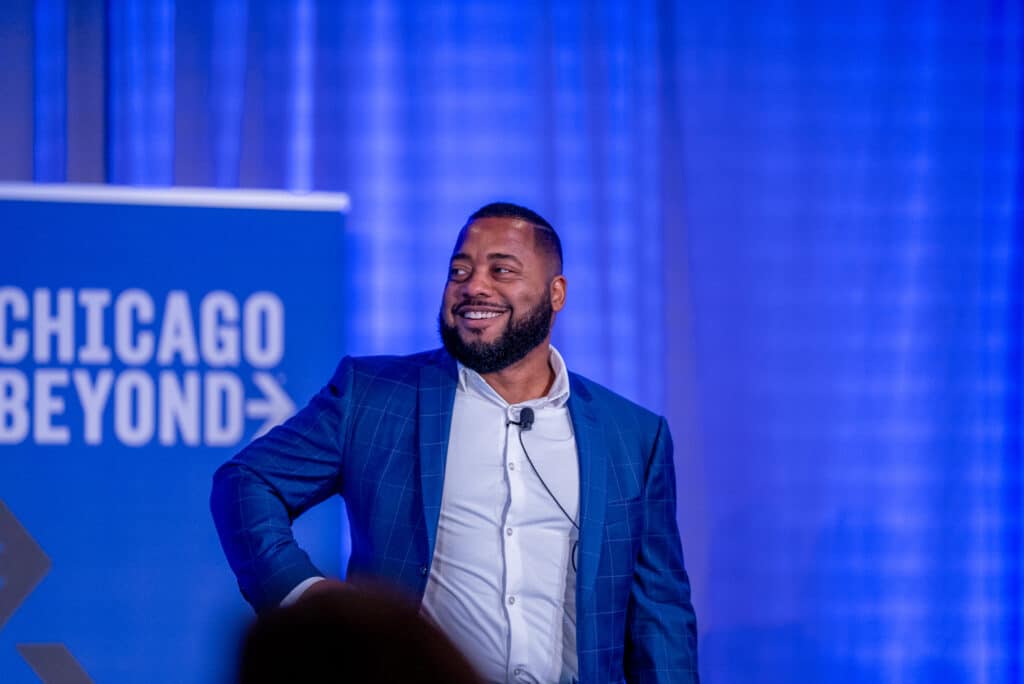
As a high school principal on the South Side of Chicago, Maurice Swinney had an inside view of the child welfare system.
He saw when it helped, but he also saw tragedy strike when the system didn’t work — like the time he was sent a graphic photo of one of his students being physically abused. Swinney went through the district’s protocol and reported the image to the Illinois Department of Children and Family Services. He was no stranger to intervening — he knew the caseworkers, knew the judges, even attended students’ court hearings. But this time, the system response was so fractured, Swinney couldn’t get the answers he sought to ensure the child’s safety.
A few years later after Swinney had left the school, the teen died. Swinney was told the cause was complications from a blood clot. This child’s face remained in his mind when he decided to focus on serving foster youth in his current role as chief innovation officer for the national philanthropic foundation Chicago Beyond.
“These problems are solvable — there’s nothing in my mind that says that we can’t do better,” he said. “It’s just systems choosing to do better by investing the right resources and creating coordinated efforts for young people who are farthest from opportunity.”
To this end, Chicago Beyond distributed $1.7 million in one-time seed grants last month to six such community-led organizations working to provide care and support to foster youth and keep families on the brink from being separated. Emphasis is placed on nonprofits led by people with firsthand experience.
“The support that they offer through this funding humanizes these interactions, these processes — this isn’t just about meeting benchmarks, this isn’t just about numbers. Those are important parts of it, but the way that they provide the funding allows us to be our most human, our most compassionate, our most involved.”
—Vanessa George, co-founder of Kin Support Program – Haa Yatx’u Saani
It’s the first time Chicago Beyond has focused its support on the child welfare system. Previously, they’ve funded initiatives to make jails safer, address Black maternal health disparities and improve education equity, distributing more than $100 million toward those and other efforts since 2016, with funding from philanthropists Kimbra and Mark Walter.
Recipients of the new grants are Foster Nation, which has paired hundreds of youth with mentors to provide guidance to teens in the system; the RightWay Foundation in Los Angeles, which provides housing, employment support and therapy to youth aging out of foster care; Neighborhood Wellness Foundation in Sacramento, which works to end intergenerational cycles of trauma and violence; and Fostering Sibling Connections, a legal group fighting sibling separation. The specific amount granted to each organization was not disclosed.

Chicago Beyond’s funding strategy is somewhat unique: Instead of making candidates go through a lengthy grant application process, Swinney’s team spent months researching the nonprofits working in the field, and reached out directly to those that most impressed them.
Foster Care Unplugged, which blends dramatic arts with traditional talk therapy in New York City and Atlanta, was among the recipients of the one-time grants.
Founder and president Melody Centeno said in that first meeting, the Chicago Beyond team asked questions about who she was and what drove her to work with young people.
Her organization provides 12 weeks of traditional therapy to foster youth, and then, with assistance from professional writers, helps them turn their personal stories into a film or stage play that is eventually screened or performed for a public audience. Cast members are other young clients in the program.
Centeno grew up in New York City’s foster care system from the age of 3. The idea for the nonprofit came from her own experiences in an acting class she took for fun while studying to become a social worker. She was struck by how similar the class felt to group therapy, and realized the role-playing and storytelling elements could be a powerful vehicle for working through trauma histories. Creating a performance piece imbues the teller with confidence, she said, giving people a chance to own the narrative after years of having little control over their lives.
When Chicago Beyond reached out to Centeno during that initial phone call last year, there was no mention of money. Centeno hung up the phone unsure of why the organization was interested in her.
When they got back in touch the following week and told her they wanted to fund her work, “it felt like a scene out of ‘Touched by an Angel,’” she said.
What surprised Centeno perhaps more than the award itself, was what Chicago Beyond suggested that her nonprofit do with part of the money. She was told that there were no restrictions on how the funding could be used, but Chicago Beyond provided a small healing stipend within the grant to help her and her staff — many of whom were also in foster care — with their own healing journeys.
“I’ve never heard anyone say anything like that,” Centeno said.
Some staff members cried when she told them about Chicago Beyond’s suggestion. One employee is choosing to take a therapeutic solo retreat. Centeno plans to use the opportunity to spend time getting to know siblings she only recently learned she had.
The funding will also help their expansion as they call “action” in Atlanta.
Leaders of the Juneau-based Kin Support Program – Haa Yatx’u Saani “were gobsmacked’’ when they learned they were the recipients of an award from Chicago Beyond, said co-director Holly Handler.
“We’re actually not quite sure how they even heard about our little program up here — I mean, we’re five people in Alaska,” Handler said.
The organization, which launched in 2024, provides legal aid, kinship navigators and positive parenting education to Indigenous and non-Native families caring for relatives, both in and outside of the formal foster care system.
Resources are scarce and the work is hard, Handler said. The nonprofit operates out of a donated office space with no support staff in a region where many of the southeast Alaskan communities they serve are only reachable by boat or plane.
“We’re actually not quite sure how they even heard about our little program up here — I mean, we’re five people in Alaska.”
—Holly Handler, co-director of Haa Yatx’u Saani
The one-time grant will allow the group to hire someone to handle administrative and clerical work, so that their team of experts can dedicate all of their time to the families, she said.
“I was almost crying,’’ Handler recalled about receiving news of the grant, “because I was like, this is going to ensure that we can continue to provide the services that we do, but it also means we can do a little bit more.”
Another boon: The unrestricted funding will allow the nonprofit to purchase food for the parenting classes and support groups they host — something most grants they receive can’t be used for but that is vital to the work they want to do, Handler said.
Co-founder Vanessa George learned early on how food can make a tangible difference in the energy at her positive Indigenous parenting classes. A table laden with pizza boxes or platters of Thai takeout offers a connection point and ice breaker, she said, and provides leftovers that caregivers can take home to feed their families.
“The support that they offer through this funding humanizes these interactions, these processes — this isn’t just about meeting benchmarks, this isn’t just about numbers,” George said. “Those are important parts of it, but the way that they provide the funding allows us to be our most human, our most compassionate, our most involved.”
Update: This article has been updated to include the Neighborhood Wellness Foundation as a grant recipient.