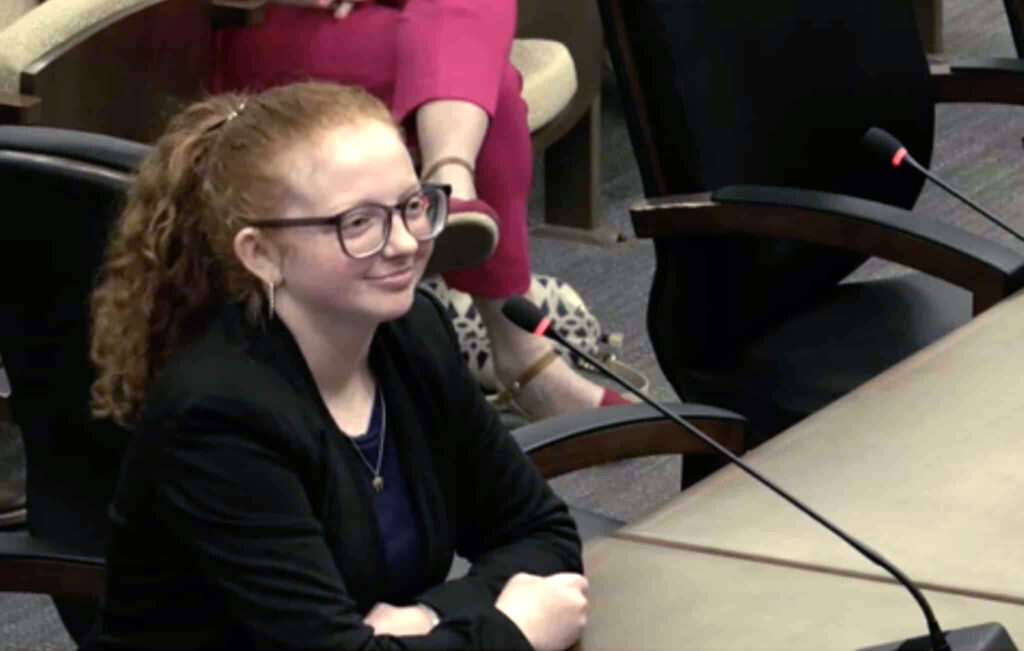
Days after turning 18, Ella Bat-Ami sat in the back of her high school economics class in Nashville, holding back tears as she texted a potential landlord. She had just aged out of foster care after a tumultuous two years; some nights, she slept in government offices, on floors crowded with children.
But before the teenager could sign an apartment lease, the landlord needed proof of her identity. State policy requires caseworkers to make certain young adults have all the paperwork they need before leaving the child welfare system. Hers hadn’t followed through.
“I didn’t have any legal documents to prove I existed — like birth certificate, state ID, nothing like that,” Bat-Ami, now 20, recalled. “I was incredibly frustrated.”
Difficulty finding a stable home is common among teenagers aging out of foster care.
What Bat-Ami did in response is not. She submitted mock legislation to an afterschool club, and then persuaded lawmakers to make it a statewide policy: Tennessee’s first Foster Youth Bill of Rights. That success launched a career as a rare and influential voice for foster youth in the state capital — and involvement in future legislation.
She’s since battled a controversial proposal making it easier to lock up foster youth. She’s also now advising a million-dollar philanthropic effort to smooth older foster youths’ transition into adulthood.
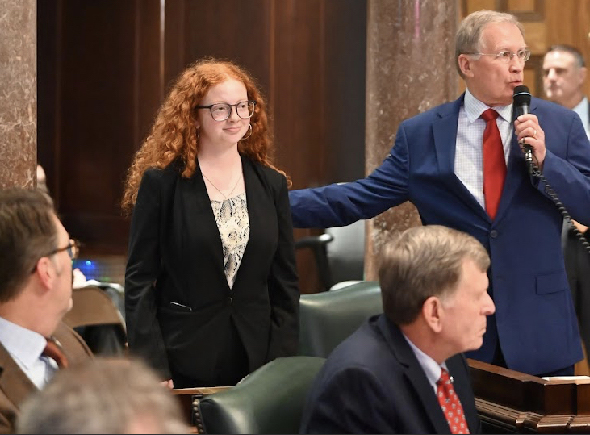
At a hearing last summer, several lawmakers praised Bat-Ami’s legwork on the bill of rights, which includes guarantees for foster youth such as “a safe, healthy environment that is free from abuse, neglect and pests.”
Sen. Todd Gardenhire, the Republican chair of the judiciary committee, choked up while discussing the proposal. “You kids in the back, you oughta see what she’s done,” he said to audience members in the hearing room. “Great example.”
Music City trials
When she entered high school, Bat-Ami, formerly Ella Brinen, was known for being polite and studious. She flew “under the radar,” despite her unusually long dresses and curls of red hair, according to one mentor at her competitive Nashville magnet school.
“I remember her being super polite, like, ‘Yes, ma’am,’ and ‘Thank you, ma’am,’” said Lauren Williams, a former social worker at the school. “High school students just aren’t really like that.”
That began to change after she entered foster care in 10th grade. Caseworkers moved her frequently, and threatened to send her to group facilities in Knoxville or Chattanooga if she misbehaved. In one foster home, she was told she could be forced out for something as simple as skipping chores.
In some homes, she grew close to “foster siblings” she wanted to protect. In others, there were outrages.
“Chilling with the homies,” she says in a 2024 cell phone video, before panning to hundreds of ants crawling across white bedsheets next to her. She starts to cry as the clip ends.
Afterward, she submitted several formal grievances to caseworkers, but they were never addressed, she said.
“She has very real faces and names of the people who she’s fighting for. She knows what her principles are and what she wants, and she’s not afraid to go get it.”
— Ainay Delahanty
Bat-Ami’s classes and reading — books like Barbara Kingsolver’s novel “The Bean Trees,” and Bryan Stevenson’s memoir “Just Mercy” — and “really retaining the information,” took on new urgency.
“I understood that when you’re in foster care, everything is up in the air. They can take your family from you, they can take your school from you,” she said. “But they can’t take your education, and they can’t take your vocabulary.”
She gradually became more bold and outspoken — and a little more rebellious — according to two people she was close to at the time. She challenged an English teacher on the moral positioning of one World War II novel. She marched on the Tennessee statehouse in anti-gun protests. She snuck into abandoned, graffitied warehouses with friends.
But as she approached her 18th birthday in early 2025, Bat-Ami said she still felt like she was in “free fall.” She would have to leave her foster home, and raced to save money for her own place. Before sunrise and school, she worked at Starbucks.
Unable to pay for college right away after graduating high school, she spent her time pitching legislators’ offices about the bill of rights. Bat-Ami sought other foster youth for input, and lawmakers who had previously passed reforms related to adoption or foster care, starting with central Tennessee Sen. Ferrell Haile, who eventually championed her bill of rights. Observing the political dynamics in the Republican-dominated Tennessee Legislature, she shared examples of similar bills of rights supported by the party in Kansas and Florida — not just Democrat-controlled states. This was “to show that this is not a partisan issue,” she said.
At one point, she faced a bank of lawyers from the state’s child welfare agency, a meeting that felt like an “ambush.” But Bat-Ami said she took it as a compliment: “Because if you’re scared of a 19-year-old and you have a law degree — that’s crazy.”
In a series of recent interviews, she said she “knew what needed to change — and I knew that I needed to refine myself enough to be the catalyst for that change.”
Tennessee foster care system rife with problems
Bat-Ami’s time in foster care coincided with a spiraling set of issues in Tennessee: In December, a watchdog audit reported children had been sleeping in state government offices and run-down temporary group facilities for years. In a class-action lawsuit filed last year in Nashville’s federal district court, foster youth plaintiffs alleged “widespread and systemic violations” of children’s rights by the Department of Children’s Services (DCS).
The agency has mounted a vigorous defense to these critiques. Its attorneys argue the class-action lawsuit’s claimed harms to youth do not go beyond “mere negligence,” and are therefore beyond the reach of federal courts, and best handled by local juvenile courts. In response to the audit by the Comptroller’s office, Commissioner Margie Quin notes it also identified progress in several areas; she told lawmakers her agency had “moved the needle” in addressing recent challenges.
“Turning a ship with almost 4,000 employees does not happen overnight,” she said. “Over the last three years, we have moved DCS and the children of Tennessee in a better direction.”
Bat-Ami, who spent more than 700 nights in this system and got to know many peers along the way, isn’t satisfied.
“She has very real faces and names of the people who she’s fighting for,” said Ainay Delahanty, Ella’s best friend and former high school classmate. “She knows what her principles are and what she wants, and she’s not afraid to go get it.”
In most interviews, Bat-Ami also seems careful to praise the child welfare system: “I do think that there are a lot of people who are trying really hard to do good work, and I don’t ever want that to be overshadowed,” she told the podcast for a Nashville transitional housing nonprofit.
But in her view, there is plenty of work to be done — and she’s quick to acknowledge the bill of rights policy she inspired lacked some of the teeth she hoped for.
Her most recent legislative push was opposing a bill introduced in January that would have made it easier to place foster youth in juvenile lockups. Its proposed language, supported by DCS, stated that judges could detain youth, “regardless of whether a petition has been filed alleging the child committed a delinquent act.”
That “functionally criminalizes being a child, just because these kids are in foster care,” Bat-Ami told state officials and local and national media earlier this year.
The agency argued the detention provision was necessary to address youth assaults in facilities, but it was removed from the bill in March.
In debates like this, while other advocates are involved, “Ella is unique in both her passion for the issue and her willingness to speak out so directly,” said Zoë Jamail, an advocate for children with the nonprofit Raphah Institute.
The fight continues
In February of this year, the Department of Children’s Services was required to begin educating all new employees and youth on the rights of foster children. Judges are also required to ensure youth receive that information annually.
This month, Bat-Ami completed finals for her freshman year at Belmont University in Nashville. She hopes to attend law school and become a public defender.
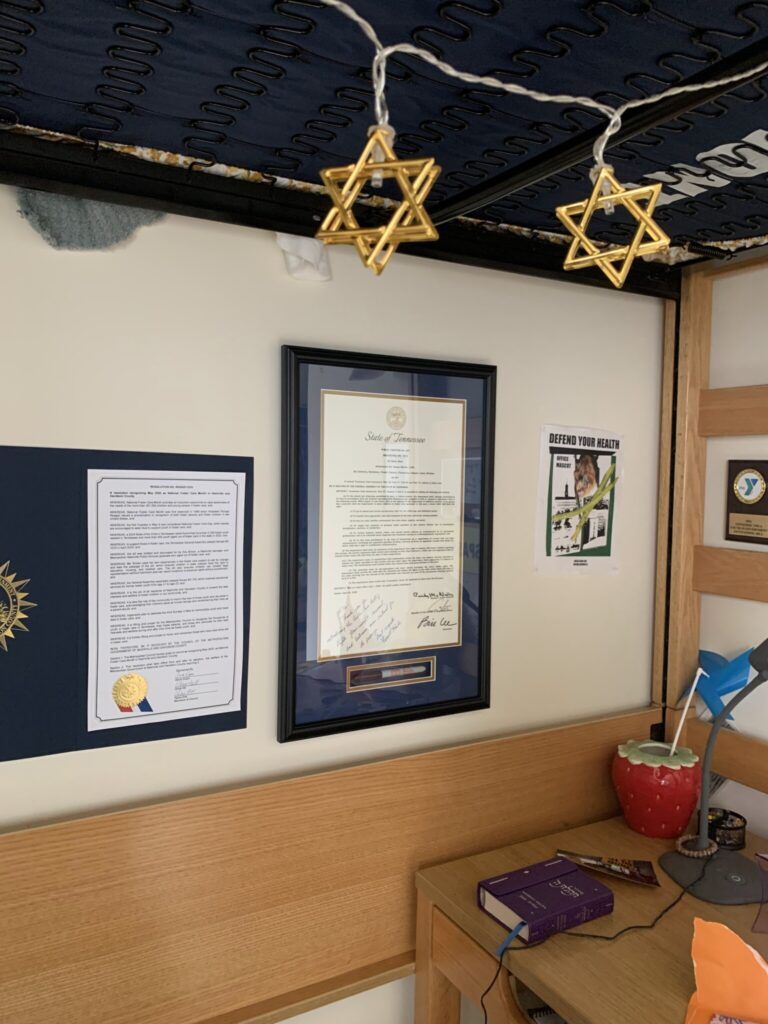
A framed copy of the bill of rights hangs by her bed in her college dorm. She also has a hermit crab tattoo, inked in the days after she aged out. She explained the symbolism in an interview with the public radio show “This Is Nashville” last year — how during foster care, she had to carry her home in her backpack, like a hermit crab.
The progressive Jewish concept of tikkun olam – “repairing the world” in Hebrew — has also taken new significance for Bat-Ami, who is Jewish. She recently reflected on where that feeling has led her, and what she wants readers of her story to understand about that.
“I want people to understand when they’re reading this how deeply and fundamentally this system changes you,” she said. “I look at my sisters and see what they go through every day. For me to turn away from them, and just age out and do nothing — it’s not in my nature.”