Late last week, a juvenile justice hearing held by the House Judiciary Committee included an exchange on the issue of transferring youth into adult court in which a conservative member of the committee seemed to get caught in his own line of questioning about the controversial case of Kyle Rittenhouse.
The hearing, titled “Juvenile Justice Pipeline and the Road Back to Integration,” looks to have been set up for two reasons: as a preamble for forthcoming legislation by Democrats on the committee, and to slam the recent Supreme Court decision in Jones v. Mississippi, in which a 6-3 majority said judges did not need to establish in a finding of fact that juveniles convicted of homicides were eligible for a life without parole sentence.
Republicans on the committee used the event to criticize the Biden administration’s handling of unaccompanied minors arriving at the southern border, directing most of their questions to one witness: Jessica Vaughan, director of policy studies for the Center for Immigration Studies, which advocates for low immigration in America.
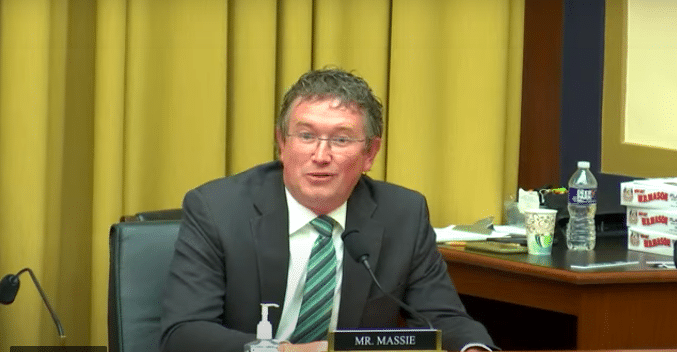
Not the case for Rep. Thomas Massie (R-Ky.), who wanted to talk about the case of Kyle Rittenhouse. For those who don’t recall, Rittenhouse was a 17-year-old when in August of 2020, he drove from his home in Antioch, Ill. to Kenosha, Wis. During the unrest following the police shooting of Jacob Blake, Rittenhouse shot and killed two people and injured another.
The issue of transferring youth to adult court had already come up at the hearing when Massie got his turn to ask questions. He began by entering into the record two opinion pieces on Rittenhouse, one of which was published by The Imprint last September. It was written by Marcy Mistrett — then of the Campaign for Youth Justice, now of the Sentencing Project — and made the case that Rittenhouse should not be tried as an adult.
“This case cuts to the soul of the conflict in our country. It is why we are having these protests to begin with,” Mistrett wrote in the op-ed. “They test our moral compass and the type of future we are building for our children.”
Massie began by requesting a yes-or-no response to the following from each witness: Did they believe that Kyle Rittenhouse should be tried as an adult?
That elicited quick no’s from four witnesses: attorney Bryan Stevenson, the famous founder of the Equal Justice Initiative whose work was featured in the film Just Mercy; Marsha Levick, a longtime legal expert on juvenile justice who co-founded the Juvenile Law Center; Brett Peterson, director of the Utah Division of Juvenile Justice Services; and Aaron Toleafoa, who is serving an adult sentence for crimes he committed as a youth and serves as chair of the Coalition for Juvenile Justice’s Emerging Leaders Committee.
Vaughan, the witness added by Republicans to keep yoking border issues to juvenile justice, was evasive. “I don’t know, I don’t have an opinion on that,” she said, before pivoting her reply back to the border.
Massie took a veiled shot at her, thanking “the four witnesses here who gave me a straight answer.” He shared his own opinion on Rittenhouse: “I believe he acted in self-defense, that’s just an opinion, I’m not a jurist or a judge. But if he’s going to be tried, I think he should be tried as a juvenile. He was 17, he should not be tried as an adult.”
He commended the four witnesses for “not having a double standard, and standing up for the rights of all juveniles.” It was left unclear which exact “double standard” Massie was referring to.
But despite his assessment of Rittenhouse’s specific case, Massie in a way ended up being the only person at the hearing to endorse the teen’s trial in adult court. The congressman said when it comes to the issue of transferring youth, “I think it should be left up to the states.”
A states’ rights view of things is not that surprising from a Republican member, but it’s worth noting that the party itself did not always have a problem with federal intrusion on the matter. Here is a piece of the Republican Party platform in 1996: “We will stress accountability at every step in the system and require adult trials for juveniles who commit adult crimes.”
And in fairness, the Democrats agreed. That same year, the party’s platform said that “when young people commit serious violent crimes, they should be prosecuted like adults.”
Youth Services Insider followed up with Massie’s office to confirm his view.
“As with most criminal prosecutions, Congressman Massie believes it should be left to the states,” said John Kennedy, his communications director. “He has not adopted an official position beyond those expressed in the hearing.”
There is actually no state in the country more likely to try Rittenhouse as an adult than Wisconsin. In fact, based on state law, it would be impossible to try him as a juvenile.
Every state has some path for youth to be tried as adults, especially in cases that involve murder and other extreme violence. But Wisconsin considers all 17-year-olds to be adults in the eyes of the law. There used to be dozens of states that took this view in law, but the list has been pared down to the Badger State, Georgia and Texas.
So in summary: Massie believes philosophically that Rittenhouse should be tried as a juvenile, but also believes Wisconsin is justified in mandating his trial as an adult in its state laws. Since his philosophical bent is toward trying youth accused of homicides as juveniles, and he applauds a lack of “double standard” when it comes to this, perhaps he just volunteered himself as a conservative backer in the fight against all transfers to adult court?
Congress has no power to override states on transfer policies, so there are really only three ways that the federal government could influence local policy on the matter. First, legislation to ban transfers to adult court in federal cases could serve as a strong symbol. Second would be federal incentives to help states open to ending transfers, plying states with the money to develop and operate plans within the juvenile justice system for serious offenders.
Authors of a 1990s-era juvenile crime bill (which ultimately failed to pass) tried to use this method to steer more transfers of youth into adult court. The bill, championed by then-Sen. Jeff Sessions of Alabama, offered up a $500 million fund for juvenile justice projects with one condition: states had to amend their criminal code in such a way that “juveniles age 14 and older may be prosecuted under State law as adults, for an act that would be a serious violent felony (as defined by State law) if committed by an adult.”
Third would be an actual challenge to the constitutionality of transferring youth to adult court that somehow made its way to the Supreme Court. Given its recent opinion on Jones v. Mississippi, even if such a case were put before them, it seems highly unlikely that the majority would embrace such an argument.