Just before the Thanksgiving holiday, the Office of Juvenile Justice and Delinquency Prevention (OJJDP) hosted its first national conference in more than a decade. It was meant to mark the 50th anniversary of the office and the legislation that established it, the Juvenile Justice and Delinquency Prevention Act.
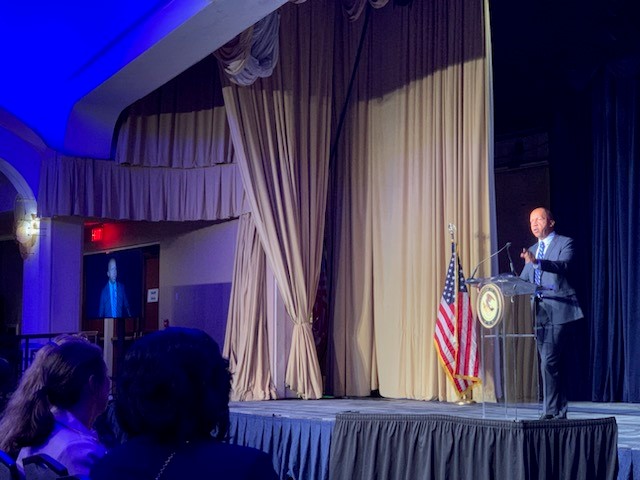
The conference kicked off with a rousing speech by perhaps America’s most venerated justice reformer, Bryan Stevenson, who acknowledged an uncertain path ahead for youth justice reform while imploring the crowd of more than 2,000 to stay committed.
“Our hope is key to our capacity to make youth justice meaningful,” Stevenson told an emotional crowd, punctuating his speech with applause and affirmation like an energetic parish on Sunday. “I believe that injustice prevails where hopelessness persists. I think hopelessness is the enemy of justice.”
Whereas the last OJJDP conference was generally a showcase of the agency’s portfolio — which in addition to supporting youth justice standards includes a range of activities from mentoring to finding missing kids — this go-round very much honed in on efforts to reform youth justice, particularly the movement to close locked facilities in favor of community-based alternatives and family-focused diversion strategies. It was noteworthy that in a two-and-a-half day agenda entirely focused on youth justice, there were almost no panel sessions about best practices or conditions of confinement in facilities at a time when many systems are experiencing worse-than-usual staffing and quality control crises in that area.
Pushing toward a youth justice system that rarely requires incarceration, and never allows youth to be exposed to the adult system, has been the life’s work of current OJJDP Administrator Liz Ryan. We spoke with her about the conference and her time in the Biden administration for The Imprint Weekly Podcast; stay tuned for that in early January.
No surprise, then, that Stevenson, perhaps the man most singularly responsible for changing the laws on life without parole (LWOP) sentences for youth, was tapped to deliver the conference’s opening statement. He has argued before the Supreme Court in cases that abolished the death penalty and greatly limited the application of LWOP sentences in juvenile cases.
Following are a smattering of moments from his hourlong address. Youth Services Insider has requested the recording of the address that OJJDP was clearly capturing next to us in the venue; no word yet, but we will update this story if we get it, it was quite a speech.
On drawing from lived experience:
I believe we have to get close to people who are poor. We have to get close to people who are marginalized. We have to get close to people who are struggling. Close to the incarcerated. Close to those who have been condemned. Close to young people who are struggling. Because when we make policies from a distance, we get the policies wrong.
You can’t make an effective policy if you don’t know the communities you’re actually dealing with.
On the last time American politicians adopted a “tough on kids” mentality:
They came up with this new term, they said these aren’t children, they said these kids are quote, “super predators.” And they used that label to demonize a generation of young people, mostly Black and brown people. And every state responded. We began lowering the minimum age of trying children as adults. We started putting very young kids in the adult criminal legal system.
And it broke my heart because I started getting calls from parents who were telling me that their 5- and 6-year-old children had been handcuffed in kindergarten for doing things that we all did. And this criminalization of very young children was sweeping across America. We created these pipelines from school houses to jail houses.
On centering the most vulnerable children in the work of reform:
If we care about the future of this country, if we care about the future of our children, we have to recognize and help this nation understand that you can’t measure your commitment to children by looking at how well you treat privileged kids, and wealthy kids, and kids in very polished situations.
We have to look at how we support poor kids, and abused kids, and neglected kids. These are the kids that will be the measure of how we move forward. And it’s in proximity with children that are in detention. Children that are struggling. Children that are overwhelmed by trauma. Children dealing with disabilities.
Children that are dealing with violence. It’s in proximity to these children. But I think we have to begin to advocate for youth justice in a way that situates their narratives with our narratives.
On the connection between youth justice and racial justice:
We cannot disconnect the work of youth justice from the work of racial justice. These two things are too connected. And that is why it is urgent that we begin to understand the obligations we have to be truth tellers in this moment. I come from a faith tradition. And what people of faith understand is that, you know, if you come to my church…you can’t say I want Heaven and redemption and salvation and all that good stuff, but I’m not going to admit to anything bad or wrong.
The clergy in my church will tell you that it doesn’t work like that. They’ll tell you that you have to be willing to admit, to confess, to repent. And I think that’s what we have to be willing to do in this country is to understand the harms we created by 246 years of slavery. 10 million Black people were enslaved in this country. We need to talk about what that did, the harm. The injury.
On the danger of hopelessness:
Nothing makes me more concerned than when I go into court and see a hopeless judge, a hopeless prosecutor, and a hopeless defense attorney. When I see hopeless advocates in court, I get very worried that people are not going to get the justice that they need.
…And that means we have to be hopeful. And I say that knowing that sometimes it’s hard. Sometimes it’s hard. You get overwhelmed. You get beat down by all of the obstacles. Things don’t always go the way you want them to go. But you still have to be hopeful.
The kind of hope I’m talking about is not just a preference for optimism over pessimism. It’s actually an orientation of the spirit. It’s a willingness to sometimes position yourself in a hopeless place. Many of the young people who have survived horrific incarceration did it because they found a way to be hopeful, even when it wasn’t rational. Even when it didn’t make sense to other people.