In 2010, the Bureau of Justice Statistics awarded $500,000 to Westat to conduct a study on juveniles who are charged as adults instead of within the juvenile justice system.
This came as welcome news to Youth Services Insider, because what happens to youth in the adult system is one of the bigger blind spots in the realm of youth and family services. Every state has at least one mechanism for charging a youth as an adult — some states do so a lot, some almost never — and we have virtually no visibility on the nature of those cases and what becomes of the youth involved.
Then the study was delayed until at least 2015. And then 2016. We gave up asking about it a few years later, assuming the survey had been buried alive in a graveyard of bureaucracy.
Now, nearly a decade and a half after the original grant was made, the Bureau of Justice Statistics (BJS) has published “Juveniles Charged in Adult Criminal Courts, 2014.”
Overall, the authors identified 37,941 cases filed in adult court against juveniles. But the published report hones in entirely on a subset of 23,553 cases from 23 states where the most serious charge was known at disposition; who knows what happened to those other 14,000 or so instances.
Is it an already dated look at this issue that might be tainted by which states could and could not provide the necessary information? For sure. But even with those constraints, it’s still the most comprehensive view ever produced of what happens when youth are charged as adults.
“While this report provides critical information on these cases, more and consistent data is needed to provide a more complete snapshot of the number of instances of children who are prosecuted in adult criminal court,” said Liz Ryan, administrator of the Office of Juvenile Justice and Delinquency Prevention, in an email to The Imprint. Ryan is an avowed opponent of the practice of trying kids as adults.
“As OJJDP Administrator, one of my top priorities is to ensure that children are treated as children,” she said. “In the vast majority of cases, prosecuting and sentencing children in adult criminal court does not increase public safety and is harmful to our nation’s young people .”
Following are Youth Services Insider’s initial takeaways from this report. We have sought some additional data from BJS, and might follow up with some more thoughts based on any response we might get.
Very few youth are convicted
There is a well-known phrase associated with the 1990s boom in policies such as direct file for prosecutors or transfer statutes that led to more youth ending up in criminal court: “adult time for adult crime.”
The data in this report suggest that more often than not, that isn’t how these cases end up.
Of the 23,553 cases traced in the report, only 44.5% resulted in a conviction in adult court. So in more than half of the cases, there was no time doled out at all, at least by the adult system.
As for the “adult crime” part of that phrase: one would assume that refers to felonies, or very serious offenses we tend to associate with hardened criminals. But a misdemeanor offense was the most serious charge in 53% of the cases in this report; and few of those misdemeanors were for violent offenses or weapons possession.
It is worth nothing that when the charges were felony-level, the conviction rate was 65%, while it was only 25% for misdemeanors. So in 2014, the majority of youth charged in adult court were sent for a misdemeanor offense and then were not convicted by that court.
Even fewer youth are imprisoned
Even among the youth who were convicted, very few were sent to prison for “adult time.” Of the 19,141 cases with a known outcome,1,263 youth received a prison sentence. That is just 15% of the youth who were convicted. Others did get jail time, or a blended sentence that originated in a juvenile facility, according to the report.
No info on “Nonconvictions”
Unfortunately absent from this report are any specifics about the 54% of youth who were not convicted after being charged as adults. This subset is dispensed of with the following note: “Nonconvictions include dismissals, not guilty findings, deferred prosecutions, and cases sent back to juvenile or family court for processing.”
Youth Services Insider has asked BJS if more info is available and will add it if so, because the parsing of that group seems important. Of particular interest: how frequently are adult court judges dismissing the charges against youth, and how often are they sending the case back to juvenile court? Either flies in the face of that publicly sold mantra of “adult time for adult crime.”
Mostly male, majority Black
Seventy-five percent of the youth charged as adults were male, which roughly tracks with the overall trends of justice involvement. And Black youth are disproportionately involved among the cases in this report. Here is a demographic breakdown, with a comparative percentage of the 12- to 17-year-old population from recent census data.
Black
Percent of cases: 38%
Population: 14%
White
Percent of cases: 35%
Population: 49%
Hispanic
Percent of cases: 21%
Population: 26%
The breakdown in the nature of the charges against Black and white youth diverges greatly, which is predictably correlated with big differences in the sentences they received. Among the white youth charged as adults, 14% were for violent crimes and 1% were for weapons. Among Black youth, it was 39% and 8%, respectively.
Overall, 48% of white youth sentenced in adult court were ordered to pay costs or make restitution only, avoiding any incarceration or probation, compared with only 13% of Black youth. Only 9% of the white youth charged as adults ended up with a prison sentence; 27% of the Black youth did.
There are probably way less youth charged as adults today
The great news from this report is that it is extremely likely that the number of youth charged in adult court has plummeted, and would be far lower in 2024 than it was in the 2014 snapshot captured here. And that is because of the nature of the 23 states in which complete data could be collected.
Of the 23,553 cases traced, 15,410 of them occurred in just three of the 23 states: Michigan, North Carolina and New York. And one thing all three of those states had in common in 2014 was that by law, they considered teens under the age of 18 to be adults in the eyes of the law: 16- and 17-year-olds in New York and North Carolina, only 17-year-olds in Michigan. In the other 20 states, everyone under 18 is considered a juvenile unless they are transferred into adult court.
(Those 20 states, by the way, are: Alabama, Arkansas, Colorado, Connecticut, Delaware, Florida, Hawaii, Iowa, Massachusetts, Minnesota, Montana, Nebraska, New Mexico, North Dakota, Oregon, Pennsylvania, Rhode Island, South Dakota, Utah, and Vermont.)
So 65% of all the processed cases occurred in those three states. That is, of course, in part because they are high-population states. But it also reflects the reality that for any specific policy about transferring kids into adult court, the biggest driver of youth into those settings are simply laws that consider all 16- and 17-year-olds to be adults, regardless of what they have allegedly done.
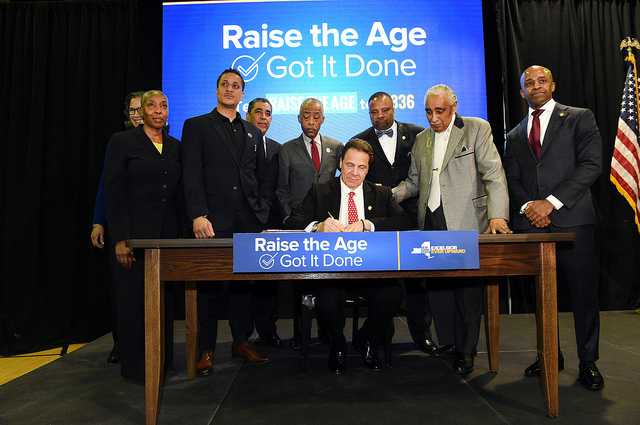
The cause for optimism that far fewer youth are involved with adult courts stems from the fact that almost every state — including Michigan, North Carolina, and New York — have raised their age to 18. Only four states currently consider all 17-year-olds to be adults: Georgia, Louisiana, Texas and Wisconsin.
Raising the age doesn’t bring the number of youth in adult court to zero, of course. But in this report, the nature of the cases in those three states versus the other 20 suggests the total will go way down. Sixty-four percent of the adult court cases in the three states were associated with misdemeanor charges. By comparison, just 34% of the cases in the other 20 states were misdemeanors. And about 30% of the adult court cases in those 20 states were for driving-related offenses (not felonies or misdemeanors), far more than in the three others.
Translation: As those three states move to a process where it has to be a decision to charge youth as adults, there is every reason to think that action will be taken less frequently.
Correction: This column originally stated that BJS did not issue a press release about this report, but a “publication advisory” was issued on the agency’s News Releases page online. Youth Services Insider apologizes for missing it.