
Life changed fast for Cadijah.
After her husband died last year, she suddenly found herself with six grieving children to raise on her own.
New York City can be an unforgiving place for those who don’t have much. She made a tough decision: to uproot her children from all they’d ever known and head to Atlanta, nearly 900 miles away, in the dead heat of August. At least her family would be there to offer support, she thought.
But her plans quickly unraveled. Finding a job proved difficult, and her relatives were barely getting by themselves. Soon, Cadijah and her children were homeless, alternating between living out of their car and spending the little money they had on overpriced hotels to avoid the streets.
Cadijah’s struggles offer a glimpse into a growing reality for families in Atlanta. A Point-in-Time survey published this summer sought to capture the state of homelessness in the city. It revealed that unhoused families increased by 14% over the past year, even as overall homelessness numbers have held steady. The survey was carried out by volunteers who canvassed Atlanta’s 243 neighborhoods and recorded what they saw for themselves on Jan. 27.
A mixture of skyrocketing rents, stagnant wages, scarce affordable housing and limited access to child care is fueling housing insecurity for families, say those on the frontlines of the effort to meet the growing needs of these parents and their children.
“I wasn’t surprised by the numbers,” said Jannan Thomas, executive director of Nicholas House, which has sheltered more than 13,000 families like Cadijah’s for the past 40 years.
“The numbers could be higher,” she added. “As housing costs rise faster than incomes rise in Atlanta, there’s going to be more and more families that are pushed over the edge.”
The annual Point-in-Time Count is conducted nationwide each January. It provides a one-night snapshot of both sheltered and unsheltered people experiencing homelessness. The survey is required by the federal government to receive critical funding for homeless services and helps cities gauge the scope of the crisis.
Nationwide, last year’s Point-in-Time Count showed that family homelessness is increasing faster than any other group, rising 39% between 2023 and 2024. Close to 150,000 children were experiencing homelessness during the 2024 count, a 33% increase from 2023.
San Francisco, a city frequently excoriated for its troubles with homelessness, saw the number of unhoused families jump by 94% between 2022 and 2024. The results spurred an 18-month pilot project announced earlier this year to provide financial assistance, employment support and other resources to help families stay housed.
In Atlanta, the number of unhoused families typically ranges between 130 and 150 year to year, said Cathryn Vassell, CEO of Partners for HOME, the nonprofit that conducted the city’s annual count this year. The 2025 increase amounts to about 15 additional families compared to last year. It’s not a dramatic surge, Vassell said, but these results don’t tell everything. She knows that local shelters are seeing growing demand for their services.
“If you talk to some of the family shelters, they’ll say the need is much higher because they base it on the number of phone calls they get,” she said.
There are also limitations in the Point-in-Time methodology that may mask the true number of affected families, Vassell said.
Only two families were found living on the streets. Most families experiencing homelessness were identified as living in shelters, and about 30% were in transitional housing, the report shows.
Families awaiting placement in shelters or housing aren’t counted.
“They’re not going to catch the person who’s staying on this friend’s couch, and then they’re maybe in the car for a couple of nights because people don’t have space for them,” Thomas said. “All of that isn’t captured very well.”
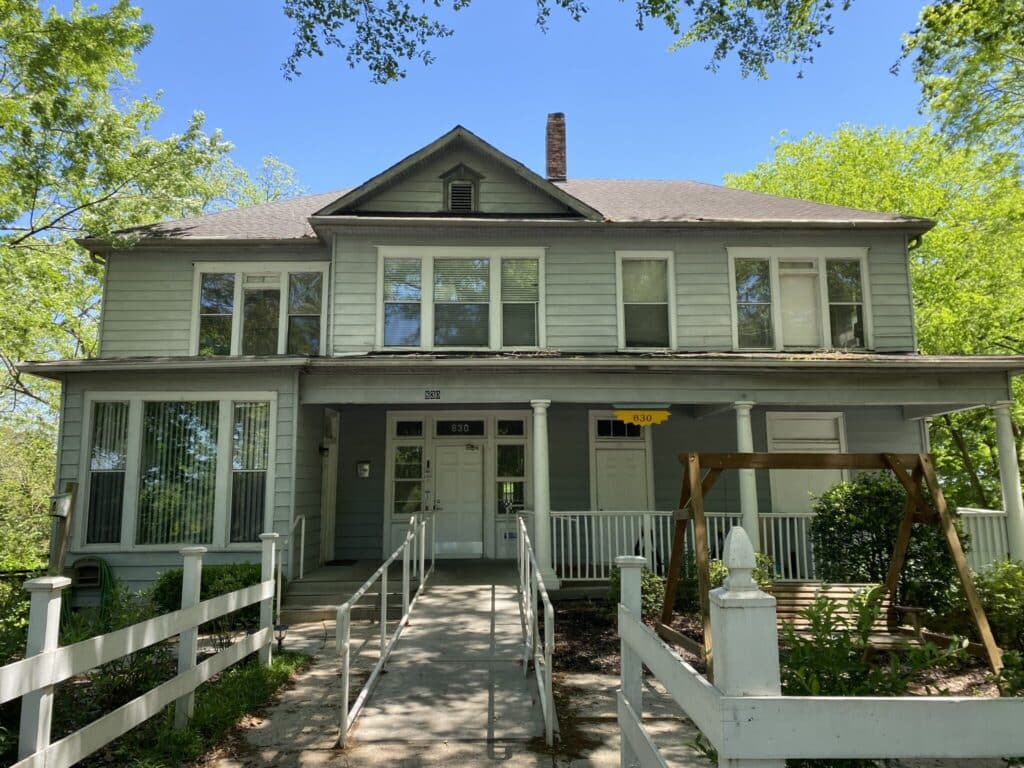
Currently, there are six family shelters in Atlanta according to Partners for HOME. Nicholas House is one of a few that accepts all sizes and configurations — single or two-parent families, or multigenerational households headed by grandparents or siblings. Residents can see the sprawling green of the city’s oldest park from the windows of the faded blue Craftsman-style home.
The wait to secure a room in the Nicholas House wasn’t easy for her family, said Cadijah, who had two teenagers, aged 17 and 16, and two sets of twins, aged 10 and 7 at the time The Imprint interviewed them at the shelter.
“We had to be outside, sleeping in the car, waiting for the moment to be approved to get here,” said Cadijah, who asked to be identified by her first name only for privacy.
Built as a single-family home back in 1904, the Nicholas House has room for up to 12 families, or 50 people, at a time. Cadijah and her six kids took the largest room available.
The goal among staff at the Nicholas House is to help families move into more permanent housing within 60 days.
But stays at the shelter are frequently extended for families, said Justin Floyd, Nicholas House’s volunteer and shelter manager. Jobs and affordable housing are hard to come by. Rent in Atlanta has increased by more than 40% in the past five years.
A recent report from the National Low Income Housing Coalition found that a minimum-wage worker in Georgia earning $7.25 per hour would need to work 163 hours per week, or hold the equivalent of four full-time jobs, to afford a modest two-bedroom apartment.
“Most of our families, all of them, have some kind of income, and most of them work.” But, he said, “they may not have a job that pays enough to afford the market rate rent. Rent is so high across the whole city, and that’s a struggle for everyone.”
Floyd acknowledges that a shelter is never the place a family wants to be. The Nicholas House is due for a renovation, he said, but staff strive to make residents as comfortable as they can.
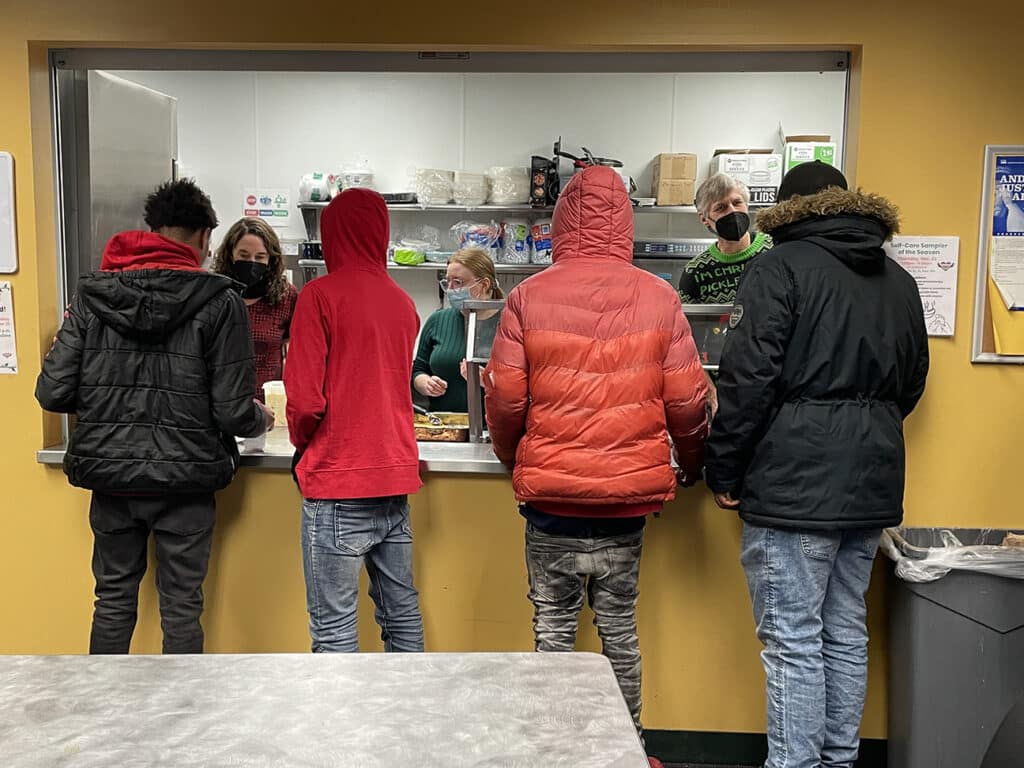
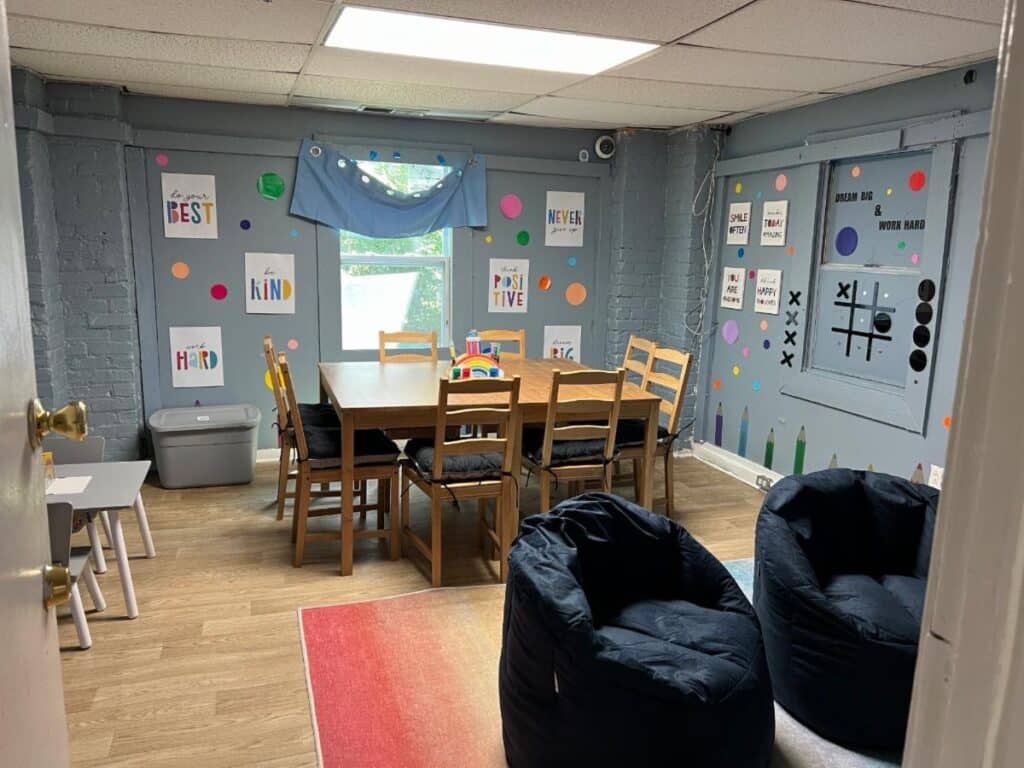
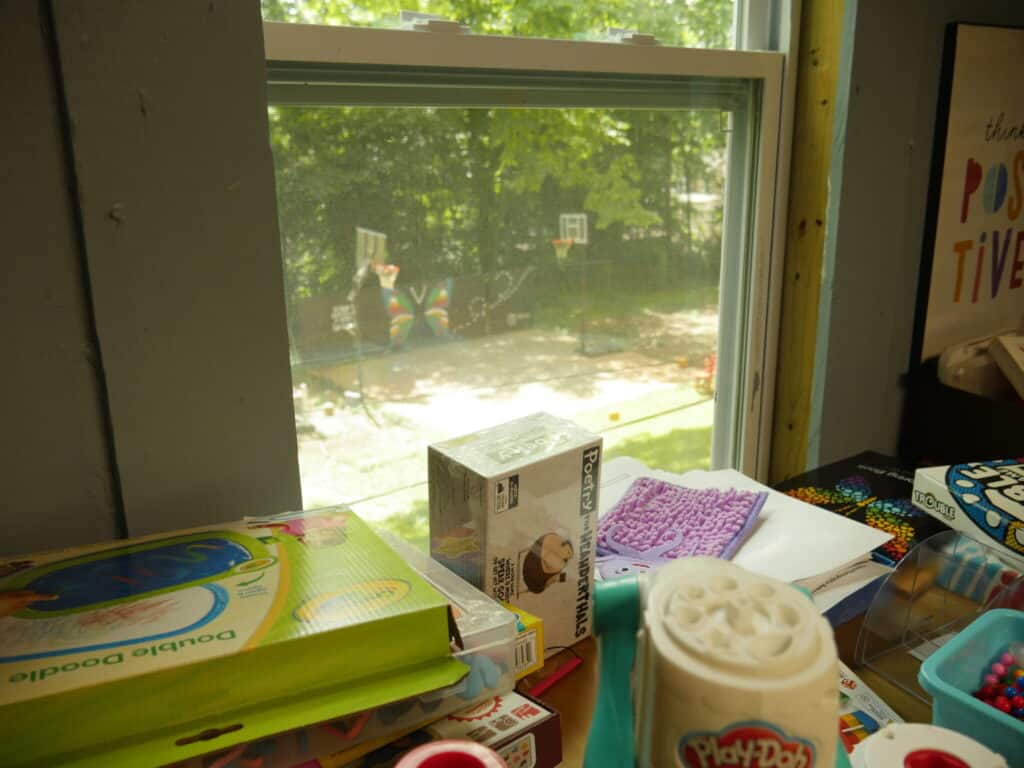
The shelter hosts communal meals every day and two playrooms are filled with children’s books and toys. There are weekly art and parenting classes. And the outdoor basketball court is a favorite spot for teenagers to hang out, Floyd said.
He believes that the Nicholas House offers families a “sense of grounding.” It’s not a forever home, he said, but at least “you’re sleeping in the same place each night.’’
“The car isn’t having to change parking spots or parking lots,” he said. “You know what your meal is going to be. It may not be the healthiest thing in the world, and we have a little too much fried chicken around here for my taste, but it still is a solid meal. It’s going to be here at six o’clock every night. You have that little bit of reliability.”
New city, new experience
For Cadijah, everything that was reliable in her world came to an end last year after her husband traveled to Bamako, the capital city of Mali in West Africa. It was a routine trip to see family, but he fell critically ill during his visit and never returned home, she said. From so far away, she could not gather many details. She said she did not even learn his official cause of death. She and her children watched his burial from a phone screen.
The move to Atlanta several months later added a world of new for Cadijah’s family: new schools, a new city without their familiar bodegas and subways; the new experience of not having a home. Now, summer days stretch long inside the Nicholas House, where Cadijah and other parents like her wait — for a job offer, a housing lead, anything to start building a different kind of life.
Four bunk beds line the light gray walls in the crowded room that serves as her family’s home for the time being. Everything must be kept as orderly as is possible in the small shared space. There are no unruly toys, and other than a scattering of small shoes on the floor and a fort fashioned from tucked blankets on a top bunk, it would be hard to tell that children lived here.
Even when children do encounter a bit of stability in a shelter like the Nicholas House, the stress and uncertainty caused by homelessness robs them of their childhoods, advocates say.
“They can’t just be kids,” said Rachel Reynolds, director of marketing for Atlanta Mission, which is the city’s oldest and largest homeless service provider. The organization has three shelters.
“When they come in, they have real, big-person, adult worries,’’ she said. They’re worried about where they’re gonna get their next meal. They’re worried about how their mom’s doing. They’re not thinking about things normal kids are thinking about.”
There are other consequences for families. Homelessness is one of the leading causes for children entering the child welfare system. A 2024 investigation by The Atlanta Journal-Constitution revealed that homelessness was cited more than 1,800 times in foster care decisions made by Georgia’s child welfare authorities between 2022 and 2024.
Many providers, including Atlanta Mission, have tried to meet the complex needs of families by offering more than just beds. Expanded services include licensed child care, trauma-informed counseling and partnerships with schools to help kids stay on track with their education. Atlanta Mission recently hired a second full-time social worker to assist families. The organization’s newest shelter, Restoration House, opened in 2021 to meet the growing needs of women and children with expanded daytime services and 102 additional beds.
But advocates argue that prevention is the only way to address the crisis. That means building a stronger safety net: more affordable housing, easier access to child care, food security, health care and job pathways, said Vassell.
“Having a family come into a homeless system, even if it’s the most beautiful homeless shelter you’ve ever seen, I think, is not good,” she said. “The more we can focus on prevention and diversion, getting families out of the shelter system as quickly as humanly possible, the better everybody will be in our community.”
In response to the crisis, Atlanta Mayor Andre Dickens announced a $150 million plan last year that called for up to 700 new or renovated affordable housing units. It’s unclear how many of these will be available to unhoused families.
The city also formed a 90-Day Homelessness Task Force and released a final report earlier this summer outlining strategies to address the problem. Outreach to families in “vehicles, motels or unstable doubling-up scenarios’’ was identified as a priority. Helping schools and hospitals connect at-risk individuals with support services was another.
The city of Atlanta did not respond to questions about either initiative.
For Cadijah, the hunt for employment continues. She hopes that her background in customer service and food service will eventually help her secure the job she’ll need to afford housing for her family.
Though grateful for the relative stability provided by the Nicholas House, the uneasy feeling of being in a temporary situation never leaves her, she said.
“The goal is to find yourself a job, because after the certain time required they give you, they cannot give you more, you’ll be on your own,” she said. “That’s the part we’re facing.”