
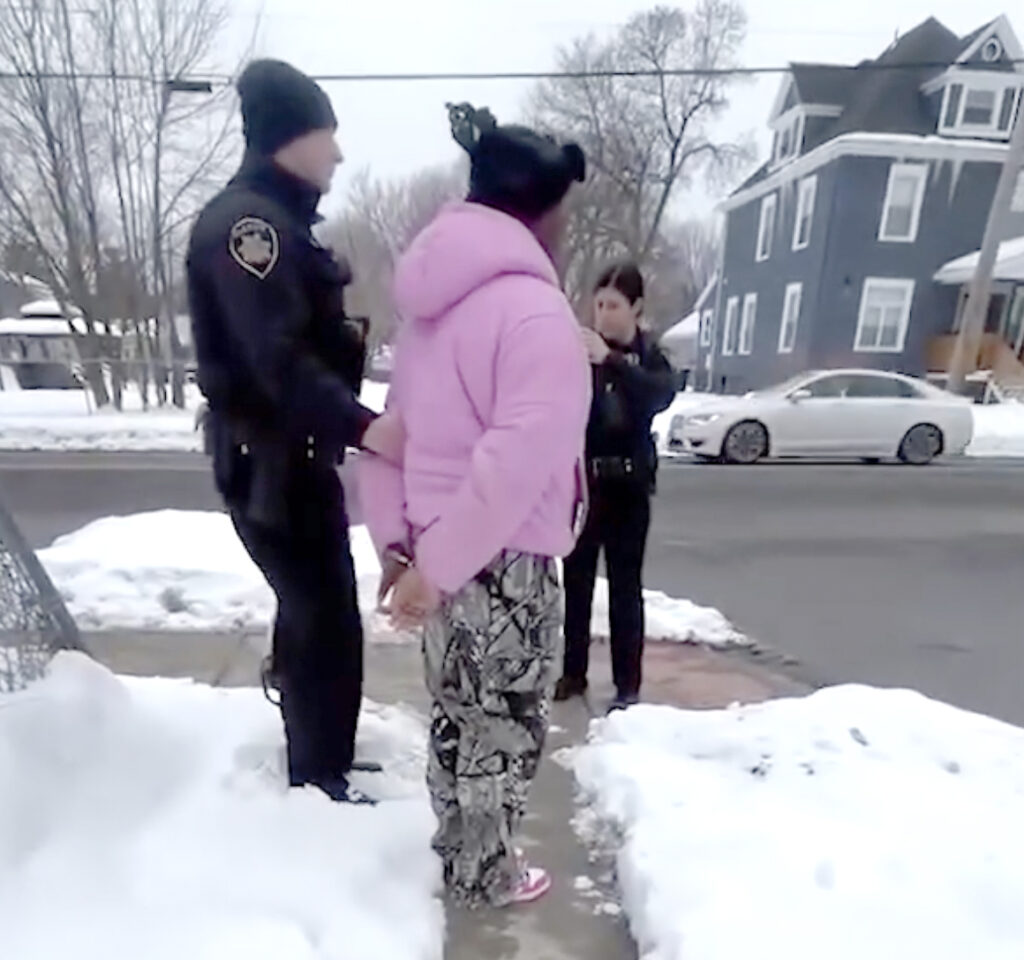
Three Black girls walking home from school on a chilly day in January stopped to make snowmen and play near their Syracuse homes before they were detained by a pair of Onondaga County sheriff’s deputies. The cops said one of the girls, an 11-year-old in a puffy pink parka, perfectly fit the description of someone who had just fled the scene of a car theft six blocks away.
A seven-minute video recorded on her cousin’s cellphone captured the astounding scene before going viral.

“You gonna lie and tell me that’s not you?” asked one deputy, showing the sixth-grader a photo of the suspect moments before asking her to get into a squad car. “If you’re honest, it’ll make it easy.”
“I feel like this is racism,” the girl’s cousin calls out. And a minute later, the deputies confirmed they had the wrong person, letting the 11-year-old go with a begrudging admission: “If it is you, you played it well today,” one said after he removed the handcuffs.
The high-profile incident is one of many similar cases in the state.
In 2020, Rochester police handcuffed a 12-year-old girl during a mental health crisis, and three months later handcuffed and pepper-sprayed a 9-year-old girl in distress. In a third case in recent years documented by a Rochester police accountability board, an officer handcuffed an 8-year-old during a child protective services call.
Around the country, other recent episodes include police handcuffing a 5-year-old in Maryland in 2021, an 8-year-old in Ohio in 2020, and a 9-year-old in Florida in 2023.
There appear to be no national data on how often this happens.
FBI files show that across the country about 40,000 children ages 12 or under were arrested in 2019, though not all arrests involved handcuffs. In Indianapolis, police handcuffed 160 children and youth younger than age 16 during an 11-year period, according to a 2021 AP report. That investigation noted that Black children made up more than half of those who police handled with force, though they’re 15% of the U.S. child population.
In 2021, New York enacted a law barring the arrest and prosecution of children younger than age 12. But they are still subject to “Terry stops” — named after John Terry, who in 1966 challenged his conviction on a weapons charge after police stopped and frisked him without a warrant. Such stops are brief detentions that are not considered arrests, in which an officer has reasonable suspicion of criminal activity.
In the case of the Syracuse girl, the interaction lasted just over seven minutes. But more than four months later, a church leader who knows the girl and her family said the incident has led to ongoing difficulty.
“She said to me, ‘The one thing that my mother would allow me to do is to walk home from school, and now I’m afraid to do it,’” H. Bernard Alex, pastor at the Victory Temple Fellowship Church, told The Imprint. Instead, the Syracuse City School District sends a van to pick her up and drop her off.
Such lasting impacts are not unknown among youth advocates, who have long decried the criminalization of children.
“Nothing that shows up on the video suggests to me that it was reasonable to put handcuffs on her, and then it doesn’t seem reasonable to leave handcuffs on her the entire time.”
— Lauryn Gouldin, Syracuse University College of Law
The Onondaga sheriff’s department didn’t respond to The Imprint’s requests for an interview.
But in a Jan. 14 press release subtitled “Why would we handcuff this child?” a department spokesperson stated that police do not always know a “detainee’s” age, and “handcuffing juveniles in this circumstance is lawful, within policy, and common practice in law enforcement.” The practice is also necessary, the spokesperson said, to prevent “a controlled situation from devolving into an uncontrolled situation; ultimately preventing altercations, force, and potential for injury.”
That said, after meeting with the girl’s mother, Onondaga County Sheriff Tobias Shelley pledged to have his department notify a parent or guardian if a child is detained, no matter how brief the encounter.
To understand the legal issues involved in the January stop, The Imprint spoke with Lauryn Gouldin, a professor at the Syracuse University College of Law. Gouldin teaches constitutional criminal procedure, evidence and constitutional law.
In two interviews, she addressed the Syracuse incident and what sound police practice might look like regarding the restraint of children during Terry stops.
Protecting children from harm is among her considerations as she pursues research on the topic.
“We’ve got a population who we think is at greater risk of trauma from being handcuffed in an interaction with a police officer,” Gouldin said. “I would want a greater justification for using handcuffs in an interaction like that. There should be an elevated set of protections when you’re talking about children.”
The following interview has been lightly edited for clarity and length.
The Onondaga Sheriff’s Department says it routinely handcuffs all suspects because “detainees may become uncooperative, may decide to flee, or may decide to fight. In some cases, detainees may be armed or have contraband/evidence they will try to destroy.” In your opinion, how does such a policy of automatically handcuffing children square with current law?
It violates the Constitution to have a policy of automatically handcuffing suspects without identifying specific things about the circumstances or the suspects that would justify the use of handcuffs. That’s an obvious constitutional problem with what happened in Syracuse.
That’s not to say that it’s the most important problem, because I think handcuffing a young Black girl in this situation is a really big additional piece of what drew local and national criticism. But it’s pretty straightforward that for adults or children, automatic handcuffing from the beginning of a stop is an excess of caution that violates the Constitution.
Does the fact that this child was handcuffed for only seven minutes make any legal difference?
There are two decisions when you think about the use of handcuffs during a stop. There’s the initial decision to use handcuffs, and then there’s the ongoing decision to continue using handcuffs for the entire stop. Both of those things have to be justified.
That’s where the video in this case is helpful. You have a child who’s completely compliant. Her friends are trying to be cooperative. They’re all answering questions. They look scared. They don’t look threatening or like they don’t plan to follow the directions of the officers. The officers are having a friendly exchange with the children.
As you watched the video of the Syracuse girl being arrested, what should have happened, in your view?
The piece that I don’t have is details about the underlying crime. It sounded to me like a car theft, and I don’t know if there was any allegation of use of weapons or anything like that. So that might change things a little. Based on the similarities in the clothing and the general description as I understood it, it didn’t seem unreasonable for the officers to want to talk with the child in that situation, right?
But nothing that shows up on the video suggests to me that it was reasonable to put handcuffs on her, and then it doesn’t seem reasonable to leave handcuffs on her the entire time.
Black children are routinely assumed to be older than they are. Does constitutional law provide any tools for addressing racial bias in decisions about handcuffing children?
Good advocates are raising data from studies to argue that we can’t evaluate this without acknowledging that officers’ threat perception varies by race. Their age perception varies by race. Attorneys are making these arguments, but there’s not clear Supreme Court case law in the Fourth Amendment space that has blessed those.
The other path to making change here may not be through constitutional law arguments. It may be through trying to persuade police departments that these are problems that they want to be partners to help fix, and so internal reform, getting buy-in from leadership, is critical to actually make policy changes.
The Onondaga Sheriff’s Department maintains that officers don’t definitively know a person’s age during a stop. What’s the answer to that?
I wouldn’t say that applies in the case of the 11-year-old in January. But I think generally police officers will say that it’s a challenge for them to figure out the age of someone they’re interacting with.
The court has addressed that and acknowledged that even where the law imposes a requirement that turns on the age of the suspect, police have some leeway to make a reasonable determination. They give them some space to make a reasonable mistake.
This came up in a case called J.D.B. v North Carolina. In that context, police were interrogating a child at school who they just pulled out of their seventh-grade class, so it was pretty easy for them to have a ballpark age.
“You have a child who’s completely compliant. Her friends are trying to be cooperative. They’re all answering questions. They look scared. They don’t look threatening or like they don’t plan to follow the directions of the officers.”
What’s prevailing law enforcement practice in New York State and nationally when it comes to handcuffing children and youth? Has there been much analysis and reporting?
We’re working on a report that describes different departments’ policies.
The Syracuse Police Department policy says that a juvenile under 14 years of age should not be restrained unless they’re suspected of a dangerous felony, or the officer has a reasonable suspicion that the juvenile may resist, attempt escape, injure themselves, injure the officer, or damage property.
The International Association of Chiefs of Police says that handcuffing anyone during an investigatory stop is not considered standard operating procedure, and it’s permitted only if there’s reason to believe that physical restraint is warranted.
But overall not much is known. I hope to have some conclusions about that at the end of our project.
How should children be “detained” by police during stops, if not through use of handcuffs?
I would like more protective policies for kids, more emphasis on de-escalation before you resort to the use of handcuffs. But I believe that also should be the law for adults. So some of our work is trying to be clear on the rules for adults and then outline some ways to modify those rules when you have kids involved.
The more you require officers to be specific about the facts in a particular case, the better. First, I think it improves their decision-making in a particular moment, and it certainly improves the ability of a judge after the fact to evaluate the reasonableness of an officer’s decision.
What are the important considerations for officers involved?
I don’t want to discount that if officers see somebody who matches the description of someone who is involved in an offense that was believed to be violent or to involve the use of a weapon, those are factors that would be in the mix for justifying the use of handcuffs in a particular case. Courts also look for evidence that someone’s going to attempt to flee or evidence that they otherwise pose a threat to the officer to justify the use of handcuffs.
Also, if we’re talking about best practices for interacting with children, certainly those include things like making an effort to explain what you’re doing and why you’re doing it, and trying to get a parent or caregiver involved as quickly as possible. So contacting a parent and letting them know right away that you are speaking with their child seems incredibly important.