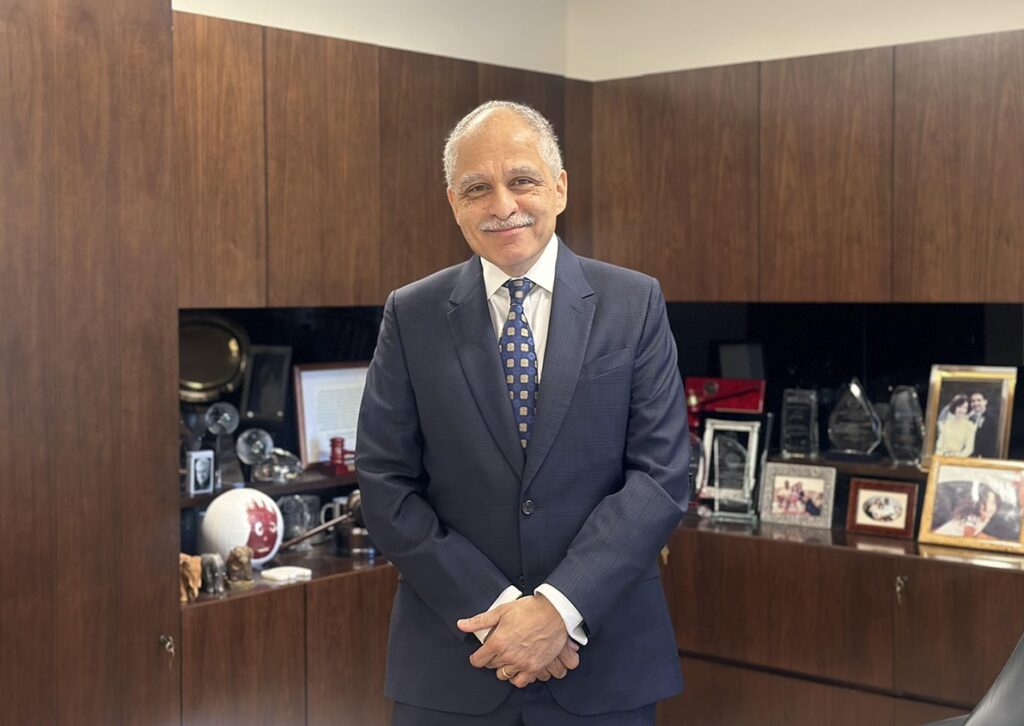
In his February State of the Judiciary address, New York’s Chief Judge Rowan Wilson spoke for only about 20 minutes about the need to reform under-resourced and overburdened family courts. Instead of continuing on, he turned the floor over to the courts’ “clients,” as he’s done in years past.
This year the speakers included a parent advocate, a former foster youth and a mom fighting for custody of her children.
Highlighting these voices and the need to better serve New Yorkers moving through the family courts has been an enduring effort by Wilson, who heads the New York State Court of Appeals. In 2024, he backed legislation seeking $102 million to hire more judges, bolster legal representation for parents in abuse and neglect cases and improve supervised visitation of foster children in resource-starved counties.
In addition to CPS cases, family courts in New York also hear the cases of young people accused of crimes. In one recent case, Wilson dissented from the majority of his fellow judges on the Court of Appeals, asserting that a teenager who participated in a violent home robbery would fare better with rehabilitative services in family court rather than the punitive measures of the adult criminal justice system.
The 65-year-old California native began his career as a corporate attorney, and later spent 21 years as board chair of the Neighborhood Defender Service of Harlem, a legal services organization known for its “holistic” approach to public defense. The nonprofit provides a team of attorneys, social workers and investigators to each client, situated within their own communities. That experience gave Wilson a unique perspective that continues to shape his administration of the state’s courtrooms.
Wilson was nominated by Gov. Kathy Hochul in 2023, and has continued the efforts of his predecessor Judge Janet DiFiore, who also fought to improve the family courts with higher pay for attorneys representing children and indigent parents, and more judges across the state to reduce backlog.
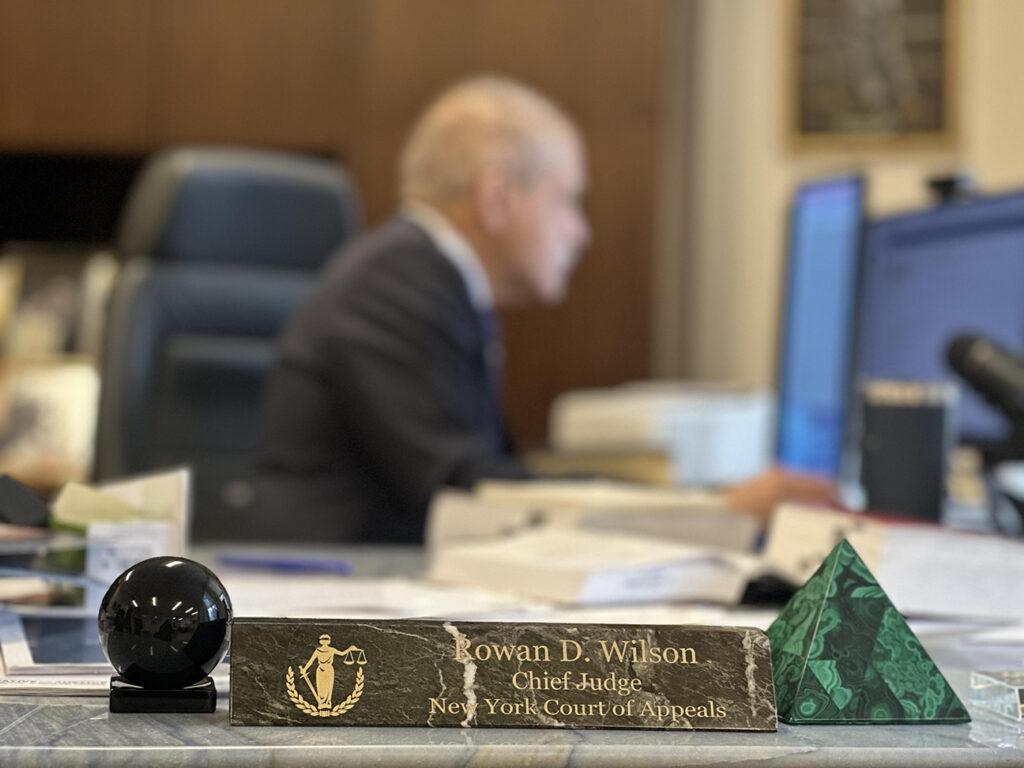
In an interview with The Imprint at his Manhattan office — the dark-wood panelling lined with awards, mementos and childhood photos of his three daughters — he described how family court judges too often prioritize punishing parents rather than helping them reunify with their children, and outlined a vision to create more equitable outcomes for New York families.
This conversation has been edited for brevity and clarity.
I’d like to begin by asking why you choose to share the floor with people involved in family court clients cases in your annual State of the Judiciary speeches?
This is not the way, to my knowledge, any chief judge has ever done this. It’s always been, get up and talk about a bunch of statistics. And as an audience member, I was pretty bored. There didn’t really seem to be a whole lot of value in just getting up and talking about statistics or how well or not well the court is doing.
An overall thing I and my team are trying to do is to humanize the court system, because we’re dealing with human beings, and they shouldn’t be treated as numbers or statistics, but recognized as people with complexities whom you need to try and help.
One such speaker at your address was Josiah Gilbert, who described his unstable journey through the foster care system and how his case languished in family court for years. Gilbert called the group home he lived in a “warehouse for children” and said “if families are given access to resources before the crisis escalates — affordable child care, educational support, housing stability, financial assistance, mental health care, youth-centered services — many cases like mine would never enter family court at all.”
You also cited a report stating that 75% of the family court cases result from poverty.
How common is Josiah’s experience?
I don’t think it’s uncommon at all. And his central point is a really important one, which is that the basic failure of the state, not just New York state, is the failure to provide support and assistance to families who don’t have the means themselves to avoid them ever needing to be a family court.
“we’re dealing with human beings, and they shouldn’t be treated as numbers or statistics, but recognized as people with complexities whom you need to try and help.”
— Chief Judge Rowan Wilson
What I’ve been doing, and the Legislature has been very helpful with, is increasing the number of family court judges, the support in family court. But paradoxically, what we really should be doing is eliminating the need for Family Court, or at least reducing the need for Family Court. What we would do instead is to provide resources up front that help people with their children, with their families.
Could the courts play a role in that?
Not directly, but I can lobby for that. I meet with legislators all the time and tell them, this is where we need to focus and this is where we need help.
And the other thing in New York that makes this more difficult is that those sorts of resources are not generally provided by the state. They’re provided by counties, and so a county that feels like it wants to devote more resources can do that. But a county that feels like it doesn’t want to, or doesn’t have the resources, won’t.
In your address, you said you and your leadership team want to take the court system in a new direction, urging judges to move away from being mere “adjudicators of right and wrong” and toward being “problem solvers.”
What do you mean by that, and how will you incentivize more judges to take that approach?
We now have over 300 problem-solving courts around the state: veterans courts, drug treatment courts, mental health courts. And the message that I’ve been trying to deliver to all of our judges is that every judge should be a problem-solving judge. We should really be trying to solve problems, not just say who was right, who was wrong.
The win should be about producing the best outcome for everybody involved, and that needs a change of focus. It takes time to convince people of that, but I think that one way to do that is to allow people to see the humanity of the people they’re dealing with — by letting people explain, even if it’s briefly, what’s happened to them, who they are, and what could have helped, what could have been different.
The public has many misconceptions about foster care and the child welfare system. From a judicial officer’s perspective, what are some of the most misunderstood aspects?
There are a few. One is that unless you are sort of putting your child in danger by abusing the child or something like that, your child can’t be taken away from you. That’s not true. You can lose your child for various reasons, a lot which have to do with poverty.
If you’re middle-class and you’ve got a child who shoplifts something, you’ll take care of that — you’ll go to the store, you’ll deal with the person, you’ll pay them, and the thing is never going to wind up in the criminal justice system. If not, your child is apprehended, and things start to snowball. You may be in public housing, and the fact that your child is found with a small amount of marijuana — not any longer, but previously — may then disentitle you from public housing. So now you’re in a shelter. There are all sorts of snowball effects like this that disproportionately affect poor people and result in their children being taken away.
Another aspect that is misunderstood is how long family court proceedings can take. It really surprised me as a trial lawyer. It could take a year and a half to conclude a trial in family court, which we’re really working to change.
In your February address, you laid out the persistent challenges faced by New York’s Family Court system: excessive caseloads, racial discrimination and a general lack of resources. As head of New York’s highest court, are there any legislative changes you want to see that would help support changes at the judiciary level?
There’s a shortage of lawyers, and the lawyers who do family court work for the institutional providers are generally not paid commensurately with other government lawyers. And they really should be. And there’s a lot of turnover — you lose experienced people because they go find other things to do.
We also want to try and move people into family court as practitioners, which we’re working on. The Legislature can certainly help with that, but I think the place where the Legislature can help the most is offering resources before families get to court.
You are the first person of color to serve as chief judge in New York. And although you currently lead the most diverse seven-member panel of Appeals Court judges in state history, that is not reflected in all counties.
How do you feel a lack of diversity on the bench affects the quality of justice for litigants, who in many courtrooms are disproportionately low-income Black and brown people?
Poverty and race are correlated, and even if a judge is not somebody who themselves were poor or had that kind of an upbringing, they have somebody they know — somebody in their community, in their church, among their relatives, who had some kind of issue like that. And it will give them a perspective that other people may not have.
I think where you see this problem more is upstate, where there really isn’t much diversity on the bench, partly because there are rarely lawyers of color up there in any reasonable numbers. So you have families who still tend to be poor families of color, where the judges are mostly white.
Chief Administrative Judge (Joseph) Zayas and I have really been working to help diversify the bench where we can. Obviously we don’t control who’s elected, but he can assign people different places.
We’ve discussed what isn’t working, but what improvements have been made in the family court system in New York that you can point to?
Over the last two years, the Legislature has funded us to add many more family court judges and more resources for family court, which is something that I’m really quite delighted about. There are places like Nassau County where we’ve opened up a whole new family and matrimonial courthouse. It’s large and well-equipped and intelligently designed.
But again, there are plenty of places in the state where we need more judges, but we can’t put them there because there’s no physical place to put them, and we don’t own the court system.
In an earlier profile of you I read that you were raised by parents who were both educators. Your mother, who was blind, eventually earned her Ph.D. at UC Berkeley. And you learned how to read at a young age because you would read aloud to her from the newspapers that weren’t available in Braille. Can you tell me more about how she inspired you?
Growing up, because I was the oldest of three, a big part of my life was helping another human being. I had a lot of responsibilities, and I enjoyed them. I really can’t think of anything I liked more than being able to help my mom with things. It made me feel valuable and useful. And I think that’s kind of carried on through my life. I find purpose and enjoyment in helping other people.