

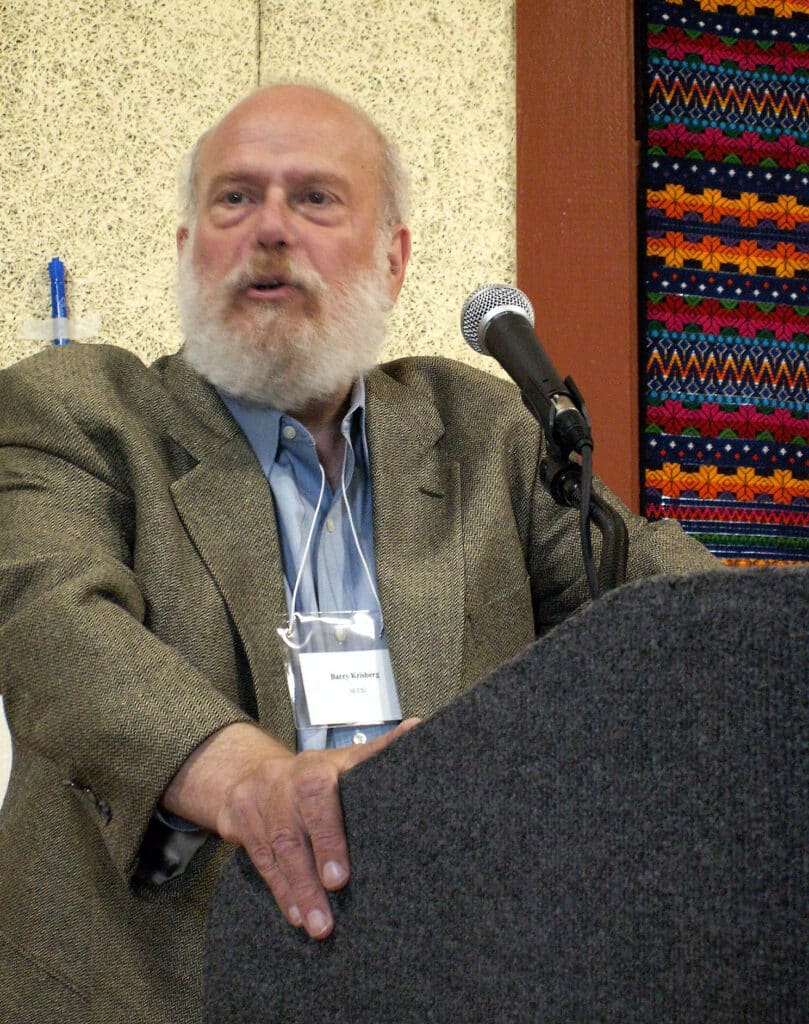
Over six decades, criminologist, reformer and tireless advocate Barry Krisberg fought to end the punitive treatment and inhumane conditions faced by young people in the juvenile justice system. Krisberg died at age 78 on Feb. 13. But his work continues to inform the overhaul of youth prisons, probation systems and rehabilitation programs across the country, say those who mourn his passing.
A burly, bearded fellow who could be as warm as he was unsparing, Krisberg was known for building consensus among diverse factions. He worked closely with judges, members of Congress, justice reformers, foundation presidents, correctional officers and state lawmakers in legislatures across the country. Former colleagues described him as measured and careful in his analysis, but always direct.
“He was someone who had the unique ability to tell people they were being jerks without losing them,” said Bart Lubow, a prominent longtime juvenile justice expert.
Krisberg began examining justice reforms in the 1970s, and became a lonely voice in the ensuing decades by pushing back against policies that had locked up tens of thousands of young people nationwide and condemned disproportionate numbers of Black and brown youth. Decades ago, the approach to youth who committed crimes centered on politically expedient lock-’em-up policies, not the mental health treatment, diversion and education focus that justice systems increasingly aspire to today.
A nationally recognized expert, Krisberg was on the vanguard of this nation’s most notable and substantive juvenile justice reforms, including the overhaul of the California Youth Authority — a once-sprawling network of Dickensian institutions that has now been completely shut down. He also studied and popularized the landmark closure of the Massachusetts Training Schools, showing it was possible to close large institutions without sacrificing public safety. In another reform that influenced systems change nationwide, Krisberg advised officials closing dozens of New York state youth prisons. Thousands of youth accused of crimes in New York City are now housed in brownstones near their homes.
Young people’s experiences, directly relayed, were essential to Krisberg’s work. He interviewed hundreds of incarcerated youth while writing reports and researching effective reforms.
“I built my career on talking to violent and disturbed adolescents,” Krisberg told The Imprint’s contributing writer Nell Bernstein in a lengthy interview last year. “I was good at that, not because I was hip or sharp; it was the opposite.”
Recalling his early interviews at the California Youth Authority’s network of state prisons — where some kids were locked up for 23 hours a day and housed in cages — he recalled their reactions.
“I was just this naive guy who had a beard and looked funny,” Krisberg said. “The kids would talk to me, and I got them to trust that I would go out and tell people exactly what they’d said.”
In the early 2000s, when serious reforms were first being examined for the California Youth Authority, Krisberg realized state administrators had little idea what was actually happening inside. When directors would come and go from the Youth Authority, he made sure to take each new appointee on a tour of the facilities so they could see firsthand the disturbing conditions.
“They’d be skeptical,” Krisberg recalled, “but then they’d see with their own eyes.”
Krisberg grew up as one of two kids in Sheepshead Bay in Brooklyn, New York. His parents, Hyman and Gertie, owned a candy store and soda fountain near Coney Island.
Krisberg attended the University of Pennsylvania as a math major, before turning to sociology. Professor Thorsten Sellin, a pioneer of the use of statistics in studying crime and punishment, was among his early inspirations. Krisberg went on to earn a doctorate from the university in 1971.
In 1977, he joined the nonprofit National Council on Crime and Delinquency (now known as Evident Change), a research and advocacy organization. He served as its president for 27 years starting in 1983. After retiring, Krisberg found a professional home at the University of California, Berkeley, School of Law and as the director of research and policy at the Chief Justice Earl Warren Institute on Law and Social Policy.
Over more than a half century, he authored hundreds of articles, books and evaluations on a variety of topics, including the death penalty, prison overcrowding and community violence prevention. The fate of young people in the juvenile justice system — particularly those locked up in brutal institutions — remained a particular focus.
UC Berkeley Law School colleagues Malcolm Feeley and Rosann Greenspan describe Krisberg as “a giant among giants.” In a March blog post, they recounted his testimony before a house subcommittee: He urged legislators not to allow states to lock kids up with adult offenders. “He was an avid talker, and prolific writer,” Feeley wrote in an email. “But above all, he was a doer.”
From the start of his career, Krisberg opposed placing children in penal institutions. At a time when “evidence-based practices” had not yet become vogue, he advocated for the use of data to inform public policy, and evaluation to dispel myths perpetuated in the public about crime.
“He deserves a lot of credit for having a spine. … It was a period in which the very existence of the juvenile justice system was at risk, and those most intimately involved in it were not doing a very good job of defending it or of introducing innovations that could counter the criticism that was raised.”
— Bart Lubow, juvenile justice expert
Part of that work involved studying the 1970s juvenile correctional reforms in Massachusetts, where a visionary leader of the state’s Department of Youth Services, Jerome Miller, had closed all the juvenile correctional facilities. When hundreds of teenagers were placed in community-based programs instead, Krisberg’s 1991 evaluation found the shift had reduced recidivism rates.
Krisberg’s research couldn’t have been easy to pursue decades ago. Bolstered by the work of sociologists James Q. Wilson and John J. DiIulio, Jr., the country seemed hell-bent on harsher penalties for young people arrested by police, even when such practices did not improve public safety. Racist stereotypes of Black and brown youth in the media demonized children of color, furthering the injustice.
Friends and colleagues noted that Krisberg stood up for a very different vision of juvenile justice — in an era when the idea of moving kids out of lockups and into community-based settings was a rarity. Krisberg’s ideas would eventually take root in the largest juvenile justice systems in the country. But longtime justice reformers remember being dismissed in those early days, or in some cases, being ridiculed for suggesting alternate approaches.
“He deserves a lot of credit for having a spine,” Lubow said. “It was a period in which the very existence of the juvenile justice system was at risk, and those most intimately involved in it were not doing a very good job of defending it or of introducing innovations that could counter the criticism that was raised.”
For justice advocates in California, Krisberg is best known for his role in documenting conditions in the state’s inhumane, violence-plagued youth prison system, setting it on a path toward eventual closure. Krisberg joined other justice experts in the early 1990s to seek reforms. And after the nonprofit Prison Law Office sued the state in 2003, Krisberg was enlisted to assist. At the behest of California’s then-Attorney General Bill Lockyer, Krisberg toured the facilities, talking to more than 100 incarcerated youth, as well as frontline staff and agency leaders. The impact was profound.
“Once I saw them, I wanted everybody to know about it,” Krisberg told Bernstein last year.
His final 2003 report was widely shared among state legislators, advocates and journalists — and is still cited to this day.
“Imagine a medieval horror story, that’s what the cells looked like,” Krisberg said in the interview. “I remember kids being chained to walls, like handcuffed to rings in cells. There was a general denial of education. Many of the kids hadn’t been to school for a long long time, if ever.”
Krisberg also documented “stunning” levels of violence and “an intense climate of fear” among youth housed in the state’s correctional facilities. The excessive use of force by staff contributed to the unsafe environments. Mental health care was a central focus of his work, and at the time it was dismal — although the needs were acute.
“He was so good at talking to the kids held in the facilities. … When he put all that information from young people into court reports, that kept the California Youth Authority in the spotlight and gave us leverage to insist on reforms to improve conditions there.”
— Sue Burrell, ATTORNEY AND youth justice advocate
Dan Macallair, executive director of the San Francisco-based Center on Juvenile and Criminal Justice, noted the significance of Krisberg’s “General Corrections Review of the California Youth Authority” report.
“When you read that report, it dispelled any notion that these facilities were a place of rehabilitation,” Macallair said. “It created this irrefutable body of evidence about what conditions were like in the Youth Authority.”
Krisberg did not stop at writing reports. He was a regular presence in the California state capitol throughout the 2000s, using his persuasive speech to highlight dangerous conditions inside the aging, adult prison-like warehouses.
In 2004, the California Youth Authority was placed under court oversight through a consent decree. Krisberg was among the court-appointed experts tasked with making regular visits to the prisons and documenting progress through reports submitted to the bench.
“Anytime you investigate a state institution, it’s difficult to get information,” said Don Specter, the former longtime executive director of the Prison Law Office. “Barry knew where to look and what to look for.”
Sue Burrell, a youth justice advocate who also worked to address failing conditions inside California’s youth prison system for more than 30 years, recalled that Krisberg’s focus on the experiences of young people held there were critical to pressuring the state to make needed changes.
“He was so good at talking to the kids held in the facilities,” Burrell said. “When he put all that information from young people into court reports, that kept the California Youth Authority in the spotlight and gave us leverage to insist on reforms to improve conditions there.”
During 12 years of court oversight, many of these decrepit California facilities — some of which dated back to the 19th century — were closed. Then, in 2020, Gov. Gavin Newsom shut down the state’s last three remaining youth prisons, citing new fiscal pressures and the system’s poor record of rehabilitation.
By that time, a new approach toward working with teenagers in the justice system was taking root in California and elsewhere in the nation. Alternatives to incarceration, and housing youth who’ve committed crimes in smaller, more “home-like” settings is now far more widespread than when Krisberg first proposed it.
Krisberg nurtured these reforms, including New York’s shuttering of 23 state-run youth facilities and the creation of the city’s Close to Home program. Krisberg assisted former Office of Children and Family Services Commissioner Gladys Carrión in that endeavor, earlier on in her tenure, later becoming a trusted mentor and adviser.
Carrión credited Krisberg with preparing her for a daunting job that brought plenty of backlash.
“I didn’t know a damn thing about juvenile justice, but I became an expert in a really short period of time, thanks in part to Barry,” she said. “Barry was one of my first partners and collaborators, whether that was cheering me on to do the craziness that I did or connecting me to the right research.”
During her time in charge of New York’s juvenile justice system, Carrión described Krisberg as a coach, helping her think through ideas, identifying best practices and making introductions to other leaders working to close youth prisons.
Years after her career as a public servant ended, Carrión continues this work.
“Now I do a lot of what Barry did for me by encouraging others,” she said. “Yes, it is possible to build community programs and alternatives to incarnation. Like he would say to me — leadership always matters, and be courageous.”
Barry is survived by his wife Karen McKie; their sons Moshe and Zaïd, and two granddaughters. A celebration of his life will be announced at a later date, according to family members. Donations are requested in Krisberg’s name to the Berkeley Public Schools Fund or a charitable organization of the giver’s choice.
Nell Bernstein contributed to this report.