
Describing people trapped “in a cycle of poverty and punishment that can be nearly impossible to escape,” federal justice officials are calling on states to eliminate fines and fees that parents have to pay when their children get in trouble with the law.
A report released late last year by the U.S. Department of Justice critiques punishing practices in much of the country that saddle low-income families of minors who’ve been arrested with weighty financial burdens. Everything from court-appointed attorneys to ankle monitors and probation supervision can be charged to the accused minor or their family — even the cost of time spent in juvenile hall. Fees that can amount to thousands of dollars per case disproportionately impact Black and brown families.
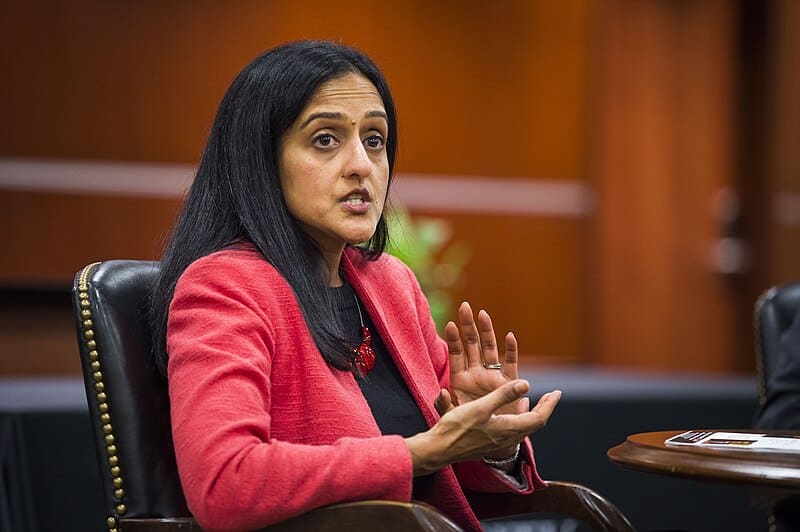
In a letter outlining the report’s findings, Associate Attorney General Vanita Gupta calls on states to take corrective action.
“Eliminating the unjust imposition of fines and fees is one of the most effective ways for jurisdictions to support the success of youth and low-income individuals, honor constitutional and statutory obligations, and reduce racial disparities in the administration of justice,” Gupta wrote.
‘Untenable choices’
Social justice activists have called for such action since 2021, when a coalition of prominent youth advocacy groups launched the Debt Free Justice campaign.
The group championed the voices of young people like Dante Bristow of Wichita, Kansas. He first entered the juvenile justice system at age 13, after getting caught trying to steal groceries because his family’s food stamps had run out. That led to years of even greater economic hardship, exacerbated by the fees that piled up following his arrest.
“I was young, I couldn’t pay for my ankle monitor. I went to jail, because I couldn’t pay for my ankle monitor,” he said in an interview with advocates. “And then they let me back out again on my ankle monitor that I couldn’t pay for.”
Bristow grew up with a single mother who struggled to afford her family’s basic needs. He estimated he’s been fined roughly $15,000 for his criminal charges — a tab he’s still working to pay off 10 years later, he said.
The Justice Department report calls on states to end predicaments like the one Bristow faces. It also highlights different approaches state and local governments have taken — with bipartisan support from elected officials — to promote accountability among youth and recoup lost revenue once fees are eliminated.
“Eliminating the unjust imposition of fines and fees is one of the most effective ways for jurisdictions to support the success of youth and low-income individuals, honor constitutional and statutory obligations, and reduce racial disparities in the administration of justice.”
-Associate attorney general Vanita Gupta
The November directive follows a letter the Justice Department sent last April to state and local officials that detailed constitutional and public policy concerns related to low-income adult and juvenile offenders, who find themselves with court system-related debts that hobble their futures.
“When fines and fees are assessed against juveniles, the consequences to youth and their families can be particularly acute, with the potential to push young people further into the criminal justice system, drive children and their parents into debt, and put considerable strain on familial relationships,” Gupta underscored. “In many cases, unaffordable fines and fees only undermine public safety by impeding successful reentry, increasing recidivism, and weakening community trust in government.”
She called those results “harmful and counter-productive.”
Youth who are unable to pay court-imposed fines and fees must lean on parents and guardians, many of whom are already struggling financially. These parents “may face untenable choices between paying court debts or paying for the entire family unit’s basic necessities, like food, clothing, and shelter,” the report states.
A 2017 study cited by federal officials goes further, revealing a public safety issue: “a strong positive correlation between monetary sanctions and youth recidivism.”
Promising practices
According to Debt Free Justice, nine states have either never charged juvenile fines and fees, or they have fully abolished them: New York, Washington, Oregon, Montana, New Mexico, Illinois, New Jersey, Delaware and Maryland. Another eight states have reduced the costs, including Texas.
California’s “Families Over Fees Act,” passed in 2020, eliminated 23 categories of criminal legal system fees, including charges for public defenders, arrests and bookings, parole and probation supervision, home detention, electronic monitoring and work furlough programs. The legislation wiped out all outstanding balances on previously assessed fees in these categories, rendering them uncollectible.
Washington, like California, has also cleared more than a million dollars of outstanding debt.
A growing number of states appear to be passing similar reforms. Earlier this month, a Nebraska legislator introduced a bill that would presume all children through age 18 to be indigent, exempting them from fees resulting from criminal justice involvement. The practice is among those recommended by federal officials.
“Our justice system — and particularly our juvenile justice system — should operate to promote safety, rehabilitation, and meaningful accountability without regard to an individual or family’s wealth or lack thereof,” bill author Sen. Wendy DeBoer told The Imprint.
“I went to jail, because I couldn’t pay for my ankle monitor.”
-Dante Bristow of Wichita, kansas
DeBoer said she has reviewed data showing “immense disparities” in state practices across the country on how fines and fees are levied. She has also heard from youth and their families about the barrier they created on the “path to rehabilitation and moving forward in their life,” she said. “We shouldn’t have a system where a family’s inability to pay a filing fee keeps a child on probation or from having their record sealed.”
In its latest missive on the practice, the Justice Department’s Office for Access to Justice — a standalone agency with a mission “to ensure justice belongs to everyone, not only those with wealth or status” — has compiled a list of promising practices across the country. They include ending the incarceration of people for failure to pay fees; lifting debt-based driver restrictions, discharging debt and repaying fines and fees that were unlawfully collected.
The Justice Department report calls on states to end the practice of charging families for children’s incarceration, actions taken by Los Angeles County in 2009 and Washington state in 2022. The report also highlighted alternative approaches to fines, including options to complete community service in lieu of paying. But the authors noted that such practices can be unfairly burdensome if they require youth to miss school or work, or result in diversion program fees.
‘Hurting the entire family’
Lynn Ausley’s family is among those affected. Her son was arrested in Washington at 15 for being behind the wheel of a car that was involved in a fatal drive-by shooting, she told Debt Free Justice. His parents were charged $250 per month for his eight years of incarceration, amounting to $24,000. That did not include restitution costs.
“I feel like sometimes, the community or system thinks that they’re just hurting the person that’s incarcerated,” Ausley told Debt Free Justice. “They’re actually hurting the entire family and the generation after that. I feel the system is punishing the family when we’re already being punished.”
Studies have found that eliminating just some of the fees youth offenders are charged has a profound effect on families’ financial health. In Alameda County, where it once cost $300 just to request a public defender, families saw a 70% cost reduction after 2016, when the county stopped charging fees for legal representation, probation supervision and incarceration, according to a California Policy Lab research brief. The average fee per case dropped from $2,200 to $670 after the policy change.
A UC Berkeley School of Law report published in 2016 revealed the need. Children’s arrests were resulting in families being forced to choose between paying the debt or covering basic household needs: A grandmother who owed detention fees nearly gave up her guardianship of a child, and a teen on probation who had accrued debts considered living on the streets to spare his family the financial burden.
Leah Gasser-Ordaz, a youth justice policy expert at the University of California, Los Angeles School of Law said she was pleased the Justice Department is highlighting innovative approaches — and she hopes other states take note.
“States that have been moving in the right direction with regard to eliminating fines and fees, will most likely look to this report, and hold it up and say, there’s some really good ideas in here that maybe we haven’t implemented yet,” Gasser-Ordaz said. “Other states that maybe aren’t as progressive as California, it would be hard to say whether a DOJ report would necessarily have that effect and benefit.”