
Legal advocates for New York’s incarcerated youth filed a lawsuit Monday alleging the state failed to release potentially vital safety policies governing its locked facilities, in violation of public records laws.
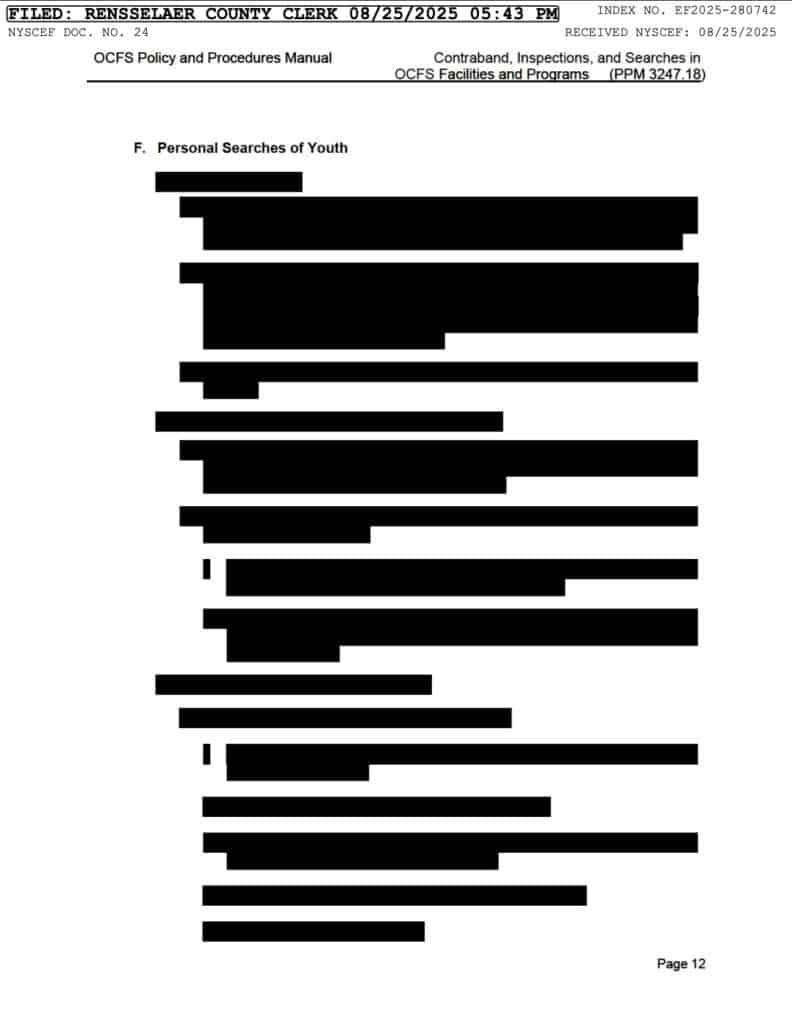
In court documents filed in upstate Rensselaer County, New York City’s Legal Aid Society also alleges that the Office of Children and Family Services (OCFS) has illegally redacted documents it has released.
Among the redacted sections — covered over in solid black — are descriptions of what staff must do when a “Duress Alarm” sounds, which is used in cases of “imminent risk of death or physical harm and no other method of summoning assistance is available.” Another blacked-out protocol involves “Code Yellow” security emergencies. Those come into play when there is “an immediate, significant threat of injury to another person” or to the security of the facility.
“OCFS not only denied responsive information through its broad and unjustified redactions,” the lawsuit states, “but also withheld potentially more than fifty responsive policies and procedures, with neither identification nor explanation.”
As a result, Legal Aid is seeking a judge’s opinion on whether the withholding violates the state’s Freedom of Information Law — as well as a court order to provide the policies sought.
A spokesperson for the Office of Children and Family Services said in an emailed statement that it does not comment on active litigation, but defended her welfare agency’s overall approach to informing the public about its work.
“The New York State Office of Children and Family Services (OCFS) provides the highest levels of public transparency while simultaneously focusing on our utmost priority: protecting the health and safety of New York’s Children,” the spokesperson wrote.
But the full policy documents should be publicly available, advocates argue, and are necessary to monitor conditions inside facilities with limited public access. The plaintiffs say they have been denied documents covering high-stakes rules on the use of physical restraint on incarcerated youth, medical and fire emergency plans, and searches for contraband such as knives, guns, explosives or illegal drugs.
The Legal Aid Society of New York City — which represents youth in delinquency or felony cases who can be detained in state-run facilities far from the city — argues in court documents that it is suing because the state did not adequately fulfill its July 2024 public records request for “all records regarding policies and procedures currently in effect in OCFS juvenile placement facilities.” The nonprofit appealed to the state agency twice as it pushed back its response time through March of this year, and finally provided some documents the lawsuit alleges are far from adequate.
Lisa Freeman, Legal Aid’s director of special litigation and policy advocacy on juvenile rights, said the records request and lawsuit seeking all of the state’s current policies were routine steps to “prepare for future cases with juvenile clients.” The complete documents would also allow juvenile defenders to ensure that the state child welfare agency is following its own policies on youth held in lockups.
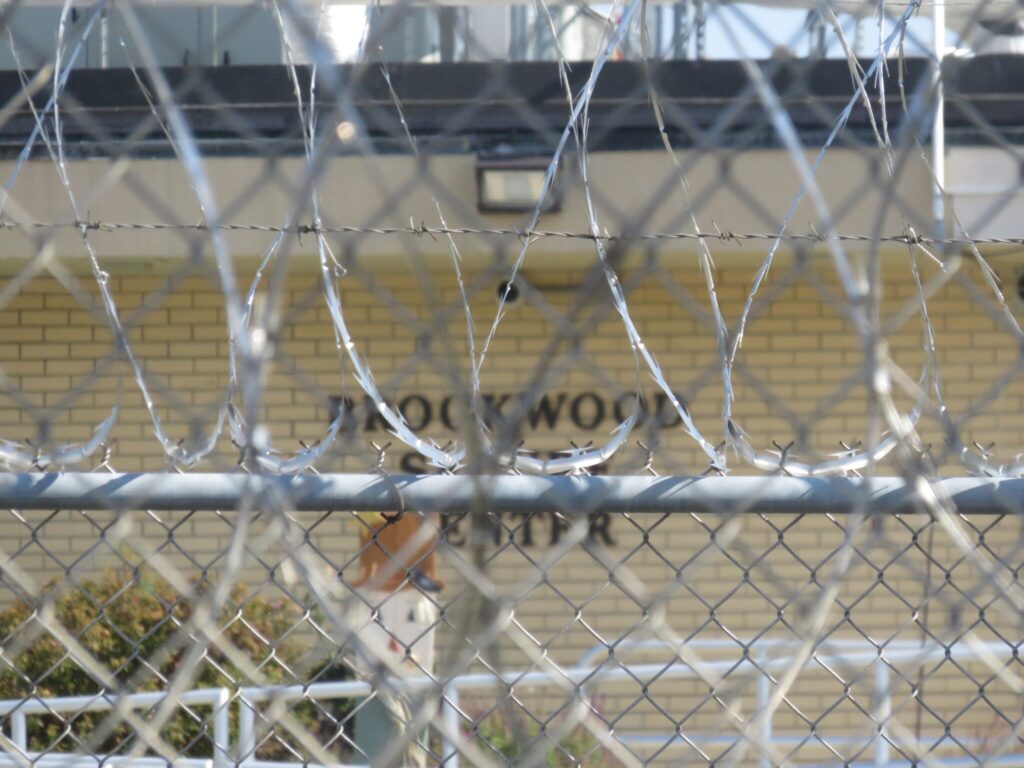
Last year, an audit by the state’s Comptroller Thomas DiNapoli found that New York often failed to follow those policies, creating risks for the hundreds of youth living in eight “Limited Secure” and “Secure” facilities. They range from the one-story, eight-unit Finger Lakes Residential Center — a tree-lined facility near Ithaca — to the barbed-wire-encased 125-bed Brookwood Secure Center for Youth, a two-hour drive north of New York City.
Freeman said her firm is performing due diligence in pursuing the documents, but noted: “We are certainly concerned about conditions in OCFS placement facilities.”
The Office of Children and Family Services’ network of facilities detains hundreds of youth ages 12 to 21. Most are at least 16 upon admission, and their trials have concluded in either family court or adult criminal court. Their crimes range from stealing cars to assault and murder, but can also include less serious offenses.
The number of such facilities has declined from more than two dozen decades ago, but the detained population has grown since a 2017 law that barred 16- and 17-year-olds from adult prisons and jails.
The latest state data shows 478 youth were admitted in 2024. The vast majority of youth placed in secure facilities — meaning the most restrictive settings — had committed homicide, assault or robbery. The less-restrictive facilities mostly housed youth who had committed property crimes such as “criminal mischief” or larceny.
Seventy-eight of the 227 youth admitted into secure centers are from New York City. Northern and western urban counties that include Buffalo and Rochester send the highest numbers of youth to limited-secure centers.
Sensitive and high-stakes issues
The records Children and Family Services withheld from the Legal Aid Society related to the most sensitive and high-stakes issues that youth face while incarcerated: discipline practices, employee misconduct, contraband smuggled into facilities, crisis response and transporting youth to and from lock-ups.
The lawsuit also notes that the state’s adult corrections agency, the Department of Corrections and Community Supervision, “publishes without redaction” detailed policies comparable to those the Office of Children and Family Services redacted.
One former state juvenile justice leader said policies’ details are critical to the safe housing of detained youth, and their prospects for rehabilitation.
Felipe Franco is a former Office of Children and Family Services deputy commissioner who contributed to the closure of 26 juvenile facilities in response to U.S. Justice Department findings of abuse and violence against incarcerated children. In that role, he also helped implement policy reforms after facing earlier legal challenges from the Legal Aid Society.
“There’s nothing more important than having real, clear expectations and guidance to staff,” said Franco, now a national juvenile justice advocate with the Annie E. Casey Foundation.
He added that lawsuits like the one Legal Aid filed this week are not unusual, and sometimes very helpful for positive reform.
“It really got us to do the right thing and create the right guidance.”