


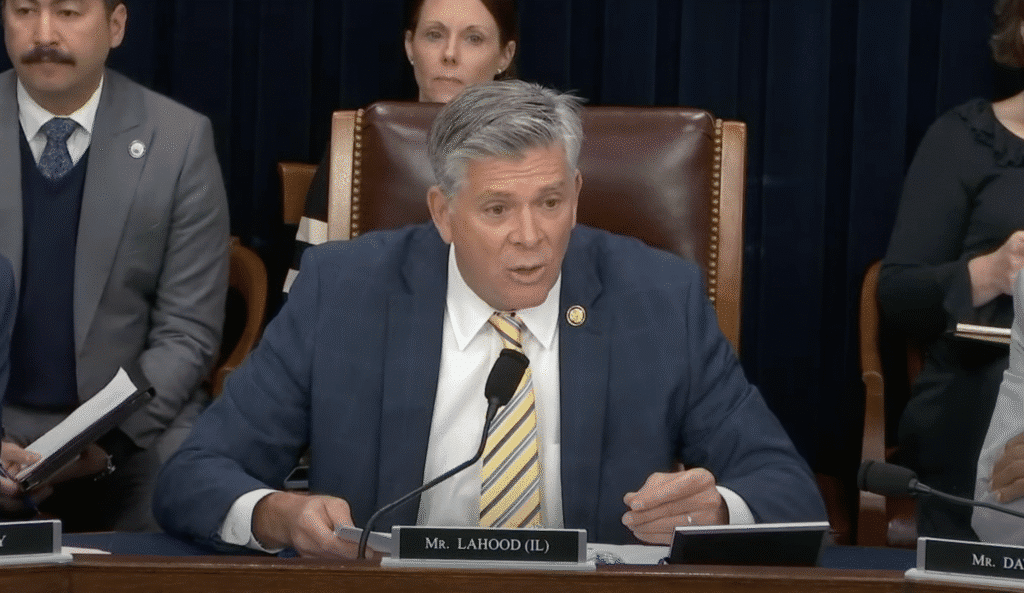
Members of Congress heard from child welfare leaders at a hearing focused on technology and funding flexibility that some lawmakers say is needed to better support the nation’s foster youth as they approach adulthood.
Republicans who led the Work and Welfare Subcommittee hearing — titled Leaving the Sticky Notes Behind: Harnessing Innovation and New Technology to Help America’s Foster Youth Succeed — want state agencies to be able to upgrade antiquated systems and help enact an executive order signed last week by President Donald Trump.
“The executive order includes a call for modernization of state child welfare systems, and expanding the use of technology,” said Illinois Rep. Darin LaHood. He pledged to “help advance those priorities” through the subcommittee he leads for the House Committee on Ways and Means. “Child welfare systems have not kept up with the pace of technology, and it’s children and caseworkers that have felt the most impact.”
Some Democrats in attendance objected to the hearing’s emphasis. They slammed their Republicans counterparts for focusing on computer software after pushing through Trump’s massive bill that scaled back access to the Medicaid and food stamps that current and former foster youth and their families rely on.
“This hearing I think is important to have. But let’s just call out what they did, and what they are trying to do — they are trying to cover up what they did four months ago,” said California Democratic Rep. Jimmy Gomez. “So it frustrates me that they wanna come and talk about technology and AI and how it’s gonna help, without focusing on what kids need from the very start.”
Rep. Gwen Moore of Wisconsin agreed, criticizing the new Republican-backed work requirements that former foster youth under age 24 must comply with in order to receive Supplemental Nutrition Assistance Program benefits, or SNAP.
Texas Rep. Nathaniel Moran defended the policy change, citing his own son’s experience in response to Moore’s critique.
“He learned skills at work at the ages of 15, 16, 17 by going to work in a warehouse and figuring out how to show up on time, and be prepared, and work hard, and take directions from his supervisor,” Moran said. “Those are the kind of skills we need to build in our youth regardless of whether or not they are in traditional families, or foster families or adoptive families. They learn those skills at work.”
There were areas of agreement across party lines as well, including general acknowledgement that youth aging out of foster care are among the nation’s most vulnerable populations given their high rates of trauma, mental health conditions, school drop-out rates and early pregnancies.
The Republicans in the majority and some witnesses emphasized that government spending could not be the solution for all those challenges. LaHood, chair of the Welfare and Work Subcommittee, indicated that his priority would be addressing the child welfare system’s reliance on old fax machines, digital “sticky notes” and “spreadsheets and clunky software applications” that he said are not optimal for identifying youths’ unmet needs or connecting them with family and kin.
Some of the five witnesses urged the committee to embrace artificial intelligence and online social networks to help caseworkers connect transition-age foster youth to supportive relationships, housing and other basic needs.
“I have seen in my own life and I believe to my core that the solutions for the community are mostly in the community, and I would love the opportunity for technology to be leveraged to help more communities to care for themselves, whenever possible,” said Adrien Lewis, founder and president of CarePortal, a technology platform whose parent organization is the Kansas City-based nonprofit Global Orphan Project.
Lewis suggested that lawmakers should ease restrictions on federal funds that Congress has allocated to support transition-age youth, allowing them to fund more digital tools and technology like his firm’s to “boost efficiency, increase adult connection, and improve youth outcomes.”
CarePortal is an app that allows child-serving professionals to submit needs for vulnerable kids, with a focus on connecting them to faith groups. One just-fulfilled request Tuesday describes a grandmother near Capitol Hill who needs help washing clothes for two of her grandchildren now in her care. The app ranked the “urgency” of her need as “normal.”
In written testimony, Jennifer Jacobs, cofounder and CEO of the Virginia-based nonprofit Connect Our Kids, described how her organization’s technology helped a Florida caseworker locate several dozen family members for a teenager in foster care named Marcus. At the hearing, she argued that federal dollars should be better targeted to strengthen relationships for foster youth.
“When youth lack the identity and belonging, of feeling claimed and valued by their own, they face higher risks of homelessness, incarceration, unemployment, trafficking, victimization and poor health,” she said. “Relationships matter. They are the protective factor that makes everything else possible.”