


In 1997, the vast majority of federal welfare funds flowed to states and then directly into the households of low-income families.
Now, such direct assistance makes up about a quarter of the $16.5 billion spent annually through the Temporary Assistance for Needy Families (TANF) program, with the rest going to programs and services nominally aimed at helping alleviate poverty. And child welfare systems are one of the biggest recipients of that money.
States spent $23.5 billion in TANF funds on child welfare between 2015 and 2022, the Government Accountability Office report finds, making it the second largest federal source of funds for state and local agencies engaged in investigating alleged abuse and neglect and intervening to support families and child safety. TANF contributes about one-third as much as the largest federal contributor to child welfare, Title IV-E, which states can tap to fund foster care payments, adoption subsidies and certain efforts to prevent removals.
Almost every state used some of its TANF funds for child welfare in 2022, though the extent of that ranged from below 20% in most states to more than 60% in Arizona, Georgia and Kentucky. The majority of states told GAO they used this money for services only, while seven states said TANF was used entirely on payments to foster parents. Those caregivers were likely a mix of kinship caregivers and non-relatives caring for children who were not eligible for IV-E funds. Another 12 states reported that they used TANF for both payments and services.
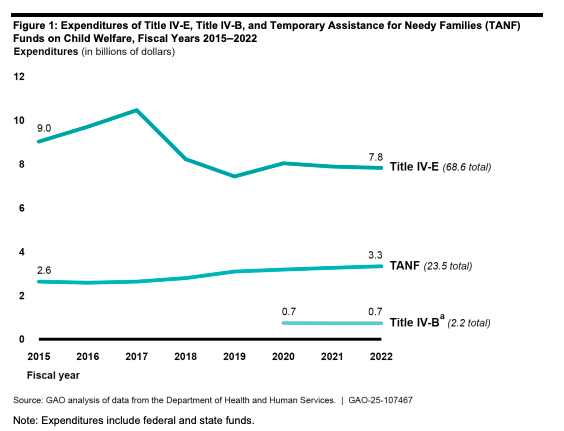
The TANF contribution to child welfare is likely even larger than this report suggests, authors say. States are allowed to transfer 10% of their TANF money to another federal program called the Social Services Block Grant, which is also widely used by states to fund child welfare expenditures. Further, GAO noted, in its closer examination of five states, they heard from officials in two states who said there are some services not categorized as child welfare but are closely related to that work.
This is one of several TANF reports issued in the past six months by GAO. A report in December, which more broadly assessed the use of TANF for non-cash assistance, recommended that Congress grant the executive branch more authority to collect information about what exactly states are spending non-cash assistance funds on. While general categories like “child welfare” are discernable, the actual expenditures and their effectiveness are opaque.
Some fear that the vagueness around non-cash assistance could be used against the entire program as Congressional Republicans look to make spending cuts in the next year.
“We’ve built the audience” for some TANF spending to be seen as waste, fraud and abuse, said Rep. Gwen Moore (D-Wis.), at a recent hearing of the House Ways and Means Committee.
At the same hearing, Rep. Judy Chu (D-Calif.) noted that in the recent reorganization of the Department of Health and Human Services, the entire staff administering TANF had received reduction-in-force notices.