


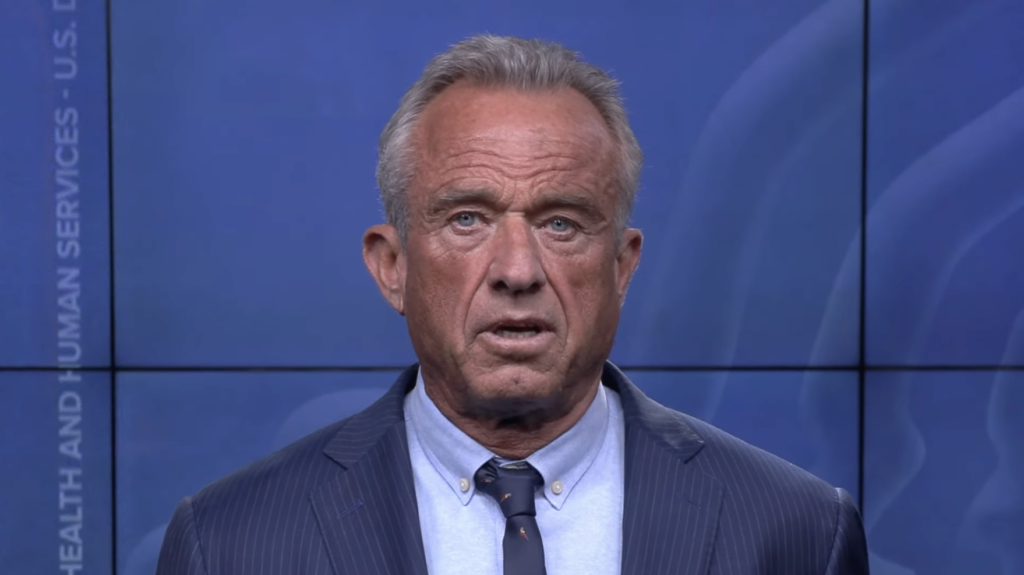
Department of Health and Human Services Secretary Robert F. Kennedy, Jr. last week announced a massive reorganization of his agency that would take its workforce from 82,000 down to 62,000 and consolidate from 28 divisions into 15.
“Over time, bureaucracies like HHS become wasteful and inefficient even when most of their staff are dedicated and competent civil servants,” Kennedy said, in an announcement of the plan. “This overhaul will be a win-win for taxpayers and for those that HHS serves. That’s the entire American public, because our goal is to ‘Make America Healthy Again.’”
The Administration for Children and Families (ACF), the main agency overseeing family support programs and child welfare systems, was barely mentioned in an outline offered up by HHS, though a source told Youth Services Insider in early March that about 200 of the division’s 1,700 employees have been given some form of notice that they’d be let go.
Thus far, the ACF has refused to reply to our request for more clarity on the status of staff or open grant competitions. The news website Fierce Healthcare cited a source within HHS telling its reporter that ACF would be facing substantial cuts as part of the reorganization.
Julie Fong, a regional program manager for ACF who worked with the agency for 25 years, told a reporter from San Francisco Bay Area network KRON4 that she and other colleagues received “impersonal” reduction-in-force emails on April Fool’s Day.
“It feels intentionally cruel, and malicious, to be honest, which is in line with some of the other things we’ve experienced recently,” said Fong, whose focus at ACF was the Temporary Assistance for Needy Families program.
The reorganization will entail the centralization of all human resources, IT, external affairs and policy at HHS. If truly all policy actions — including a letter to agencies or an information memorandum — are moving into a centralized operation, that certainly seems as though it would lower the scope of direct influence at ACF, or at least require a lot more upward sign-off before things happen.
One agency whose responsibilities that will be scattered through other parts of HHS is the Administration for Community Living (ACL), which helps states with funds and other assistance to aid seniors and people with disabilities. Two ways in which ACL plays a role in the child welfare continuum:
The National Family Caregiver Support Program and the closely related Native American Family Caregiver Support Program, established in law in 2000, which collectively pass along $200 million dollars into communities to help support older Americans (55 and up) who are caring for children. That money flows into local Area Agencies on Aging, which can use it for referral services, respite care, and individual counseling for senior caregivers.
Home and Community-based Services ($392 million), which complements the Medicaid program by the same name and is focused on helping people with disabilities, including children, live at home and without the need for institutionalization or residential care.
For evidence of the connection between that and child welfare, look no further than the recent federal report that found about 5% of all entries into foster care are connected not to findings of abuse or neglect, but of parental relinquishments of children. The primary driver of this phenomenon are disabilities and related behavior that are beyond the capabilities of the parent; several states, including Texas, are moving on legislation on the subject.
HHS has not laid out specifics on what will become of the various ACL programs. Our guess would be that the caregiver support program is moved to the Administration for Children and Families, and Home and Community-based Services heads to the Centers for Medicare and Medicaid Services.
Kennedy has been asked to testify before the Health, Education, Labor, and Pensions Committee about the reorganization on April 10.