


A landmark study released today by the Department of Health and Human Services found a significant number of youth enter foster care each year because of child behavioral health issues that their parents are struggling to help them with.
Researchers tracked entries into foster care between February 2017 and 2019, not counting children below the age of 3. They found that “as many as 25,000 foster care entries (or 5 percent of all foster care entries) might have been instances of custody relinquishment.” In these cases, abuse or neglect by a parent didn’t contribute to the entry into foster care.
The vast majority of these entries, 79%, involved teenagers. In nearly two-thirds of the entries, the primary caregiver was a single parent.
A key indicator that these entries largely relate to child behavior: Authors were able to link these records to Medicaid data in Florida and Kentucky, and found that 98% of children in this group had a diagnosed behavioral health condition. And one in five had such a diagnosis along with a disability.
The research confirms a phenomenon for which there have certainly been markers. Each year, the federal Child Maltreatment report identifies thousands of children as having received foster care services even though they are classified as “non-victims.” But that group is much larger, and includes youth who end up in foster care after their parents are offered an alternative response path that does not involve a formal investigation.
The use of foster care to address child mental health was acutely on display recently in Ohio, where the state announced a retooling of its approach to youth and young adult mental health. In doing so, state officials said a major motivator in pursuing this reform through Medicaid was that parents were being told by mental health workers to surrender their kids to foster care to get the often expensive mental health treatment needed.
This is a factor noted by report authors. “Entering foster care could provide children with access to services that are otherwise unavailable due to limited capacity,” the report said. “Custody relinquishment could also occur to receive services not otherwise covered by the child’s health insurance, because children in foster care are automatically eligible for Medicaid.”
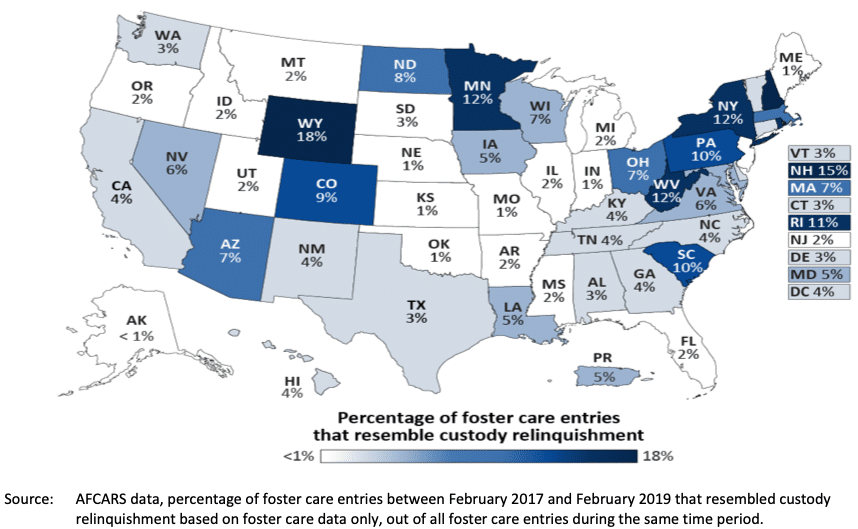
While the report shows an estimated 5% of foster care entries nationwide are due to custody relinquishment, there was enormous variance across states on this. In several states, 1% of entries were in this group; in eight states, more than 10% of entries were linked to custody relinquishment. In Wyoming, this predicament accounted for nearly 1 in 5 foster care entries.
Researchers note that one big takeaway here is that they demonstrated it is possible to isolate these relinquishment cases within the larger group of foster care entries. It would be interesting to see whether a subsequent look in the next few years would find a lower proportion of these among the total, because there is a potentially disruptive change to federal child welfare policy that followed this report’s window: the Family First Prevention Services Act.
The Family First Act passed at a time when Congress was seeking solutions to the opioid crisis, and it was designed to fund the prevention of foster care in some child welfare cases. The focus was certainly on parenting conditions: substance abuse, mental health challenges and other parenting deficiencies.
But the clearinghouse for allowable services under Family First has greenlit several models of treatment that focus on adolescent behavioral health. Most states have gotten approved for Family First spending, but few have started to actually draw down that money (which must be matched with state funds). Certainly, this offers a path by which in tandem with Medicaid, states could chip away at how often a parent feels unable to continue caring for their kids.