


The number of foster homes is down. But so is the number of youth who need them.
The Imprint is still wrapping up 2025 data collection for Who Cares, the nation’s first public resource on foster care capacity. We will update our project website, FosterCareCapacity.com, with all of the responses we have received from states in early 2026. This includes information on foster homes, kinship caregivers, congregate care and more.
Since our topline data point — the number of total licensed foster homes — has been referenced by the Trump administration in its goal to achieve a 1:1 ratio of homes to youth in foster, we wanted to share what we have on that metric as the year comes to a close.
Thus far, we have been able to collect information on the total number of licensed foster homes in 45 states. Along with Washington, D.C. the following states have not yet provided 2025 data:
- Alabama
- Hawaii
- Indiana
- Louisiana
- South Carolina
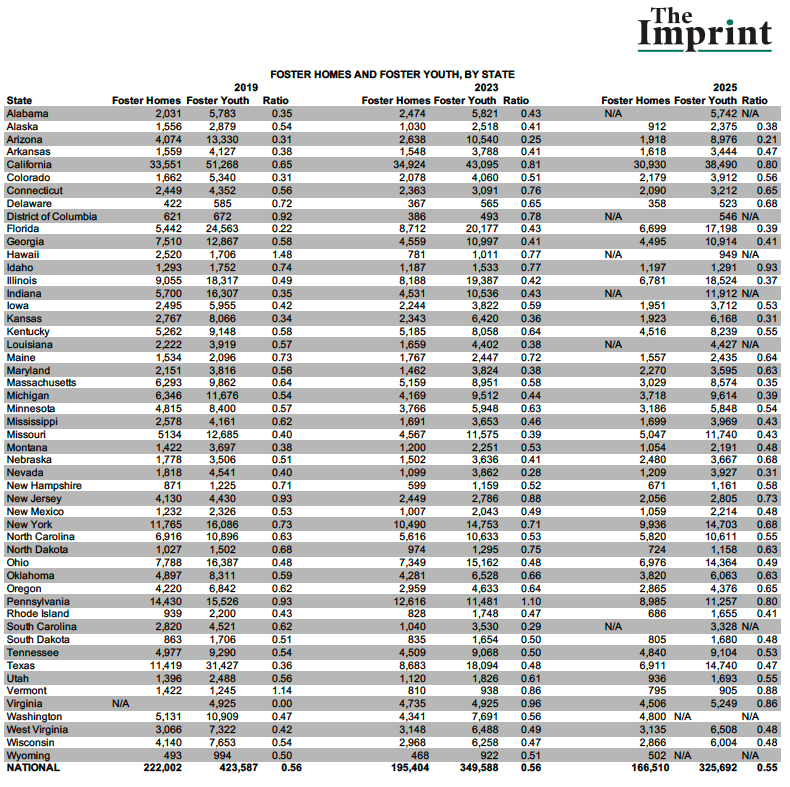
In those 45 states, the total number of homes identified is 166,510. When compared to those same 45 states in 2023, the last year we collected data, this marks a 9.7% decrease from the 2023 total of 184,533.
If you apply that 9.7% decline to the other five states and Washington, D.C., the projected total number of licensed homes in the country is 176,326, as compared to the actual total of 195,404 in 2023.
Going back to 2019, the year previous to the beginning of the COVID-19 pandemic, we can compare 44 states, as Virginia did not respond to our 2019 request. In those 44 states, there has been an 18% decline in the number of licensed homes from 2019 to 2025.
So the overall trend is decidedly downward when you look only at licensed foster homes. But that does not paint the entire picture of whether states have a home for every child in foster care, for two key reasons.
The first is that states vary in the way they count and track the homes of relatives and other kinship caregivers. In some states, there are likely a significant pool of kinship homes that are unlicensed and often receive little support from systems. But they are homes, and efforts to simplify the approval and licensure process for kin have taken hold across the country of late.
The other factor is more straightforward: while the number of licensed homes has dropped, so has the number of youth in foster care. And as a result, the ratio of homes to children in foster care has barely budged since 2019.
To produce a ratio, we used our licensed homes data as the numerator, and the most recent federal AFCARS data on youth in foster care as a denominator. Because Washington and Wyoming have not provided 2024 AFCARS data yet, we excluded them from this calculation.
Here are the national ratios for the three years referenced above …
2019 (42 states): .56
2023 (43 states): .57
2025* (43 states): .55
[Note: Because 2025 AFCARS numbers are not out yet, we used the 2024 figures released this year.]
The administration’s goal, as discussed with The Imprint by Assistant Secretary for Family Support Alex Adams, is to achieve a 1:1 ratio of foster homes to children in foster care. As these numbers show, at least as far as licensed homes go, the national average is about half of that.
The stickiness of the national average belies quite a bit of volatility from state to state. Among the 26 states that saw a decline in the home-to-child ratio, 10 of them experienced a drop of 20% or more. Of the 16 who saw home-to-child increase, nine went up by 20% or more.
Below is a state-by-state chart showing the number of licensed foster homes collected by The Imprint in 2019, 2023 and 2025; the nearest federal data for youth in foster care in those years; and the ratio of homes to youth. Go to FosterCareCapacity.com to see more; we will be updating the site with complete 2025 data soon.
View a PDF of the data here.