The Flores settlement has long protected immigrant kids in detention. The Imprint talked to a legal expert about the Trump administration’s efforts to end those legal protections.
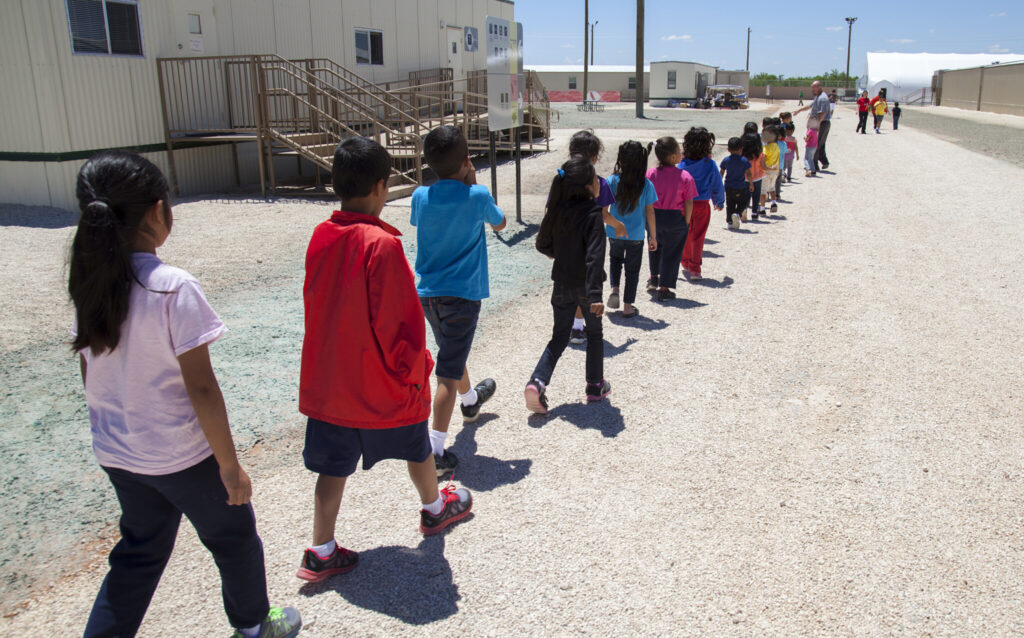
In 1985, a girl fleeing violence in El Salvador ended up at a makeshift detention facility in Pasadena, California. Jenny Lisette Flores, then 15, was one of dozens of people of all ages fleeing civil war and political unrest in Central America who was detained at the converted Mardi Gras Motel, circled by razor wire, a chain-link fence and a guard station.
At the improvised lockup, migrant children were strip-searched by guards. There was no school or family visitation, so kids sat around a drained pool with nothing to do.
To protect Flores and other migrant children, in 1985 public interest attorneys filed a class-action lawsuit against the federal government. That case advanced all the way to the Supreme Court before ending in a 1997 legal agreement that now bears her name.
Since then, the Flores settlement agreement has required the government to provide basic standards of care to immigrant children in detention as well as age-appropriate classroom education. Most importantly, the settlement agreement prohibits children from being held for more than 20 days.
Prior administrations, such as the Obama presidency and the first Trump regime, have tried unsuccessfully to chip away at Flores in the courts, through regulations and arguments that its terms should not apply to all detained immigrant children, just unaccompanied minors. In both cases, a judge disagreed.
The second Trump administration has gone even further. Amid an unprecedented immigration crackdown and mass deportations, federal officials filed a motion to terminate the agreement altogether, saying it encourages border crossings. Despite widespread evidence to the contrary, administration officials also claim that the Department of Homeland Security has already met its terms and no longer needs court monitoring.
A district court rejected the administration’s motion three months later, but the case is not over. The government subsequently appealed to the Ninth Circuit Court of Appeals, which has yet to rule.
Meanwhile, the number of children detained by Immigration and Customs Enforcement at the U.S. border or swept up by agents in their communities has mushroomed since President Donald Trump began his second term, and conditions of confinement have worsened.
“Our country shouldn’t be needlessly cruel to children. I don’t think that’s too much to ask.”
— Elora Mukherjee
About 170 children are now being held on an average day, compared with roughly 25 during the last year and four months of the Biden administration, according to the Deportation Data Project, an archive of immigration enforcement data based at UC Berkeley and UCLA. As of December, roughly 1,300 children have been held beyond the 20-day limit mandated by the Flores settlement.
Accounts of migrants being housed at the recently reopened Dilley Immigration Processing Center near San Antonio, Texas, detail rotting, worm-filled food and contaminated water, according to reporting by The Marshall Project. Letters written by children locked up with their families for months on end reveal sadness, depression and water that makes them sick.

“Please get me out of here,” a 9-year-old girl wrote, pleading to return to Colombia. Another 14-year-old girl from Honduras wrote that since she arrived at Dilley, “all you will feel is sadness and mostly depression.”
Elora Mukherjee, a clinical professor of law at Columbia Law School and director of the Immigrants’ Rights Clinic, said without the Flores settlement agreement, the Trump administration can’t be trusted to keep children in safe and sanitary conditions. She has been an essential voice in bringing the experiences and conditions of children held in Texas facilities such as Dilley and the Clint Border Patrol Station to light.
In 2019, Mukherjee testified before Congress about the degrading conditions at immigrant detention facilities housing children, who she interviewed in person. None of the children had access to soap, she said, and some had not had not bathed for days. More recently, she has written and spoken about Dilley, a place she calls a “hellhole.” Children live in squalid conditions and also endure threats from officers, who say they’ll separate them from their families, she said.
For the current case arguing to maintain the Flores agreement, Mukherjee co-wrote an amicus brief filed on Jan. 28 in the Court of Appeals on behalf of more than 160 immigration lawyers, law professors, scholars and former immigration judges. Dozens of U.S. senators, state attorneys general and pediatricians have signed on to similar briefs.
In an interview this month with The Imprint, Mukherjee talked about what would happen if the Flores settlement agreement were unraveled, how extended detention is affecting children in ICE custody and why alternatives to detention programs are effective.
“Our country shouldn’t be needlessly cruel to children,” Mukherjee said. “I don’t think that’s too much to ask.”
This conversation has been lightly edited for brevity and clarity.
When we talk about the Flores settlement, does it apply to unaccompanied minors or all children in the immigration system?
It applies to all children in federal immigration custody. The federal government has repeatedly argued through the years that it only applies to unaccompanied minors, so children who entered the United States without a parent. But federal district courts in the Western District of Texas, the Central District of California and the Ninth Circuit Court of Appeals have all unanimously found that the settlement agreement applies to all kids in federal immigration custody.
If the Flores settlement is dismantled, how will children in the immigration system fare?
It will be devastating for children in federal immigration custody, children will be left with virtually no protections.
In June 2019, the first Trump administration argued before the Ninth Circuit Court of Appeals that it was safe and sanitary for children in federal immigration custody to be detained for days without access to toothbrushes, soap and showers, and to sleep with the lights on 24/7 without access to blankets to keep them warm on concrete floors in Customs and Border Patrol custody.
With the so-called “One Big, Beautiful” bill that became law on July 4, 2025, there has been an expansion in the detention budget by $45 billion.
What I fear is that, if the Flores settlement agreement is dismantled, children will be detained for prolonged periods of time, months and years, while their immigration cases are proceeding through the system. And during that time, they’ll be detained in increasingly degrading and inhumane conditions.
“If the Flores settlement agreement is dismantled, children will be detained for prolonged periods of time, months and years, while their immigration cases are proceeding through the system. And during that time, they’ll be detained in increasingly degrading and inhumane conditions.”
— Elora Mukherjee
How often are you seeing excessive detention past the 20-day time limit to detail a migrant child?
A federal district court interpreted the Flores settlement agreement to generally limit the detention of children accompanied by a parent to 20 days maximum. Yet in hundreds of cases over the past year, we have seen children being detained for far longer than 20 days.
Last week, I was able to secure the release of 5-year-old twins who had been detained for more than four months. I’m currently working with three children ranging in age from 4 to 13 who have been detained longer, nearly 130 days.
Detention is never appropriate for children. The American Academy of Pediatrics and every major medical association has condemned the use of family detention because of its long-term effects on children’s physical and mental health.
As someone who represents children in immigration courts, how do you see prolonged detention affecting some of your clients?
Kids in detention regularly regress. Over the past year, I’ve represented a first grader who had been living in New York for almost two years who regressed to the point that he wet the bed regularly while in detention. I’ve represented children who have tried to harm themselves in immigration detention, literally as young as 5 years old. My most recent public case is about baby Amalia, who is a year old, and she nearly died at Dilley last month.
At Dilley, children and families don’t have access to sufficient drinking water. They don’t have access to sufficient nutritious food. Children and parents alike have told me repeatedly that they found worms, bugs and mold in their food. There is not adequate access to appropriate medical care. Children are allowed to go to school for one hour a day, which consists of one hour where they are doing worksheets and coloring. The teacher there only speaks Spanish, so children who are not Spanish speaking from around the world — and including children who’ve been living in the United States for years who have taken AP classes in high school here — this is all they have access to.
The Trump administration has expanded the use of “mandatory detention” policies for immigrants in ICE custody, even those who have lived in the country for decades. Are minors subject to the same rules?
Non-citizen children are now at risk of being detained anywhere they have been and continue to be detained on their way to school, on their way home from school, at airports and public parks — literally in the parking lots of hospitals trying to seek emergency medical care. It’s horrifying.
This should not be happening in the United States of America, and the Trump administration’s sweeping claims about mandatory detention have instilled fear and terror in the lives of many immigrant children and families, including those families with mixed status, and even families with U.S. citizens who are worried that they’re going to be wrongly arrested and detained.
One of the arguments the Trump administration makes when opposing bail for children held at immigration detention facilities is “flight risk.” What is the evidence for this among children and families?
There is a lot of data from ICE itself showing that families who participate in alternatives to detention programs, such as the family case management program, show up for their immigration court proceedings, hearings and their ICE check-ins at rates of 99 to 100%. There is no reason to detain law-abiding, asylum-seeking children and families.
It is also notable that detaining children and families is also far more expensive than relying on alternatives to detention. But the short of it is, alternatives to detention programs have proven to be extremely effective in ensuring that children and families comply with all aspects of their immigration proceedings, which means there’s no reason to detain children and families.