
Early next year, the federal government will conclude a historic public reckoning with the brutality of this nation’s founding: a final report on the devastation caused by U.S.-backed Indian boarding schools.
The second volume in the Department of the Interior’s accounting for the past harms of boarding schools is expected in the coming months, and will outline in more detail some of the still-unknowns — just how many Indigenous children died at school and who these children were. The amount of government money pumped into this network of 408 residential schools that opened in the 1800s is also expected to be further quantified, according to an Interior Department press statement.
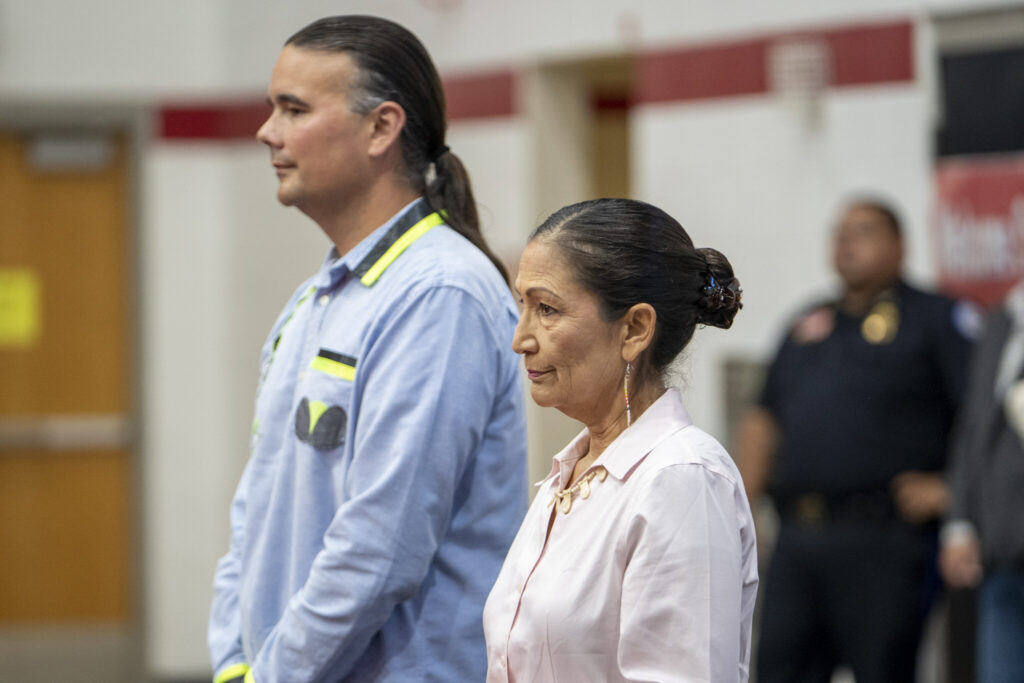
Heading the inquiry into “the troubled legacy of federal Indian boarding school policies” is Secretary of the Interior Deb Haaland, a Laguna Pueblo member from New Mexico, and Assistant Secretary for Indian Affairs Bryan Newland, a citizen of the Bay Mills Indian Community. They have an ambitious aim: “to address the intergenerational trauma” these federal policies created.
The Interior Department released its initial accounting of Indian boarding schools in May, 2022. The groundbreaking report launched by Haaland, the nation’s first Indigenous cabinet secretary, included an inventory of schools that had never before been fully detailed by federal officials. The government also identified 53 marked and unmarked burial grounds on school sites. It has so far accounted for 500 child deaths across 19 schools, with family members rarely notified.
The causes of death are likely myriad. Federal archives show the U.S. government “coerced, induced, or compelled Indian children to enter” the schools where they were subject to “solitary confinement; flogging; withholding food; whipping; slapping; and cuffing.” They were also ravaged by disease introduced into otherwise healthy Indigenous societies.
Interior officials say the second volume of findings will include further information in the “list of marked and unmarked burial sites at federal Indian boarding schools” as well as “an approximation of the total amount of federal funding used to support the federal Indian boarding school system.”
Alongside the inquiry, Secretary Haaland completed her more than year-long Road to Healing Tour in late-October. Her stops across the country sought out personal contact with American Indian, Alaska Native, and Native Hawaiian survivors of the federal Indian boarding school system, allowing them the chance to share their stories in private sessions with the Secretary, and to connect with “trauma-informed” support. The tour also served as material for a permanent oral history.
That project, according to federal officials, “will document and make accessible the experiences of the generations of Indigenous children who attended the federal boarding school system.” Discussions are now underway with the Smithsonian National Museum of American History about assisting in this work.
The archive will be managed in part by the National Native American Boarding School Healing Coalition, which federal officials credit as having “a proven track record of gathering stories through a survivor-centered protocol.” The coalition has been awarded $3.7 million in grant funding for the project, which focuses on gathering first-person survivor narratives.
“The U.S. government has never before collected the experiences of boarding school survivors, which Tribes have long advocated for to memorialize the experiences of their citizens who attended federal boarding schools,” Secretary Haaland stated in a September press statement. “This is a significant step in our efforts to help communities heal and to tell the full story of America.”
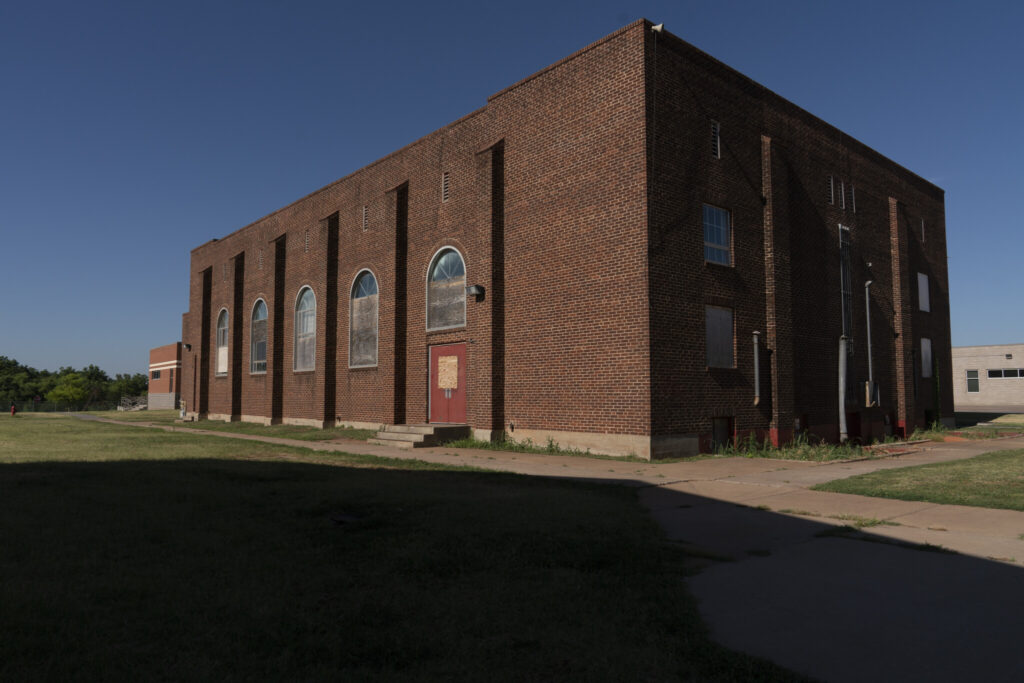
Haaland’s Road to Healing Tour began last July in Anadarko, Oklahoma, at the Riverside Indian School. She made similar visits to Michigan, South Dakota, Arizona, Washington, Minnesota, California, Alaska and New Mexico before a final stop last month in Bozeman, Montana. Transcripts from many of Haaland’s tour stops are available on the Interior Department’s website.
In Oklahoma, an Imprint reporter watched as hundreds gathered to greet Secretary Haaland — including Desiray Emerton, a Seminole Nation council member and military veteran who brought her daughter Krystal. Emerton’s mother and grandmother survived boarding schools.
“We just want the truth, we’re not trying to blame anybody,” Emerton said. “We just want to make sure that our history is being told. We want the truth known so we can begin to address the healing process.”
Other healing tour attendees have recounted some of the countless horrors that took place.
In Montana, Donovan Archambault, the former Fort Belknap tribal chairman, told Haaland of his experiences, according to an account published by the Bozeman Daily Chronicle.
“The boarding schools are something that pulled my whole family apart. Two of my sisters committed suicide. Three of us almost drank ourselves to death. One is a pedophile because of what the priest did to us,” he testified.
Archambault said when he once got the courage to speak up about the abuse he and other students experienced at the Pierre Indian School in South Dakota, “all I did was get beat up. The matriarch took a shoe and started hitting me. She gave me a nosebleed and a scar on my forehead.”
Secretary Haaland is uniquely positioned to archive these revelations. She is the granddaughter of boarding school students and the great-granddaughter of a man sent to the Carlisle Indian School in Pennsylvania as a boy. The infamous Carlisle was the first government-run institution for Indigenous children, founded on the explicit goal of forced assimilation. On the Road to Healing Tour, survivors across the country greeted her with raw emotion and deep embraces.
“This is a significant step in our efforts to help communities heal and to tell the full story of America.”
-Secretary of the interior deb haaland
But centuries ago, the Interior Department — along with what is now called the federal government’s Bureau of Indian Affairs (BIA) — played a key role along with the church in the establishment, funding and maintenance of boarding schools.
Janine Pease of the Crow Tribe is among those keeping Indigenous language and culture alive despite the historic onslaught. There were once 16 Indian boarding schools in Montana, institutions that snatched Crow, Blackfeet, Fort Peck and Fort Belknap children from their communities.
Language loss and suppression is one of the central and lingering thefts by the boarding school era, as students were forced to speak English and punished for speaking their native tongues. But Crow and numerous other languages have been diligently maintained.
“When we were taken over by the BIA and colonizers, our language did not come to a halt,” Pease said in an interview. “We continued to name everything in our world as ours and our language is vital, right up to the present day.”
These days, Pease, 74, said among her generation “the grand majority are fluent Crow speakers.” She now teaches Crow Studies at Little Big Horn College, educating students about how the Crow language has survived despite the predominance of English in all aspects of life.
Pease said she feels blessed to pass on this “proud legacy of language” to younger generations, including the great-granddaughter she is raising.
“I’m telling her in our language how my brothers and sisters played along the banks of the Little Bighorn; how we picked berries, dug turnips, gathered wild carrots, and hunted deer, elk and buffalo,” she said. “We are preserving our family, our tribal nation when we do all of that.”
Children and families need nonprofit news.
Nonprofit news needs you.
Donate today to support The Imprint in 2024.