

Legislation now before Congress seeks better accounting of “hidden foster care” — a widespread but poorly regulated practice relied upon by child welfare agencies to shuffle kids out of their parents’ homes without court oversight.
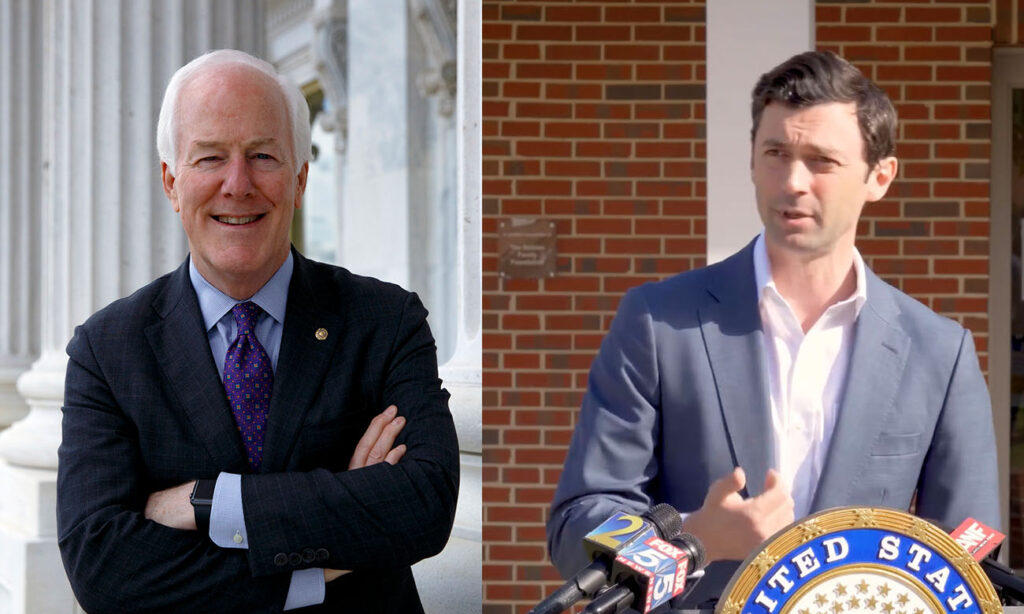
Indicating the non-political nature of the issue, the Foster Care Placement Transparency Act was introduced late last month by a bipartisan pair of lawmakers. Texas Republican John Cornyn and Georgia Democrat Jon Ossoff are cosponsors of Senate Bill 5214. It would require states to track and publicly report how often families investigated by Child Protective Services are separated outside of formal procedures.
The parents involved are under pressure to have their children move to the home of a relative or close friend. In exchange, the workers do not file a petition with a juvenile or family court alleging abuse or neglect.
“Every child deserves a safe and loving place to call home with someone to nurture them to their full potential,” Cornyn said in a press release last week. “This legislation seeks to ensure that every foster child in Texas and throughout our country is accounted for and taken care of, regardless of their informal or formal custody arrangements.”
So far, few additional details are available on the early-stage bill, and legislative text has not been publicly released. Cornyn said it will require states to report “how and when these arrangements are used to better protect children and ensure their well-being.” This state data would be reported to the U.S. Department of Health and Human Services, which would share the annual figures with Congress and make them publicly available.
Emilie Cook — a former attorney for children and parents and now a legal fellow at Emory University’s Barton Child Law and Policy Center — described the bill as “an important first step.”
“The data collected would allow stakeholders to better evaluate and meet the needs of impacted families and children,” Cook said. Too often, she added, these families “find themselves in a sort of legal limbo following informal separations.”
‘Little, if any, meaningful due process’
Legal scholars and child welfare experts have long been concerned about the transfer of custody taking place under these informal separations, referred to as shadow or hidden foster care, kinship diversion or parental child safety placements.
Rather than requiring a judge’s approval, these often-abrupt moves typically involve parents signing away custody through “safety plans” that are supposed to be voluntary, but are presented under the threat of a formal foster care case being opened should they refuse. The practice has come under increasing scrutiny in recent years by child welfare experts and the media.
A foundational analysis was published in a 2020 article in the Stanford Law Review. Authored by Columbia Law School Professor Josh Gupta-Kagan, it points to studies suggesting 250,000 or more children are removed from their homes this way each year.
These numbers are distinct from the most recent federal stats showing that in 2022, more than 186,000 children nationwide entered the formal foster care system.
Gupta-Kagan criticizes hidden foster care for breaking up families “with little, if any, meaningful due process.”
Unlike cases formally filed and monitored by family courts, the practice does not require social workers to present evidence to a judge that a child has been mistreated, or that leaving home is necessary to keep the child safe. There are no lawyers involved to help parents and children understand their rights and to defend them. And low-income caregivers who take in the children receive none of the financial assistance, health care or therapy services that would be available through a formal foster care placement.
Though these arrangements are described as voluntary and require parents to sign off on them, critics say they are inherently coercive and reflect the power imbalance between parents who may be facing hardships and social workers with the authority to take their children.
Some child welfare professionals point out the benefits; parents avoid a formal finding of abuse or neglect, families avoid social worker surveillance and parental rights are not terminated.
These informal placements can also give struggling parents more say over who cares for their children, supporters argue. Rather than watching helplessly as their kids are sent to live with strangers, Texas lawmaker Gene Wu told The Imprint last year, parents have time to address safety concerns by completing drug treatment or counseling.
Wu is a coauthor of legislation that passed in Texas last year, not to prohibit hidden foster care, but to better regulate the practice by placing a limit on the length of time the arrangements can continue.
Key concern in lawmakers’ home states
In Texas as well as in Georgia, lawmakers and child welfare experts have flagged such a need.
Earlier this year, the Senate Judiciary Committee, which Sen. Ossoff chairs, released a report on foster care in his state of Georgia that focused on broad “systemic” breakdowns.
But in a finding that received less public attention, the 64-page report also took issue with what it identified as “voluntary kinship placements.” Those cases, the Senate’s investigators found, were not being “properly vetted” in Georgia, leaving children placed with people who had histories of sex crimes or child abuse allegations of their own.
Tom Rawlings, a former Georgia Division of Family and Children Services director who worked as a juvenile court judge in the early 2000s, said he supports the federal legislation but added that it doesn’t go far enough.
When he worked inside the child welfare system, Rawlings said he often heard from relatives that they’d agreed to temporarily care for children. But then months would pass and they’d receive no updates, guidance or financial assistance.
“There are good reasons for needing to track this information and make it public,“ Rawlings said. He added, however, that “what’s probably needed is not just a matter of reporting data, but making sure that there are strict time limits on these types of placements and making the federal and state funding easier.”
Lawmakers in Texas have been seeking to regulate hidden foster care for several years. After multiple failed attempts, a law that took effect last September puts parameters around the practice. Hidden foster care arrangements automatically expire after 30 days. In some instances, they can be renewed, but only for a maximum of 90 days. After that point, the child must be returned to the parents or a case for continued out-of-home placement must be presented to the juvenile court or signed off on by an attorney representing the parents.
The new law requires social workers to inform parents of their right to an attorney, before they agree to a parental child safety placement. State child welfare authorities, in turn, must include tallies of all such placements in data reported to the federal government.
During the last fiscal year — the first year since the new regulation was in place — 2,582 Texas children lived in hidden foster care arrangements, according to the Texas Department of Family and Protective Services. This is a sharp decrease from the 12,000 just a few years prior.
“Children should not be removed from their parents, traumatizing families, without appropriate due process and oversight,” Texas state Rep. Lacey Hull said in an email sent today. Hull authored similar bills in 2021 and 2023 that failed to pass. “I hope that the Texas reforms stand as a model to other states and am very thankful to see Senator Cornyn lead on this issue at the federal level.”
Cornyn said the newly introduced Foster Care Placement Transparency Act was inspired by his state’s bill “and would require all states to follow Texas’ lead.”