


Child welfare advocates have hoped to increase the amount of federal support for older youth in foster care, about 20,000 of whom age out of the system every year without having been reunified or connected to a permanent family in some other way.
So it cannot have come as good news that some states are not spending their current allotment of the John H. Chafee Foster Care Program for Successful Transition to Adulthood, the main conduit of federal funds for this group. A report by the Government Accountability Office this month found that millions of dollars for independent living, college tuition and more are going unspent, and being returned to the Administration for Children and Families (ACF), the federal agency that oversees child welfare policy and spending.
From the report: “Federal funds for this program have gone unspent for several years despite states reporting many unmet needs. In some cases, Tribes and territories have returned all their federal Chafee program funds, although those communities may be historically underserved and face other unique challenges.”
The findings frustrated advocates, who said the inability to spend down the money runs counter to the demand they see for help among older foster youth.
“How can states be returning tens of millions of funding every year while our young people are crying out for supports?” said Serita Cox, co-founder of iFoster, which conducts an annual survey of youth, caregivers and workers called Voices of the Foster Care Community.
“There is clearly a disconnect with less than a quarter of transition-age foster youth receiving independent living services despite over 70% of youth and social workers surveyed (saying) that there is a desperate need and want for supports with respect to housing, independent living, employment, and food assistance,” Cox said.
The Chafee program was first implemented in 1999, and it is comprised of two components: Independent Living Services, a flexible pot that states can use to provide cash or living assistance as well as life skills or employment help; and the Educational Training Vouchers (ETV), which can be used to help current and former foster youth pay for the cost of college and other postsecondary academic pursuits.
The program has been funded at about $186 million for decades, so with inflation, its value has eroded greatly. But following the outbreak of the COVID-19 pandemic, one of the earlier rounds of stimulus included an additional $400 million for Chafee, to be used between fiscal years 2021 and 2023.
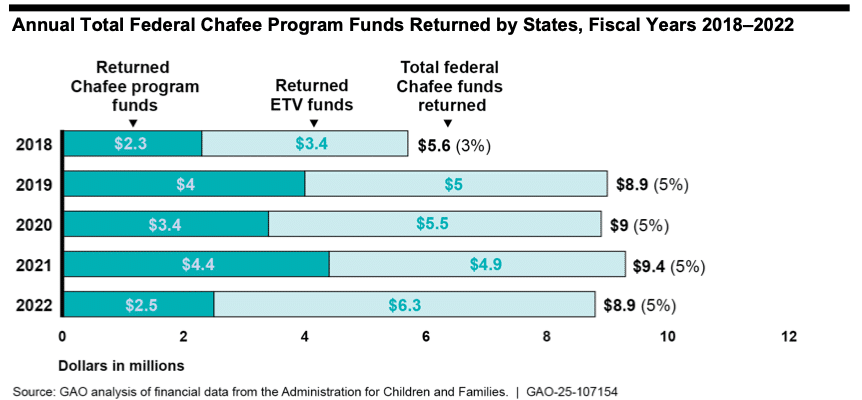
GAO’s analysis found that in the five-year period between 2018 and 2022, states returned
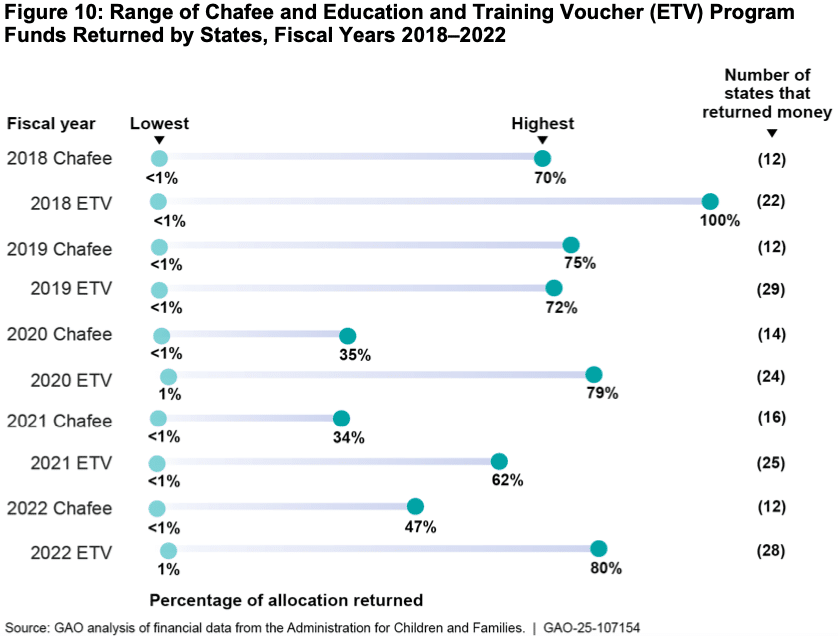
about $42 million in Chafee funds. In each of those years, more than 20 states returned a portion of their ETV funds to help foster youth pay for college.
Of the $400 million in Chafee pandemic funds, GAO found that $50 million went unused. GAO noted that ACF reported that several states struggled to distribute the pandemic money in time because of delays in gaining authority from state legislatures or getting through procurement processes.
GAO did not include a state-by-state breakout of returned money, though Youth Services Insider has queried them to see if it exists. But report authors interviewed officials in six states about Chafee and surfaced the following perspectives on why funds might go unspent:
“Selected states described a variety of challenges with spending their full Chafee federal allotment. For example, officials from one state said in previous years, they did not always know they had funds remaining until they started having regular meetings between their state financial and program teams. Officials from another state told us they had delays getting invoices from contractors and they sometimes did not realize they had a balance until it was too late to spend it. Officials in one county told us they find it challenging to spend their full funding because of inadequate staffing and lengthy unfilled vacancies for staff serving older youth. Similarly, ACF officials told us that reasons for state underspending included staff turnover, delays in state and county procurement processes, and issues with contracts such as serving fewer participants than budgeted for.”
The report makes only one recommendation based on its findings, suggesting that ACF make its regional staff be more proactive in identifying specific barriers in states that are returning funds.
The National Foster Youth Institute said the process for states to distribute funds has to be made easier.
“The fact that unspent funds are being returned or reallocated highlights systemic challenges that states and agencies must address to ensure timely and effective distribution of Chafee resources,” said Rebecca Louve Yao, the organization’s CEO, in an email to Youth Services Insider. “The response to that should not be to remove funds and make a challenging time even harder for young adults; it should be to make the process for distributing the funds more effective through increased communication with the states and more clarity around the purpose of the money.”
A silver lining here: when Chafee funds go unspent, they remain available for two years for other states to claim through redistribution. And that puts most of the Chafee funds to work: for fiscal 2022 for example, $8.2 million of the $8.9 million unspent funds were redistributed to other states. For fiscal 2023, California nearly doubled its Chafee allotment by applying for redistribution funds.
But in a federal funding climate that became quite uncertain this week, there is no doubt concern that the failure of states to spend their Chafee allotment makes the case for increasing the program difficult, even though there is no evidence that the problem is a lack of foster youth who need the help.