


Note: This article was updated to include the comments of federal officials about the release of the Child Maltreatment 2022 report.
The level of abuse and neglect reporting in the United States has returned to pre-pandemic levels, according to newly released federal data in the Child Maltreatment 2022 report. That reporting yielded a record-low number of identified victims of child maltreatment, though fatalities attributed to abuse and neglect increased for a fifth straight year.
“The child maltreatment report shows we are making strides in preventing child abuse and neglect,” said Jeff Hild, acting assistant secretary for the Administration for Children and Families (ACF). “However, the numbers of child maltreatment deaths are higher than they were five years ago, and we need to further understand the underlying circumstances of these fatalities so we can continue to enhance and expand our prevention efforts to keep children safe and well.”
Almost exactly half of the 4.3 million reports in 2022 were “screened in,” meaning some form of investigation or alternative response occurred in the case. Those 2.1 million screened-in cases involved just over 3 million children, and 558,899 of them were deemed to be victims of either abuse or neglect. This makes 2022 the fourth consecutive year where a record-low number of maltreatment victims were identified.
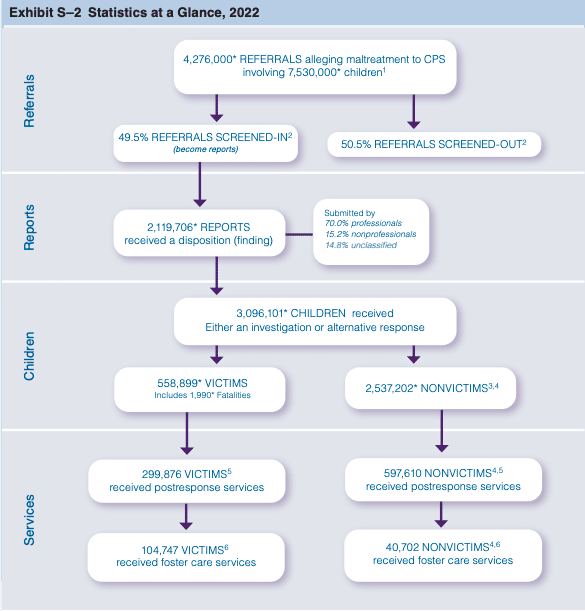
The number of child fatalities tied to abuse and neglect in 2022 was 1,990, a 3% increase from the previous year and an 18% increase since 2017. The number of fatalities, and the rate per 100,000 children, has increased every year since 2017.
More than half of those fatalities were of children under the age of 2. The fatality rate for Black children has reached 6.37 per 100,000 children, up 36% from 10 years ago.
ACF has yet to release any statement on Child Maltreatment 2022. But for a second consecutive year, Children’s Bureau Associate Commissioner Aysha Schomburg used the preface letter of the report to espouse the view that its findings are a starting point rather than a final say on what is happening with child safety, particularly in terms of racial and ethnic disproportionality. From the letter:
…The report is only the beginning of the inquiry: use it to ask yourself and your colleagues more questions and to challenge existing assumptions. For example, think about ways to support families who have economic needs in order to prevent child maltreatment or child welfare involvement. What additional questions does the disproportionality data raise for you? My hope and expectation is that this report will encourage jurisdictions to ask as many questions as it answers so that we can continue to work together to improve the lives and outcomes for children, young people, and families.
The feds have yet to release their 2022 “AFCARS” numbers on foster care trends, entries and exits, which typically is published in the fall of the following year. But according to this Child Maltreatment report, the use of foster care as an intervention continued to decline: it documents 145,449 children that received foster care services as a result of an investigation, down from 156,576 in 2021.
The Imprint’s annual collection of state data on foster care also suggests that the number of youth in foster care dropped in both 2022 and 2023.
In addition to the standard sections included in Child Maltreatment, there is usually a “Special Focus” chapter. This year, that section includes a deep dive on maltreatment types experienced by victims, and the driving impetus for this seems to be identifying the rate at which this data collection shows co-occurring abuse and neglect within the confines of 2022.
The analysis found that for the vast majority of victims, 89%, experienced only one type of maltreatment, and as is well known, most of those victims experienced neglect. Of the victims who experienced multiple types of substantiated maltreatment in 2022, the most frequent combination by far was neglect and physical abuse, which occurred for 4.2% of victims.
In Youth Services Insider’s opinion, the most intriguing finding from this section might be the tracing of report sources — meaning what person notified CPS — to substantiated victims of maltreatment. The Child Maltreatment report includes a breakdown each year of who called in, but that annual tabulation includes all reports that are screened in; so it discards things that hotlines quickly reject, but includes plenty of reports that end up being unsubstantiated.
This chapter isolates the extent to which each type of reporter connects to substantiated instances of abuse and neglect. So at least for 2022, you get a good look at the delta between overall reports from different constituencies and substantiated ones. Here is the comparison for the five biggest sources of reports:
Law Enforcement and Legal Workers
Share of screened-in reports: 21%
Share of substantiated victims: 38%
Education Personnel
Share of screened-in reports: 21%
Share of substantiated victims: 11%
Non-professionals (families, neighbors, victims, etc)
Share of screened-in reports: 15%
Share of substantiated victims: 11%
Medical Staff
Share of screened-in reports: 11%
Share of substantiated victims: 13%
Social Services
Share of screened-in reports: 10%
Share of substantiated victims: 12%
What stands out the most, of course, is that education and legal/law enforcement staff account for about the same amount of reports that get screened in. But when it comes to substantiated victims of maltreatment, law enforcement reports account for a share well in excess of their reporting behavior and school staff account for far less.
Also included in this section are helpful visuals that plot each of the major maltreatment types by age and sex. They all show a strikingly similar pattern, with the exception of sexual abuse: boys account for a slightly larger share of victims until the age of about 11, at which point the trend reverses; by age 17, there is a fairly large gap between them.
For sexual abuse, girls account for 55% of the very youngest substantiated victims and by age 17, account for 87%.