


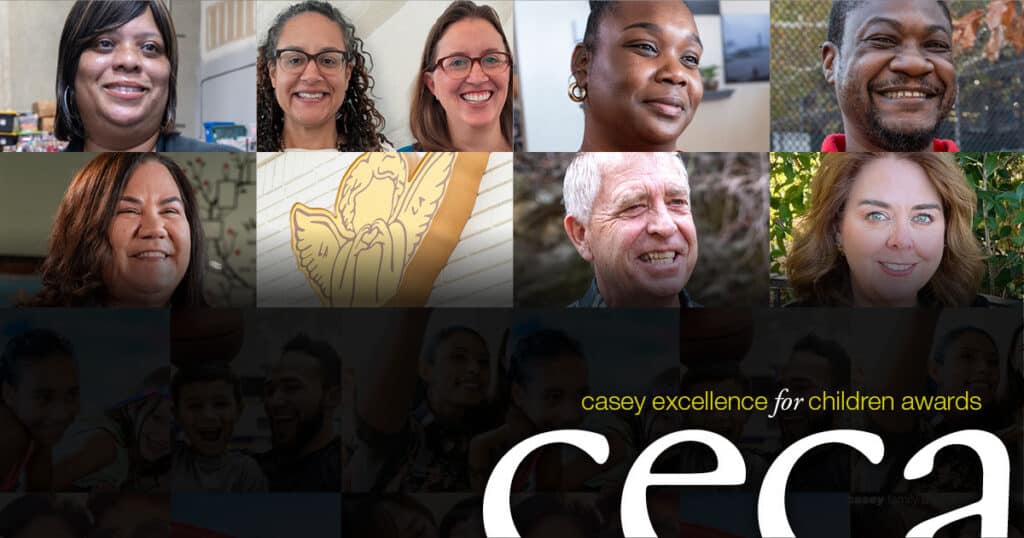
Casey Family Programs has announced its annual Excellence for Children award winners, which this year includes an architect of the lived experience movement and a unique job training program for current and former foster youth.
Each year, the Seattle-based organization bestows the honor onto leaders from every corner of child welfare — from caregivers and youth with lived experience to professionals dedicated to improving the system. Each winner’s story is captured in short videos presented on the organization’s website.
“This year’s award recipients embody what it means to build Communities of Hope,” said Dr. William C. Bell, President and CEO of Casey Family Programs, in a statement. “Their work reflects a deep belief that when families are supported and communities come together, children can thrive and live into who they’re meant to be.”
April Curtis, deputy director of the Illinois Department of Juvenile Justice, received the annual Alumni Award for her long history of contributions to building a space for the voices and perspectives of youth with lived experience in America. Curtis co-founded Foster Care Alumni of America with Misty Stenslie in 2004, with financial support from Casey, and continues to serve as its board chair.
The idea for the organization grew out of a Casey project that involved interviews with more than 1,800 former foster youth, many of whom expressed a desire to help advocate for reform.
When Curtis’ sister was adopted at the age of 13, she recalled in her profile video, “I spent years fighting the system because a piece of paper told me that we were no longer siblings. So when we talk about why I do what I do, I do it because I don’t want nobody to go through it” in that way.
Casey also awarded a Leadership Award to La La Land Foundation, which operates a slate of coffee shops in three states that provide work opportunities to youth who have experienced foster care. The La La Land Cafe model was created in 2017 by Francois Reihani, a Dallas restaurateur. Reihani founded La La Land after learning about the monumental challenges youth face when they age out of foster care without a support network. He talked with young people who told him that what they most needed was help starting a stable career.
For a deeper dive on the rise of La La Land, click here to read Imprint reporter Sara Tiano’s feature story on the organization.
Other Excellence Award recipients this year include:
Birth Parent Awards
Timothy Evans, a peer specialist and a credentialed alcoholism and substance abuse counselor, is the founder and CEO of Rebuilding the Black Nuclear Family (B.R.I.D.G.E.), a Brooklyn-based program that provides trauma-informed mentorship and healing spaces for youth and families, especially those aged 13-24.
Christine Simmons Saucier, a peer support specialist in the same Mississippi court where she went through her own child welfare case. She has used her lived experience to advise several national organizations including RTI International, Child Welfare League of America and the Children’s Trust Fund Alliance.
Kinship Caregiver Award
Alisa Thornton-Banks is the executive director of Manassas, Virginia-based Tavares Taylor Charities, dedicated to uplifting children, families, veterans and underserved communities. Thornton-Banks, who served as a primary caregiver for her granddaughter, is a former peer recovery specialist and family support partner with National Alliance on Mental Illness.
Resource Caregiver Award
Paul Tonnessen has been a foster parent in Hawaii since 1994, and since 2012 has led Friends of the Children’s Justice Center of Maui. Tonnessen also founded the Journey to New Beginnings, a program for high-risk youth in Molokaʻi.
Leadership Awards
Kim Johnson serves as secretary of the California Health and Human Services Agency, and Angie Schwartz is the deputy director of the Children and Family Services Division at the California Department of Social Services.
Stephanie Muth is the former commissioner of the Texas Department of Family and Protective Services.
Casey Family Programs is a financial supporter of The Imprint. The foundation played no role in our decision to publish this article, per our editorial independence policy.